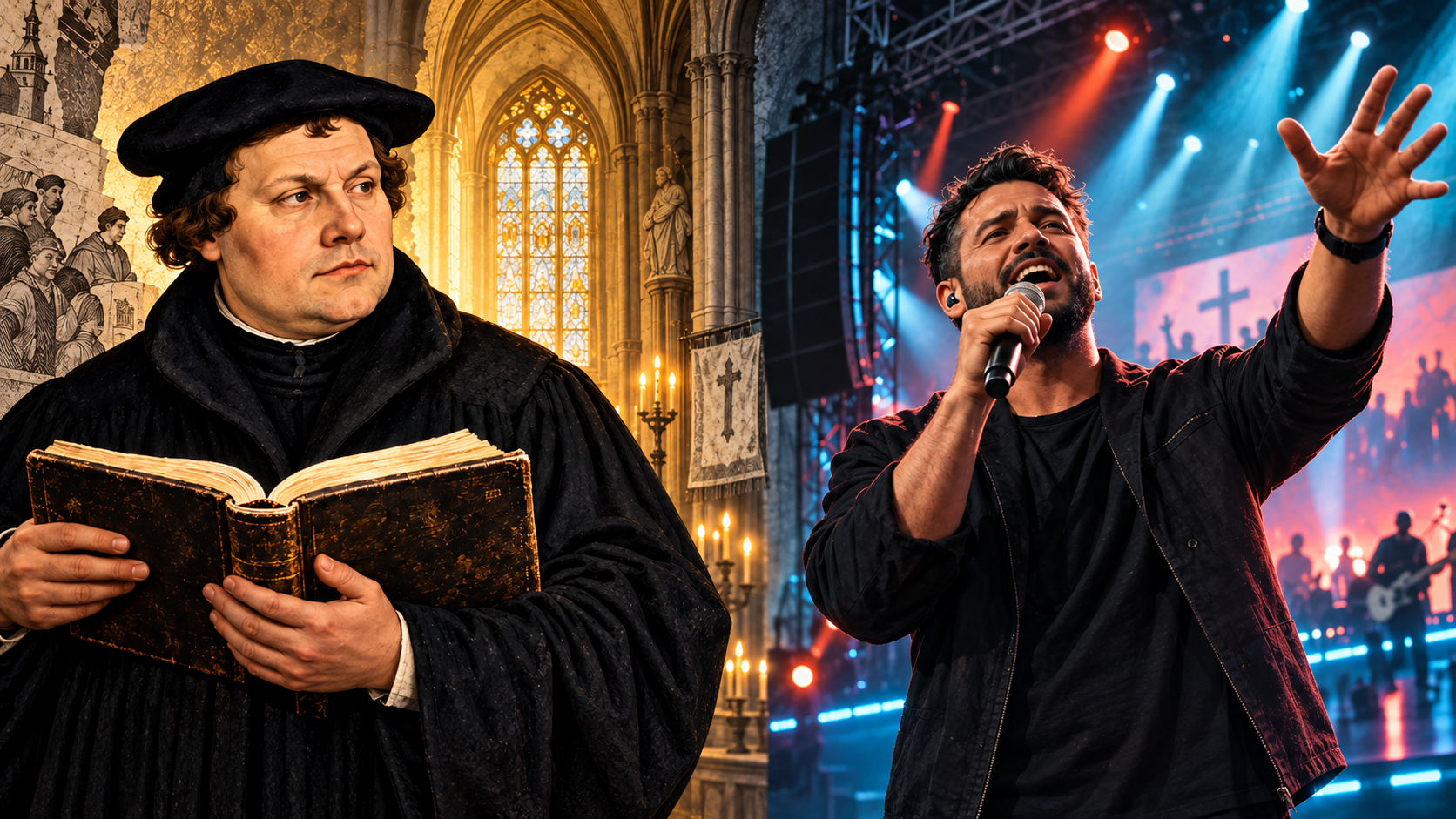
The question before the church
Have we begun rebuilding the things the Reformers sought to tear down when they sought a return to Scripture? This is a question that we should not rush past or consider carelessly. The contemporary church has not returned to the sacrifice of the Mass, restored the papacy, or formally abandoned justification by faith alone.
Many churches continue to confess the authority and sufficiency of Scripture, the good news of the gospel, and the centrality of Christ in our preaching and ecclesiology. There are congregations today which experience Scripture preached faithfully, Christ exalted, and the means of grace treasured.
However, the searching question is whether a church which confesses sola Scriptura may communicate its locus of authority elsewhere through its practices. One may give lip service to the priesthood of all believers while structuring worship in a manner that the congregation functions as spectators. Medieval clericalism is rejected while the church places an extraordinary dependency upon the pastor or worship leader as a Christian influencer or celebrity. Salvation by grace alone is preached, while the church’s health is measured by attendance, building size, popularity, influence, and production quality.
Reformational thought has always seen church history as more than merely a theological argument about justification. The Reformation was essential so the church may be brought back under the authority of God’s Word. Doctrine and worship are inseparable, because what the church believes about God inevitably shapes how she approaches congregational worship, the sacraments, and how we live our ordinary lives as Christians. Martin Luther and John Calvin looked at the church of their day and saw more than doctrinal errors. They saw a church that had created its own dependence on an elaborate religious system and its professional representatives. The Reformers’ answer was not to make Christianity more impressive, but to make the church more faithful to Scripture.
“I will cause the boy that driveth the plough to know more of the Scriptures than thou dost.”
William Tyndale
When the congregation becomes an audience
This is where the contemporary church needs to undertake serious self-examination. A clear example of this is the modern worship service. There is nothing inherently unbiblical about guitars, keyboards, drums, microphones, or a worship band. Scripture is clear in its commands that we are to sing and use musical instruments within worship. We are not bound by a biblical requirement that Christian worship must take place in an eighteenth-century church accompanied by a pipe organ. I am not questioning whether contemporary instruments are permissible, but what happens to the congregation in a contemporary worship service. Musicians stand on raised stages, professional vocalists lead from the front, and the congregation is left standing in a darkened room, while spotlights and lighting point at individuals with microphones and electric guitars. The sound system dominates the room, and the congregation is relegated to merely following along with lyrics on a screen. Under such circumstances, it is possible for a service to function more like a concert than corporate worship of the church.
The diminished role of the congregation becomes apparent when the average attendee finds themselves struggling to sing the songs being presented. I have found that many contemporary worship songs are written in musical ranges that are primarily suited to a professional singer rather than an ordinary congregant. The sheet music illustrates complicated arrangements, repeated musical changes, extended instrumental sections, or a particular vocal style that cannot be easily reproduced in a smaller church by a pianist and their congregants. If the worship band ends up offering a performance while the congregation listens, then there is effectively no participation of the whole body in the central act of singing.
The apostle Paul admonishes Christians to sing with one another as we speak in psalms, hymns, and spiritual songs (Ephesians 5:19). The congregation should never be an audience gathered to watch other people sing on their behalf.
This is a clear distinction which transcends a matter of musical preference. This is a reminder of the Reformation’s desire to recover ordinary Christians as active participants in worship. The reformers sought scripture to be preached and exegeted to the congregation and for Christians to sing. They wanted the sacraments administered according to Christ’s institution. Worship was brought out of the realm of religious spectacle and into the ordinary lives of the gathered church.
The Westminster Confession describes this as the ordinary worship of God and is seen in the necessity and primacy of Scripture reading, preaching and hearing of the Word, prayer, singing and the sacraments. These were never meant to be decorative elements surrounding worship; they were the ordinary worship of God’s elect.
“The reading of the Scriptures with godly fear, the sound preaching and conscionable hearing of the Word, in obedience unto God, with understanding, faith and reverence; singing of psalms with grace in the heart; as also, the due administration and worthy receiving of the sacraments instituted by Christ, are all parts of the ordinary religious worship of God.”
Westminster Confession of Faith, XXI.5.
The Puritans developed this conviction. Scripture was not merely raw material from which one could elicit an interesting talk on religion. They saw it as the living Word of God, which had to be opened, explained, applied, and pressed on our conscience. The Puritanical Reformed pastor Richard Baxter explains the call upon the preacher as not principally that of a public personality, an organizational executive, or religious celebrity. He is a shepherd of souls, responsible for teaching, warning, catechizing, visiting, encouraging, and correcting the congregants under his care. The Puritanical pulpit is one that is possessed by a seriousness that is foreign to much of the modern world.
Preaching and the care of souls
Let’s compare these Puritanical practices to contemporary church practices as illustrated in the Hartford Institute for Religion Research and Warren Bird conducted a new national megachurch survey in 2025: Megachurch pastors see themselves primarily as preachers, teachers, and administrators. These preachers don’t see themselves as called to personally visit members, the sick, or shut-ins. 80% of preachers saw themselves as preachers or teachers alone, with less than one percent being able to identify members of their church or visitation as an area in which they excel to any degree.
This raises a critical question for contemporary churches. Has preaching remained the centre of their ministry as God’s Word is central, or is preaching the only component which preachers believe they excel at? A sermon can easily become a thirty-minute TED Talk wedged between music and a closing song. The contemporary preacher can effectively become a motivational speaker who happens to quote Scripture out of context. Such sermons are usually judged primarily by their ability to entertain, create a memorable illustration, or offer some form of emotional satisfaction. This is at odds with Scripture, which calls the preacher not to keep people interested, but to preach the word (2 Tim 4:2). The preacher’s responsibility is not to manufacture emotional experiences, but to faithfully explain and apply what God has already said.
Many churches have a preoccupation with performance. We have developed extraordinary skills at manufacturing atmosphere. This is seen in the careful use of lighting, music, screens, video, sound, and carefully thought-out emotional crescendos. The contemporary church knows how to make a Sunday service feel significant. The preacher is presented as authoritative, and the worship team as musically professional. Yet, as Reformed Christians, we need to ask the searching question of where God commanded such structures and practices. This links to the regulative principle of worship. This conviction governs our worship. God’s revealed will is to govern our ecclesiology rather than human imagination, church preferences, or creativity.
“All worshipping, honouring, or service invented by the brain of man, in the religion of God, without His own express commandment, is idolatry.”
John Knox, The Mass is Idolatry (1550)
Who governs our worship?
This principle is profoundly counter-cultural in contrast to contemporary worship, which assumes that if something produces a strong emotional response, it must be useful. This misguided association of emotionalism with usefulness in the church has developed under the influence of seeker-sensitive church marketing, particularly through the work of figures such as Bill Hybels and Rick Warren. They taught the language of marketing: we are to pursue that which attracts people, retains them, creates excitement, produces engagement, and brings them back the following Sunday.
Christianity is not a product to be consumed, nor is worship of God a commodity that needs continual redesign according to consumer expectations. The Seeker Sensitive system falsely claims that Christianity and the church are to bow before analysed data which shows off discoveries of what sinners find most entertaining, and then to construct “church” around those findings. The church exists to glorify God and proclaim Christ as it makes disciples.
The phenomenon of the megachurch is not a new creation, nor is there anything inherently wrong with a large congregation. The New Testament records how thousands came to faith in Christ, and nowhere does Scripture establish a maximum size of a local church. Likewise, a small congregation does not automatically possess greater spiritual health than a megachurch. Size is not of concern; the issue is when increasing in size is seen as a measure of success wherein sustaining enormous numbers begins to redefine what Christians understand church to be.
Acts 2 provides a striking image of the early Christian community. They devoted themselves to the apostles’ teachings, fellowship, the breaking of bread, and prayers. Life was shared with one’s fellow believer. Worship was communal; care was shown for all. The church never existed as a crowd gathered around a religious platform, but as a people who belonged to one another as they belonged to Christ. The early Christians took to heart the commandments to bear with and encourage, admonish, serve, and love one another as authentic and meaningful.
“For him who in preaching seeks his own honor, it is impossible to remain in the right path and preach the pure Gospel.” Martin Luther
The church and the celebrity
TBN, Daystar Television, and The Victory Channels have given prominence and rise to Christian celebrity ministers such as Joel Osteen, Joyce Meyer, Creflo Dollar, Joseph Prince, and Kennith Hagin. A similar situation existed within the medieval period. Extraordinary importance was given to prominent religious figures. Many would travel long distances to hear famous clergy and placed spiritual significance and trust in particular personalities. The contemporary Christian is guilty of a remarkably similar practice. Podcasts, social media, conferences, books, and online sermons of celebrity ministers are devoured by millions. Devotion is given to particular preachers whose names and faces are known around the world. Millions listen to each new sermon released each week while knowing almost nothing about those who are shepherding their souls and forming their spiritual lives. And, in doing so, we may be guilty of being more familiar with the content and style of a personality of a distant celebrity than with the spiritual condition of the Christian sitting next to us in church.
One cannot overstate the comparison of medievalism in the contemporary church, even though our celebrity culture is not identical to medieval clericalism. Yet, the functional resemblance should make us extremely uncomfortable. As Reformed Christians, we need to recognise that the Reformation never sought to replace a Catholic priest with a protestant celebrity. It sought to place God’s Word at the centre of our being and within ecclesiology. The minister’s authority is derivative. He is only possessed of authority when he faithfully ministers the Word entrusted to him. This was Calvin’s model of the ministry and is profoundly different from that of the modern celebrity preacher. The minister is a servant of Christ and a shepherd of God’s people.
“And just as all believers have a gift, so also they all stand in the office. They have not only in the church as organism but also in the church as institute a calling and task, which is imposed upon them on the Lord’s behalf.”
Herman Bavinck, Reformed Dogmatics, 4:375
Contemporary Christianity seems to be asking the wrong questions. They ask what attracts people, while the reformers asked what Scripture teaches. The contemporary church asks what will create an emotional atmosphere, while the Puritans asked what will bring sinners to repentance and believers to holiness. This line of questioning continues as it asks what will create quick church growth rather than how we are conformed to the image of Christ. Many people leave church on a Sunday morning questioning themselves if the service was enjoyable, rather than the fundamental question of whether God was worshipped in spirit and truth as determined by His Word.
I am not making a case for Christians to despise beauty, excellence, technology, good music, or institutional smallness. The church is to use every biblical means to communicate the gospel clearly as it seeks to remove obstacles from achieving this end. What is of great concern is when the means displace the message. Human excellence seeks to perform, worship becomes entertainment, preaching is downgraded to motivational speaking, and church growth becomes an end in itself.
Recovering the ordinary means of grace
We are to actively seek to return to the Puritan understanding that Contemporary Christianity needs to recover: God delights in using the ordinary means for his grace: The reading of scripture, clear preaching of scripture, prayer, congregational singing, the sacraments, pastoral visitation, catechising our children, caring for the poor, visiting the sick, correcting and disciplining the wandering, and bearing with one another’s burdens. None of these are spectacular or entertaining; they are the ordinary means of our life as Christians.
“The worship to which we are called in our renewed state is far too important to be left to personal preferences, to whims, or to marketing strategies. It is the pleasing of God that is at the heart of worship. Therefore, our worship must be informed at every point by the Word of God as we seek God’s own instructions for worship that is pleasing to Him.”
R.C. Sproul, A Taste of Heaven
No viral moment or internet sensation is required as a minister patiently exegetes Romans 8. No marketing plan is required in teaching our children the tenets of faith. No filming crew is required for visiting the elderly, widows, and wandering Christians. There is absolutely no need for a smoke machine or spotlight for Christians who faithfully lead the prayers of the people within the service, year after year. Perhaps this is why the role of the Reformation is still relevant today.
We need to be reminded daily that the church does not belong to a pastor, the worship team, denomination, the congregation, or the whims of a constantly changing culture. The church is Christ’s alone. Its authority is given by His Word. Its message is the gospel. Its only hope is the grace of God. Its power is His Spirit, and its purpose is to make disciples who worship God as they seek to be conformed into the image of the Saviour.
“Christ is the head of the holy common church; she herself is his body, and each elect is his member and consequently part of the Church, which is Christ’s mystical—that is, mysterious—body.”
Jan Hus, De Ecclesia (On the Church)
Popular arguments regarding instruments used in worship, the size of the congregation, and the role of technology miss the real point. The deeper question is what has become central in the contemporary church.
We are to reflect on whether the congregation can barely sing because the musicians are performing rather than leading. If people attend a church for years without belonging in a meaningful way to other Christians, something deserves examination. If we have elevated the numbers of attendance, the size of buildings, revenue received, and online influence as the signs of success, we are to repent.
A congregation again
This leads to a sense of irony wherein those who identify as Reformed lose confidence in the very things the Reformers sought to recover. We are to restore the Word as central and to faithfully proclaim Christ. We may achieve this today through opening Scripture and ensuring worship is under the authority of God’s final revelation. And through this we are to ensure that effective reformation penetrates into homes, consciences, marriages, work, prayer, personal holiness, and the everyday lives of God’s people.
We do not need more innovations; we are to return to the authoritative paths set before us. This means a return to the ordinary means of grace and the rediscovery of the profound simplicity of Christian worship. The congregation needs to be a congregation again rather than an audience that is to be entertained. The pastor needs to be the shepherd rather than a viral celebrity. The Word of God is to be faithfully opened in the pulpit rather than using this as a platform for motivational performance. The musicians and singers are to be people who help the congregation sing rather than singers who entertain. And ultimately, the church building is to be an area to facilitate the gathering of God’s people rather than become a monument to man’s success.
Ultimately, we need to recover true confidence in God. We have all that is required. We have his Word, his Gospel, and his sacraments. The effectiveness of their application depends upon the God who has ordained them.
The Reformers knew that the church cannot save itself through human methods. They knew God saves sinners through Christ, and Christ builds his church through Word and Spirit. This negates our human need to be seen as spectacular to be powerful. The church also doesn't need to be enormous to wield power or be seen as significant. We only need to be faithful.
“That we observe and do all whatsoever the Lord Christ hath commanded us to observe, in the way that he hath prescribed; and that we add nothing unto or in the observation of them that is of man’s invention or appointment.”
John Owen, A Brief Instruction in the Worship of God
The Reformation shook the world for the glory of Christ and a return to his Word. And we are to be children of the Reformation as we seek to uphold the principles of Scripture as our model of ecclesiological praxis. Praying for God’s clear guidance and illumination should be our duty as we reflect on our contemporaneity. Perhaps we too are guilty of quietly rebuilding some of the things the Reformation sought to leave behind? If this question makes us feel uncomfortable, we are not to dismiss it; it makes an area in our collective lives wherein we have trusted the ways of man above God.
The answer is never another spectacle, but a repentant return to Christ, to Scripture and the ordinary means of grace. Open the Bible, read it carefully, preach it faithfully, pray earnestly, sing together, administer the sacraments, teach our children, shepherd the flock, care for the weak, restore the wandering, bear one another, and gather as God's people. And then trust the Holy Spirit to do what no think tank, board of leaders, or production team can ever achieve. Through this we may rediscover how to worship God in spirit and truth rather than impressing the world.