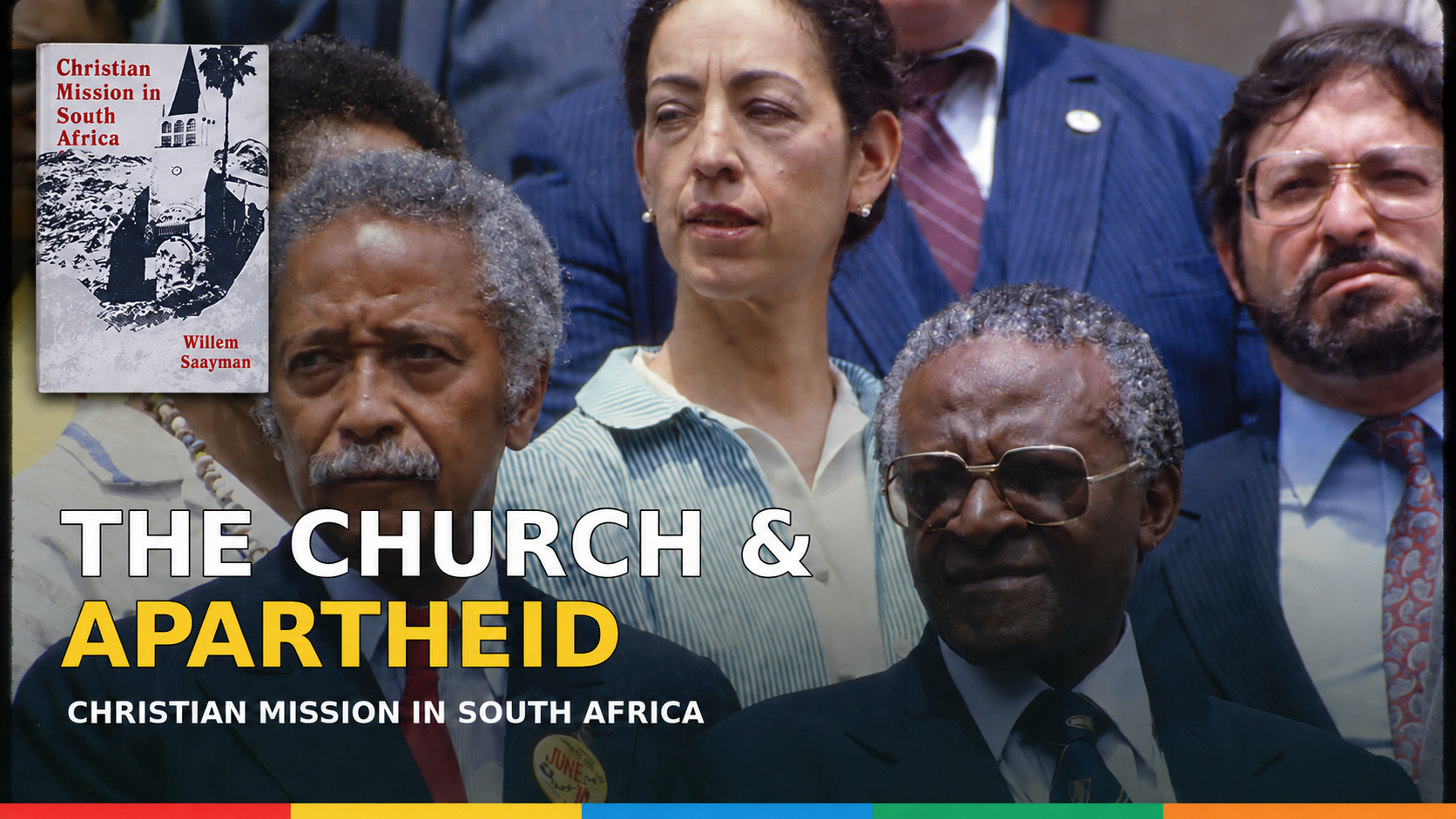
Christian mission in South Africa
Introduction
It is amazing what a hymn can do to someone. A few months ago, I was introduced to a hymn titled Lifikile iVangeli esizweni sakwaZulu which crystalized what I had always felt in conversations about the history of Christianity in Africa. What was that? This: that the Gospel offers great promises for a people that believe in the Lord Jesus Christ, but the delivery of that Gospel is not always as glorious. The gospel arrives as the power of God unto salvation, transferring rebels from the kingdom of darkness into the kingdom of God’s beloved Son, a reality the hymn captures beautifully in tune. With the arrival of the missionaries, we, the sons of Ham, had a clearer understanding of the character of God, and His incarnational mercy in Christ Jesus who is offered as a substitute on our behalf. Such are the glories the hymn reminds me of.
Yet, its arrival was not as glorious. Why? Well, because the carriers of this gospel carry it in vessels of clay. At times, the advocates of this gospel were complicit in the national destruction of a people through the undermining of their kings, chiefs and leaders, the stealing of their lands, and the eradication of their culture and languages. And these two truths must be held in tension. This glorious hymn, sung in concert with Saayman’s “Christian Missions In South Africa”, confronted me with a reality I have since overlooked: Church history is not as clean as we’d like to think. My previous writings highlight the good that came from the Mission enterprise, highlighting characters both black and white, who dedicated their lives to protecting local populations, translating African languages and openly challenging colonial governments, this article is different. It is different because I intend on walking the darker paths of Church history in South Africa.
This article outlines my reflections and interactions with Saayman’s book, and not a review. Stating the purpose of this paper as an interaction means that this paper will not be a regurgitation of Saayman’s points. Instead, it will be a theological conversation with him. This will be done by 1) giving an overview of the book 2) its strengths, 3) a critical evaluation and 4) its implication for African Christianity.
Christian mission in South Africa
Book overview
Christian Mission in South Africa is Saayman’s most significant contribution to the study of Missions in South Africa. The book was published in 1991, after the release of Nelson Mandela, the unbanning of Anti-Apartheid political parties and civil societies. This context is essential as it gives the reader a picture of the type of conversations Christians were having at the turn of Apartheid. Writing from the lived experience of Apartheid, Saayman sought to redefine Christian mission in a “Christian Nation” deeply divided by race, politics and economic inequality from mere evangelism and church planting to incorporate political engagement with political realities, social justice and ecumenical cooperation. Again, it is important not to divorce this book from its historical context. The book was written at a critical historical moment when churches in South Africa were being forced to confront their complicity in apartheid as well as their potential role in liberation and reconciliation. Boesak (1981, 1-7), in his seminal work Farewell To Innocence, had removed the mask of so-called neutrality and revealed its sin of complacency. In an attempt to further unmask this neutrality, Saayman insists that Christian witness inevitably has political consequences.
Christian mission in South Africa
Saayman’s strengths
The central argument of the book is that authentic Christian Mission in South Africa must be politically responsible, ecumenical, contextual and liberative. It must be politically responsible and address systems of oppression and injustice, refusing to comply with the “status quo”. Christian Mission must also be ecumenical, representing the catholic church, transcending even denominational boundaries. Additionally, Christian Mission must be contextual. By this, Saayman means that missions must be rooted in South African realities and not importations from European models. And lastly, liberative as it seeks to participate in God’s work of liberation and reconciliation, and he calls this a “process of humanisation”. By defining Christian mission thus, Saayman challenges the traditional missionary paradigm that views missions primarily as the conversion of individuals and advocates, instead, for a broader understanding of mission that includes social transformation and the pursuit of justice.
Christian mission in South Africa
Critical interaction
Early in his work, Saayman criticizes Evangelicals for maintaining a “neutral” political stance which, more often than not, supports the status quo. And as a way of unmasking this façade, he asserts that from the early church the Church understood mission as confronting the civic ills of the state. This was the typical Christian view of Christian engagement with the state.
Looking at the example of the apostle Peter in Acts 2:22-24 and 3:13-14, Saayman demonstrates the boldness with which the early church entered the political sphere to be a prophetic – even revolutionary – witness against the evils of the political system. Additionally, Saayman appeals to Acts 17:6-9 where Christians are characterized as people “who cause trouble all over the world, people who turn the world upside down, people who defy Caesar's decrees” (1). And he demonstrates that this political outlook was not exclusively held by church leadership, but included the general polity. You can see this in the way Peter and John were “unanimously supported by the whole congregation” (Acts 4:23-31). Things changed, however, Saayman maintains, with the church coming close to state authority with Constantine.
I sympathize with Saayman’s frustration with the Evangelicals. Some Evangelicals are often content with the political status quo and have thus completely delegated their prophetic responsibility to social activists. Furthermore, I sympathize because the prophets and apostles' engagement with the civil leaders gives us a model of political engagement: charitable confrontation, yet we do not see this in current political discussions. The prophets of old confronted entire empires, and the apostles called for the repentance of both the Jewish religious elite and the Roman system. Although I sympathise with Saayman, understanding Christian witness primarily as political seems to be an oversimplification of prophetic witness and obscures the centre of Christian witness which is calling sinners to repent and believe the gospel. While the proclamation of the Gospel undeniably carries profound political and social implication, the book of Acts does not present the apostolic mandate primarily as an effort to confront structural or political injustice. Instead, the Holy Spirit explicitly directed the apostles to proclaim Christ, call individuals to repentance, establish local churches and teach sound doctrine. This fact can be demonstrated by a careful reading of the passages Saayman refers to.
In this chapter, the apostle confronts the authorities in unambiguous terms. “You delivered Jesus to Pilate and denied him when Pilate was willing to release him”. He goes on to say, “You denied the Holy and Righteous One”. These confrontations find their culmination in this accusation, “You killed the Author of life”. Now there is no dispute that these are political statements. The Jews unjustly and illegally killed Jesus. Saayman is right to characterize this as “The unjust killing of Jesus”. While that is true, the most controlling theme of not just the book of Acts but the Bible together is the fulfilment of God’s promises. Peter’s statements, though they might have a political tone, are moreover Christological and redemptive. What the Jews meant for evil, God intended for the salvation of many souls; and the invitation goes even to those who killed the Messiah, hence Peter calls them to “Repent and believe”. Although these statements are political, they are primarily theological because Peter mentions how this injustice was prophesied and has thus been fulfilled. Now, if this political injustice is primarily a theological conflict, then that means the remedy must be primarily spiritual. That is why Peter calls his audience, not to political reform but to an ethical-religious phenomenon: faith (vs 16), repentance (vs 19) that led to times of renewal. Perhaps, then, the most precise way to characterise Peter’s proclamation is to say that his gospel proclamation has political implications although the proclamation itself is not political. Peter saw the real problem, namely sin in the political sphere, and called his listeners to an ethical-religious phenomenon: faith and repentance
Despite their shortcomings, this is the model Evangelicals aim for. Sadly, Evangelicalism has historically produced both defenders and opponents of social injustice. Nevertheless, many significant abolitionist and anti-segregation movements arose from evangelical theological commitments such as the imago Dei and the universality of the gospel. Therefore, I think, we ought to be careful in our criticism of Evangelicalism and not be too judgmental, forgetting the great social changes they have done in society, motivated by evangelical theological commitments.
Having established that, I think he is right in highlighting the political dimensions of Christian witness. If politics is, “the practice and art of human affairs in relation to the whole of life”, I agree with him. I agree with him because such a definition is the fulfilment of the second greatest commandment: Love your neighbour as yourself. What this means then is that we must love our neighbour holistically, not just spiritually but also politically.
Nevertheless, I have some reservations regarding what I see as an underestimation of sin in Saayman’s framework. While he emphasizes humanization and liberation throughout the book, to what extent do these concepts sufficiently account for humanity’s fundamental problem of sin and the necessity of Christ’s propitiatory work? I fear that minimizing the primary reason the apostles entered the political sphere, and their frequent call for ethical-religious renewal, weakens the very testimony of the scriptures and the gospel that Christ and His apostles preached.
My second thought concerns a caution for missionaries or even just us as Christians. Reading this book, I was reminded of the importance of self-awareness, particularly as it relates to one’s presuppositions. For me, this awareness went past political outlook and included our cultural narratives. Both our political and cultural outlooks must be critiqued by the Word of God. The reason for this critique is so we don’t neglect our primary mission, which is to preach the Gospel. Failure to self-critique will lead us to use the gospel as means to justify our political outlooks and cultural narratives that are, at times, contrary to the Gospel. And this has historically manifested itself in the conflation of Missions with the Western inculturation of the African man, to the neglect and eradication of his own.
Christian mission in South Africa
Implications for African Christianity
This inculturation is the consequence of the “Constantinian era”. This era, according to Saayman, looked different as far as its political mission was concerned. This was the case because the church had increasingly cordial relations with the state. Consequently, “The kind of confrontational, even revolutionary, stance which the early Christians sometimes took, was no longer acceptable” (2). The growing alliance between church and state called for a completely different political relationship. Saayman goes on to say:
As the church benefited … from the growth of the empire, she felt the need to justify the political status quo and the reasons the church had for supporting it.
Willem A. Saayman
Saayman continues his observation, saying:
This intermingling had an influence on the church’s evangelization because evangelization became basically the incorporation of subjected peoples and the responsibility for their inculturation to the “Christian imperial culture”.
Willem A. Saayman
My reading of Saayman leads me to think that the close entanglement between mission and colonialism was to be expected. The colonialist state dispossessed a people of their land, language, culture and ultimately their humanity. Consequently, it would not be a stretch to say, in an attempt to sanctify its evils, the colonial state expected the missionaries to aid them in “civilizing the natives”, which is euphemism for creating passivity in the colonised and the acceptance of colonialism as a norm. I do not think the missionaries were fully aware of the consequences of this union, nor of its existence, but because it benefited them they were complicit in sustaining a system that legitimised dispossession and oppression, even when their stated intention were religious. In this sense, the mission project became entangled with colonial power, because the conversion of the “natives” could not easily be separated from the broader colonial project of reshaping African societies, not according to the Word of God, but according to European values and interests.
Returning to the so-called “Constantinization of the Church”: although the term may oversimplify the history and development of the Church, the criticism of the Church’s entanglement with the state remains pertinent. Such an unholy marriage inevitably compromises the Church’s witness and risks diverting her God-given resources toward the interests of the state rather than the fulfilment of her God-given mission. This intermingling, however, need not always be explicitly political. It can also take social and cultural forms, including the narratives and assumptions through which a community understands itself. That has certainly been the case – and, to some extent, remains so – in South Africa, and African Christians continue to feel its effects.
It is partly because of this unholy marriage between the abuses of Western colonialism and the Church that many African Christians have become sceptical of the notion of a universal “Christian worldview”. What is often presented as simply “the Christian worldview” or “Christian culture” may, in reality be a distinctly Western Christian worldview or culture presented as though it were universally Christian. the distinction is important: the Christian faith is universal, but its embodiment within particular cultures need not take a single cultural form. To illustrate this, the analogy of a seed is fitting.
The Gospel arrives within a community or culture as a seed, not as a fully grown tree. before the arrival of Christianity in Europe, the continent was marked by profound vice and disorder. It was into this soil that the Gospel was planted and, by God’s grace, took root ad transformed European society (D’Aubigne, 2015, 3-13, Vol. 1). As Bavinck (1) aptly put it, “The Gospel converts the whole man”. The Gospel entered the European man’s mind, heart and conscience, cultivating “a new world of ideas, conditions and dispositions”. From within, the Christian faith extended into every sphere of human life, exerting its influence and leaving its mark upon the elements of culture. The seed, therefore, grew into a tree: a Christian worldview embodied within a particular cultural context. In this sense, what emerged in Europe was not merely Christianity in the abstract, but Christianity expressed through European history, culture, institutions and social imagination. It consequently became a Western Christian worldview.
Consequently, it would be a mistake to uproot this Western Christian tree and transport it wholesale into foreign soil, expecting it to take root in precisely the same form. The soil may reject what is foreign to it, and the Gospel may consequently appear ineffective when, in reality, what has been rejected is the cultural form in which the Gospel was presented. Rather than transplanting the Western tree, we ought to plant the seed of the Gospel. We till the soul, water it with the Word of God and trust that, by God’s grace, the seed will grow into a tree appropriated to its particular soil, possessing its own cultural particularities and idiosyncrasies. This does not mean that every tree will bear different theological fruit. The African Church shares the same Gospel as the Eastern and Western Church. We confess the same Christ and have received the same Trinitarian baptismal formular. We share the apostolic faith expressed in the Creed (Bavinck 21-26). Yet that same Gospel, when received and embodied within a different cultural context, will “cultivate” a new world of ideas, conditions and dispositions”. Those ideas, conditions and dispositions may differ from those cultivated within Western Christianity precisely because the Gospel is taking root in a different historical and cultural soil.
The result, therefore, should not be understood as a competing Christianity or an alternative Gospel, but as an African Christian expression of the one catholic faith. The African Christian worldview can stand as a fellow brother and pilgrim alongside the Western Christian worldview, both journeying toward the celestial city and awaiting the day when our knowledge of God will be made perfect.
I recognise that this analogy, however illustrative it is, has limitations and contains potential theological vulnerabilities if it pressed too far. It is therefore necessary to clarify its scope. But before, let me mention its limits. The first limitation is that the analogy could suggest that the Gospel produces entirely different, localised truths in different cultural soils, inadvertently introducing theological relativism. if each soil produces its own “tree” without sufficient qualification, one could mistakenly conclude that Christianity has no universal doctrinal content.
The second limitation is that the analogy could appear to diminish the catholicity and theological unity of the Church of which Paul speaks in Ephesians 4:4-5: “One body, one Spirit, one Lord, one faith, one baptism”.
Notwithstanding these limitations, I still believe the analogy is useful. Theological uniformity is safeguarded precisely by the image of the seed. the seed is the Gospel, and it is only the Gospel seed that can produce a genuinely Christian tree. The African Church does not possess a different seed from the Eastern and Western Church. We share the same Christological confession, the same Trinitarian faith and the same apostolic Gospel. The existence of trees that look different, therefore, need not imply the existence of different truths. Rather, it may reflect different cultural expressions of the same truth. And once this seed is planted among every people, tribe, tongue and nation, the result need not be a forest of identical trees. Rather, by God’s grace, it may become a beautiful forest in which the one Gospel is beautifully communicated and embodied in the particularities of every culture. The unity of the forest lies not in the uniformity of its trees, but in the fact that every tree has received the same seed.
Christian mission in South Africa
Concluding thoughts
Saayman's Christian Mission in South Africa remains an important and timely contribution to South African missiology. I say this because the book reminds the church that the gospel can never be divorced from the social, political and cultural realities within which it is proclaimed. His insistence that Christian mission must be politically responsible, ecumenical, contextual and liberative serves as a necessary corrective to forms of Christianity that retreat into private spirituality and neglect the command to love one's neighbor in every sphere of life. In a nation still wrestling with the legacy of colonialism and apartheid, his work challenges Christians to examine their own complicity in systems of injustice and to recover their prophetic responsibility within society.
At the same time, Saayman's emphasis on liberation and humanization must be carefully balanced by a robust theology of sin and redemption. The witness of Scripture suggests that while the apostles did not shy away from confronting political authorities, their engagement with the political sphere was ultimately theological in its orientation. They recognized that behind unjust political structures lay humanity's deeper problem: sin. Consequently, their primary call was not primarily to political reform, but to repentance, faith and reconciliation with God through Jesus Christ. A faithful Christian mission, therefore, ought never to reduce itself to social activism, however noble its aims may be, but must remain grounded in the proclamation of Christ crucified and risen as the only remedy for both personal and corporate sin.
Furthermore, this book serves as a necessary warning against the historic entanglement between the church and cultural or political power. The close association between Christian mission, colonialism and Western cultural dominance has understandably produced skepticism among many African Christians toward claims of a universal “Christian worldview.” Yet the solution is not the rejection of Christianity as foreign, but the recovery of the gospel itself.
The gospel does not arrive in a culture as a fully-grown Western tree to be transplanted onto foreign soil; rather, it comes as a seed that takes root within a people, transforming them from within while allowing a distinctly African Christian expression to emerge. Such an expression will possess its own cultural particularities while remaining united with believers across the world in the shared truths of the Christian faith.
Ultimately, the hymn Lifikile ivangeli/Esizweni sakwa Zulu, reminds me of the beauty of the Gospel. But more than that, it being sung by a people who have been historically and systematically oppressed by both the state and the church captures the tension and the paradox that this book has helped bring into sharper focus. The gospel has indeed brought immeasurable blessings to the peoples of South Africa, but those who carried it have not always reflected its beauty. These two realities must continue to be held together. We ought neither romanticize the missionary enterprise nor dismiss the genuine work God has accomplished through it. Rather, Christians today must pursue a mission that is biblically faithful, historically self-aware and culturally sensitive: one that boldly proclaims Christ, confronts injustice wherever it is found, and seeks the transformation of both persons and societies under the lordship of Jesus Christ.