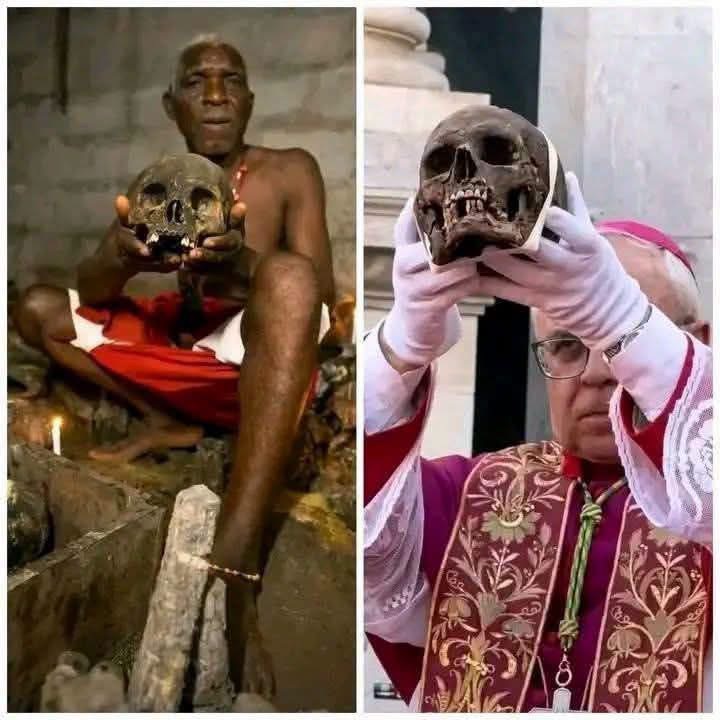
A striking image has been circulating across African social media. A Roman Catholic cardinal, dressed in elaborate vestments, holds up what appears to be a human skull during a religious ceremony. Beside it, Africans have placed photographs of traditional religious practitioners holding human remains. One viral caption captured the controversy perfectly:
“When Africa does it, it’s idolatry. When Rome does it, it’s holy.”
Another went further: “Study finds African rituals become significantly less demonic when performed in Europe.”
The humour is sharp because the question beneath it is serious.
African Christians have long been told that we must abandon the invocation of ancestors. We must not speak to departed relatives, seek their spiritual assistance, approach God through them, or maintain religious relationships with them. Christ is sufficient.
But then Africans encounter another form of Christianity in which people kneel before images, kiss relics, honour human remains and ask departed Christians to intercede for them before God.
The African quite reasonably asks:
If we cannot do it, why can they?
As a Protestant, I think we need to stop dodging the question.
The answer is: they cannot do it either.
Not if Scripture is the standard.
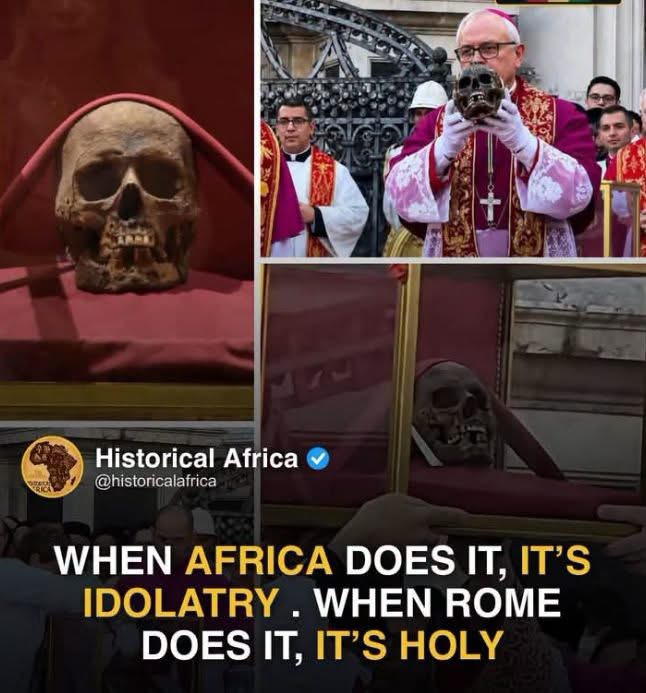
First, What Actually Happened?
The viral photographs require some correction. The skull was not a newly discovered corpse, nor was the Catholic Church attempting to resurrect or summon a dead person.
The controversy concerned Saint Agatha of Sicily, a Christian martyr killed in the third century. On 17 August 2026, Catania commemorated the 900th anniversary of the return of her relics to the city. During the celebrations, Cardinal Pietro Parolin, Vatican Secretary of State and papal legate, ceremonially crowned the skull relic after Archbishop Luigi Renna had placed it within its restored reliquary bust. The Vatican confirmed the ceremony as genuine. (cbcgha.org)
So accuracy matters. This was not some secret pagan ritual accidentally caught on camera.
It was an officially sanctioned Roman Catholic celebration involving the bodily remains of a deceased Christian whom Rome venerates as a saint.
And that clarification does not make the Protestant problem disappear. It makes the question clearer.
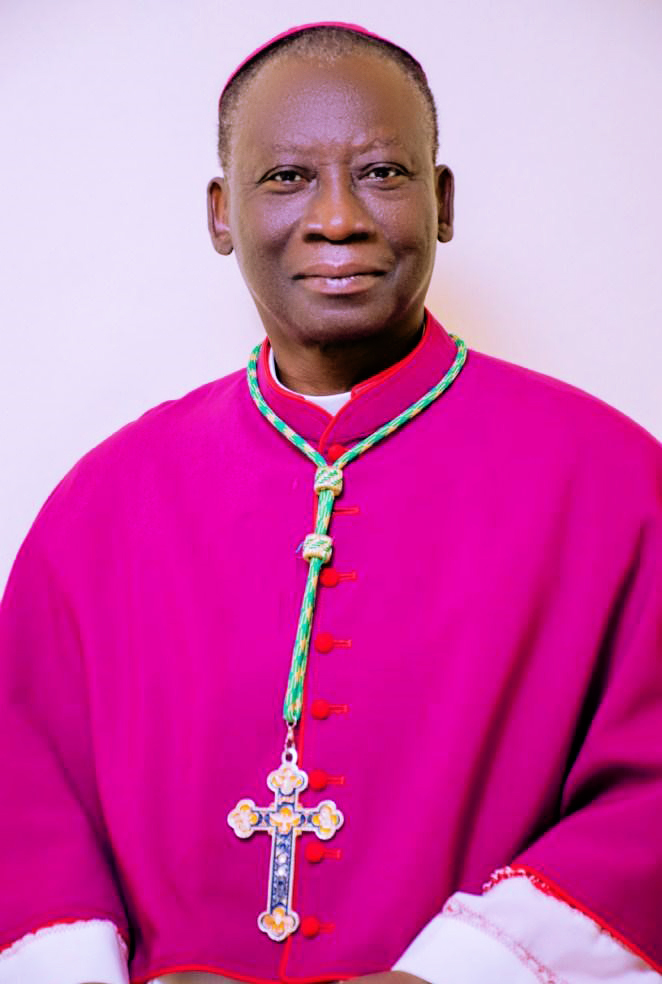
An African Catholic Bishop Responds
What happened next is especially important for this discussion because the controversy did not remain in Europe.
The images disturbed Catholics in Ghana precisely because of the obvious associations they raised in an African religious context. The Ghana Catholic Bishops’ Conference subsequently issued a pastoral letter addressing the viral video. The letter itself acknowledges that many Ghanaian Christians saw the handling and display of a human skull and immediately thought of necromancy and occultism. (cbcgha.org)
The response was signed by Bishop Matthew Kwasi Gyamfi of Sunyani, President of the Ghana Catholic Bishops’ Conference.
His defence is important because he articulates almost every Catholic distinction relevant to our discussion.
Gyamfi argues that Catholics are not worshipping the skull. He explains that a relic provides a tangible connection to the holy person whose remains are being honoured. When Catholics kneel before a relic, kiss it or carry it in procession, he says, the honour is not directed toward the bone as though the bone were itself divine. He compares it to kissing a photograph of a deceased loved one: the affection does not terminate on the paper but on the person represented. (fides.org)
He then directly addresses the accusation of necromancy. According to Gyamfi, Catholics are not attempting to summon Saint Agatha's spirit or extract hidden supernatural knowledge from her. Instead, they ask the saint to intercede with God. He argues that this is essentially the same kind of request as asking another Christian to pray for you. (fides.org)
That distinction deserves to be represented accurately.
But for an African Protestant, it also makes the problem sharper.
Because many practitioners of African traditional religion would immediately respond:
“That is exactly what we have been trying to tell you.”
We don't worship our ancestors.
We honour them.
They aren't gods.
They remain alive in the spiritual realm.
We maintain a relationship with them.
They assist the living.
They mediate or intercede.
Of course, African ancestral religion is not identical to Roman Catholicism. And Bishop Gyamfi is correct that seeking hidden information through a medium is different from asking a saint for intercession.
But the question has now moved deeper.
Has God authorised Christians on earth to religiously address human beings who have departed this life?
That question cannot be answered merely by saying, “It is veneration, not worship.”
And in Africa especially, we cannot allow that distinction to settle the matter for Rome when we would never allow the same distinction, by itself, to settle the matter for African ancestral religion.
Rome Really Does Teach the Invocation of the Departed
Sometimes Protestants criticise Catholicism so carelessly that Catholics can dismiss the criticism by saying, “You don't understand what we believe.”
So let Rome speak for itself.
The Catechism of the Catholic Church teaches that departed saints continue to intercede for Christians on earth. More importantly, it goes beyond saying that saints pray for us. Paragraph 2683 says:
“We can and should ask them to intercede for us and for the whole world.”
That is official Catholic teaching. (vatican.va)
Canon Law similarly promotes the “veneration” of saints and explicitly provides for public veneration of those whom the Church has recognised as saints or blessed. It also protects the veneration of sacred images and relics. (vatican.va)
So let us identify the actual practice under dispute.
A Christian on earth deliberately addresses a human being who has physically died, believing that person is consciously present with God, and asks that departed person to perform a spiritual service on his behalf.
Rome calls this invocation and veneration of the saints.
And this is precisely where Africans are entitled to raise their hands.
“But We Don’t Worship Them”
The standard Catholic response is important: We don't worship saints.
Catholic theology distinguishes the adoration owed exclusively to God from the honour or veneration given to saints. Catholics will therefore object strongly if someone says that they believe Saint Agatha is a goddess.
Fair enough.
But the African traditionalist can make almost exactly the same defence.
Many Africans who practise ancestral religion will immediately correct you if you say, “You worship your ancestors.”
No, I don't worship them. I honour them. I acknowledge them. They are our departed family. They remain connected to us. They intercede for us. They are nearer to the spiritual world. Through them we approach the divine.
That doesn't make Roman Catholicism and African traditional religion identical. They are not. Their understandings of God, Christ, salvation and the spiritual world differ profoundly.
But on this particular question, the structural similarity is impossible to ignore.
The African says: “My ancestor is physically dead but spiritually alive, and I address him because he can assist the living in the spiritual realm.”
Rome says: “The saint is physically dead but spiritually alive, and I address him because he can intercede for the living before God.”
You cannot defeat the first position simply by saying, “That is communication with the dead,” and then defend the second merely by giving it the more respectable theological name veneration.
A Latin word cannot turn an unbiblical practice into a biblical one.
The Word “Veneration” Solves Nothing
This is perhaps where the debate becomes most important for African Christians.
Rome distinguishes veneration from worship. But Protestants should ask a more fundamental question:
Where did God authorise this particular form of veneration?
Suppose an African kneels before an object associated with an ancestor, kisses it, lights candles around it, treats it as sacred, addresses the departed person represented by it and requests spiritual assistance.
Would we accept the answer:
“Don't worry, I'm not worshipping. I'm venerating”?
Of course not.
We would open the Bible.
Therefore Rome must submit to the same test.
Calling something veneration describes Rome's theological intention. It does not establish biblical permission.
And Rome itself is quite explicit about what it means by the practice. The Catechism says that the honour rendered to an image “passes to its prototype” and that the person who venerates an image venerates the person portrayed. It calls this “respectful veneration” rather than the adoration owed to God alone. (vatican.va)
That clarification actually sharpens rather than removes the Protestant objection.
The objection was never that Catholics think wood, stone or bone is literally God.
The issue is religious devotion directed through an object toward a creature.
This becomes especially serious when physical acts are involved: bowing or kneeling before images, kissing them, carrying relics in religious processions, displaying human remains for devotion and addressing the departed saints represented by them.
Indeed, Bishop Gyamfi's own defence openly acknowledges the kneeling, kissing and processions. (fides.org)
The question is not merely what the worshipper says is happening internally.
The Second Commandment deals with religious actions:
“You shall not bow down to them or serve them.”**
— Exodus 20:5**
Rome cannot simply construct a distinction between latria—adoration—and dulia—veneration—and expect the distinction itself to settle the biblical question.
Where does Scripture teach Christians to give departed human beings religious veneration at all?
That is the question.
“But the Saints Aren’t Dead”
Here we encounter another popular Catholic defence.
Jesus says that God “is not God of the dead, but of the living” (Luke 20:38). Christians who die remain alive in Christ. Paul expected after death “to depart and be with Christ” (Philippians 1:23).
Absolutely.
But that argument proves far too much.
The African ancestor has not ceased to exist either.
When Scripture prohibits consulting the dead, it obviously does not mean that deceased human beings have been annihilated. The entire biblical doctrine of the intermediate state rules that out.
Indeed, Samuel still existed after Samuel died. That did not give Saul permission to seek contact with him in 1 Samuel 28.
So saying “The saints aren't really dead” misses the issue.
They are dead in precisely the ordinary biblical sense relevant to this discussion: they have departed this earthly life.
If being spiritually alive before God establishes the legitimacy of invocation, Rome has handed African Christians an extraordinary argument for ancestral invocation.
Suppose my Christian grandmother dies.
I believe she is with Christ.
Why may a Catholic say,
“Saint Agatha, pray for me,”
while I may not say,
“Gogo, pray for me”?
Both women have physically died.
Both are claimed to be consciously alive in the presence of God.
Both are being addressed by Christians still living on earth.
If Rome's answer is that Agatha is canonised while Gogo is not, then show us the biblical institution of canonisation by which the Church acquires authority to determine which deceased Christians may now be religiously addressed by the living.
Scripture gives us no such category.
Scripture Gives Us a Very Different Pattern
This is where the Protestant case becomes overwhelming.
The New Testament is filled with prayer.
Christ teaches his disciples:
“Our Father in heaven…”**
— Matthew 6:9**
Paul asks living Christians:
“Brothers, pray for us.”**
— 1 Thessalonians 5:25**
James commands:
“Pray for one another.”**
— James 5:16**
The church prays for Peter in Acts 12. Paul repeatedly asks churches to pray for him. Christians intercede for other Christians constantly.
Yet something remarkable happens when Christians die.
Nobody starts praying to them.
Stephen is brutally martyred in Acts 7. The church mourns him. Nobody subsequently says, “Stephen, servant of God, intercede for us.”
James the apostle is killed in Acts 12. Nobody invokes James.
The apostles know that Abraham is alive before God. Nobody asks Abraham for prayer.
Moses and Elijah literally appear alive at Christ's transfiguration. Yet Christ never tells his disciples afterwards to petition Moses or Elijah.
Mary is blessed among women. Yet nowhere in Acts, nowhere in Paul's letters, nowhere in Peter, nowhere in John, and nowhere in Revelation is a Christian instructed to address Mary in prayer.
Peter eventually dies. Scripture never establishes a practice of invoking Peter.
Paul dies. Christians are never instructed to pray to Paul.
This is not an insignificant silence.
The New Testament contains persecution, sickness, martyrdom, demonic opposition, missionary crises and churches desperately needing prayer. If Christians in heaven were intended to become part of the devotional prayer life of Christians on earth, this is precisely where we would expect the apostles to teach it.
They never do.
Instead, Scripture relentlessly directs the believer upward:
“Through him we both have access in one Spirit to the Father.”**
— Ephesians 2:18**
The pattern is beautifully sufficient:
To the Father. Through the Son. By the Spirit.
Rome adds an address Scripture never gives us.
But Isn’t Asking a Saint Just Like Asking My Friend to Pray?
No.
And here Bishop Gyamfi's defence needs to be challenged directly.
He says that asking a saint for intercession is, in essence, no different from asking another Christian to pray for us. (fides.org)
But there is one rather enormous difference.
Your Christian friend is alive beside you. The saint has departed this life.
Asking your Christian brother sitting beside you to pray is explicitly modelled throughout Scripture.
Addressing Peter after Peter has died is not.
The Catholic argument usually runs like this: If I can ask my friend at church to pray for me, why can't I ask Saint Peter?
Because God has revealed one practice and not the other.
That difference is decisive for anyone who believes Scripture regulates Christian worship.
The issue isn't whether Saint Peter might be praying in heaven. He may well be. Revelation portrays the heavenly church engaged in worship, and Christians throughout history have differed over exactly how much the departed saints know concerning earthly affairs.
But even granting that saints in heaven pray for us does not establish that Christians on earth should address them.
Let them pray.
The question is whether God has commanded us to invoke them.
He hasn't.
What About Christ the One Mediator?
Paul writes:
“For there is one God, and there is one mediator between God and men, the man Christ Jesus.”**
— 1 Timothy 2:5**
Catholics correctly point out that Christ's unique mediation cannot mean that Christians should never pray for one another. Paul himself requests intercession.
That response is correct—but it does not rescue saint invocation.
Christ's unique mediation means that believers possess direct access to God through Christ. Hebrews therefore doesn't tell struggling Christians to find someone spiritually closer to God's throne.
It tells them to come:
“Let us then with confidence draw near to the throne of grace.”**
— Hebrews 4:16**
Why?
Because Christ himself:
“always lives to make intercession for them.”**
— Hebrews 7:25**
The Protestant objection is not that Christians cannot pray for Christians.
It is that Rome has constructed a devotional system in which Christians address departed believers for heavenly assistance when Scripture repeatedly directs them to God through the sufficient mediation of Christ.
The Bible’s Saints Are Not Rome’s Spiritual Elite
There is another problem with the entire discussion.
In the New Testament, saint is fundamentally a description of Christians, not a special class of departed believers created through later ecclesiastical recognition.
Paul writes:
“To all those in Rome who are loved by God and called to be saints.”**
— Romans 1:7**
He addresses the Corinthians as those:
“called to be saints.”**
— 1 Corinthians 1:2**
And writes:
“To the saints who are in Ephesus.”**
— Ephesians 1:1**
These people were still alive.
Some were immature. Some were struggling with sin. The Corinthians were an ecclesiastical disaster in several respects.
Yet they were saints because they belonged to Christ.
Certainly some Christians are exemplary and should be remembered. Hebrews 13:7 tells us to remember faithful leaders and imitate their faith.
That is wonderfully biblical.
Remember Athanasius.
Remember Augustine.
Remember the martyrs.
Remember faithful African Christians who carried the gospel before us.
Remember Tiyo Soga.
Tell their stories. Read their writings. Thank God for them. Imitate their faith.
But Scripture never makes the leap from:
remember them
to
address them.
Is This Necromancy?
This requires precision, but not timidity.
Classical necromancy normally involves attempting to summon the dead, consult them or obtain supernatural knowledge from them. Roman Catholic invocation of saints is therefore not identical in every respect to the medium of Endor. Rome itself condemns necromancy.
Bishop Gyamfi makes precisely this distinction: the ceremony, he says, does not attempt to summon a spirit or extract hidden knowledge. (fides.org)
Fine.
But distinguishing two practices is not the same thing as proving that one of them is biblical.
Deuteronomy 18 condemns those who “inquire of the dead.” Isaiah gives us an even more penetrating principle:
“Should not a people inquire of their God? Should they inquire of the dead on behalf of the living?”**
— Isaiah 8:19**
There is the biblical instinct.
Why are the living turning toward the departed when they have God?
Catholics will reply that they are not seeking secret information from saints. Granted.
But the Protestant should then ask:
Where does Scripture establish another permissible category in which Christians may deliberately address departed human beings for spiritual assistance, provided they ask for intercession rather than information?
The biblical text establishing that category never appears.
So we should distinguish Catholic saint invocation from the specific divinatory practices of ancient necromancy without surrendering the larger point:
Christians have no biblical warrant for religiously addressing the departed.
And that principle cuts equally against Rome and African ancestral invocation.
Rome Has Created a Serious Problem for African Christianity
This is where African Protestants need to speak particularly clearly.
Imagine an African convert coming out of ancestral religion.
We tell him:
You do not need your ancestors to reach God. You have Christ.
Do not invoke them.
Do not seek spiritual protection from them.
Do not address them.
Do not construct a religious relationship between the living family and its departed members.
Christ is sufficient.
Then that convert encounters Roman Catholic Christianity.
He sees Christians kneeling before images.
He sees relics being kissed and carried.
He sees the remains of departed Christians receiving religious veneration.
He discovers prayers addressed to Mary and the saints.
He reads the Catholic Catechism saying:
“We can and should ask them to intercede for us and for the whole world.”
And then, perhaps most strikingly, he hears the President of the Ghana Catholic Bishops' Conference explaining that kneeling before and kissing a relic is veneration rather than worship, and that asking a departed saint to intercede is comparable to asking another Christian for prayer. (fides.org)
And he asks his Protestant pastor:
“What exactly did you tell me to leave behind?”
That is not an ignorant question.
It is devastatingly perceptive.
Because Christianity's answer to African ancestral mediation cannot be:
You have the wrong dead people.
It cannot be:
Stop addressing African ancestors and start addressing officially recognised Christian saints.
It cannot be:
Stop venerating your departed family and learn the correct ecclesiastical form of venerating departed Christians.
The gospel announces something radically different.
You don't need the dead.
You have Christ.
The Cathedral Does Not Change the Standard
This is why those viral African memes, despite sometimes oversimplifying Catholic theology, have exposed something important.
If an African bows before an ancestral object, we test the practice by Scripture.
If an Italian bows before an image of a saint, we test the practice by Scripture.
If an African invokes his departed grandfather, we test the practice by Scripture.
If a Catholic invokes Saint Agatha, we test the practice by Scripture.
If an African carries ancestral remains in a religious ceremony, Scripture is the standard.
If Rome processes the bones of a martyr through a cathedral, Scripture remains the standard.
Christianity does not become less biblical when Africans practise syncretism and somehow become more biblical when Europeans institutionalise something analogous.
Vestments do not change the standard.
Cathedrals do not change the standard.
Antiquity does not change the standard.
He Ecclesiastical approval does not change the standard.
And the word veneration does not change the standard.
The question remains:
What has God said?
If We Can’t Do It, Why Can They?
So let us return to the African objection.
“If we can't do it, why can they?”
The Protestant answer should not be complicated.
They cannot.
Not because Saint Agatha was evil. She was an early Christian martyr, and Christians can rightly thank God for believers who remained faithful unto death.
Not because Christians cease to exist when they die. They are alive with Christ.
Not because remembering the dead is sinful. Scripture commands us to remember faithful believers and imitate their faith.
The problem begins when remembrance becomes invocation, honour becomes religious veneration, and departed Christians become persons whom believers on earth address for heavenly assistance.
Rome has no biblical warrant for that practice.
And African Christians should not allow an impressive cathedral, ancient tradition or sophisticated theological vocabulary to intimidate us into applying one biblical standard to African religion and another to European Christianity.
Our ancestors cannot mediate for us.
Rome's saints cannot mediate for us in the devotional system Rome has constructed.
We do not need either.
There is already someone standing before the Father.
There is already someone interceding for his people.
There is already someone through whom we have access to the throne of grace.
There is already one mediator between God and man.
Jesus Christ.
So perhaps the most Protestant answer to the viral meme is also the simplest:
When Africa does it, test it by Scripture.
When Rome does it, test it by Scripture.
And where Scripture has not authorised the living to invoke the dead, neither Africa nor Rome has authority to invent permission for itself.
The answer to African ancestral mediation is not Romanised ancestral mediation.
It is Christ.
And Christ is enough.