Reformed Theology for Africa
Introduction
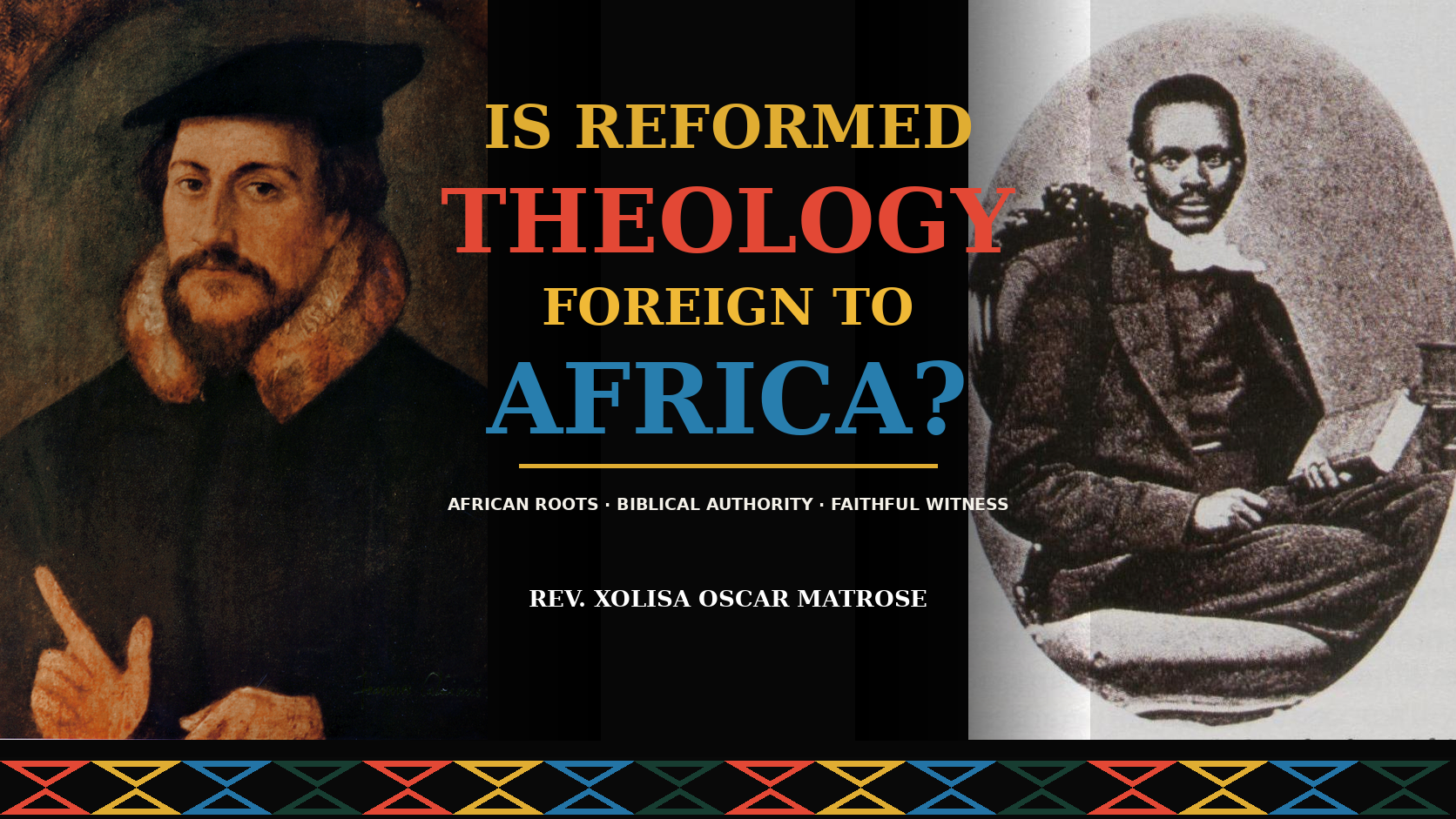
Is Reformed Theology a European religion for European people? Many African Christians think so. Because the Protestant Reformation occurred in sixteenth-century Europe, Reformed Christianity is often dismissed as foreign to Africa. Yet this assumption ignores both the African roots of Christianity and the authority of Scripture upon which Reformed Theology is built. While the Reformed tradition emerged within the European Reformation, the biblical truths it seeks to express are not the possession of any one culture, nation, or continent.
Reformed Theology is sometimes described as a white or Western theological tradition because the Protestant Reformation took place in sixteenth-century Europe. Yet Christianity itself did not originate in Europe. Africa has been part of the history of Christianity from its earliest centuries, and African Christian thinkers such as Augustine of Hippo and Athanasius of Alexandria made significant contributions to the development of Christian doctrine.
This does not mean that Augustine or Athanasius were “Reformed” theologians in the sixteenth-century confessional sense. Rather, it means that important theological convictions later emphasised within Reformed Theology have deep roots in the wider catholic Christian tradition, including the African church (Han, 2008; Vorster, 2010).
The sovereignty of God, humanity's fallen condition, salvation by grace, faith in Christ, and the authority of Scripture are theological convictions grounded in the Christian Scriptures rather than being the possession of any particular culture.
This distinction is particularly important for the African church. Christianity in Africa must be understood within an African religious and cultural environment in which African Traditional Religion continues to influence the beliefs and practices of many people, including some who identify as Christians. Stoker and Matrose (2024:1–28) argue that the influence of African Traditional Religion on Christian churches in Southern Africa can result in syncretistic practices in which elements of traditional religious belief and practice are incorporated into Christian faith and worship.
Reformed Theology therefore has an important contribution to make in the African context, not because it is a European theological system that must be imported into Africa, but because its commitment to Scripture provides a framework for testing every cultural and religious belief by the Word of God. The challenge is to confess the biblical faith faithfully while engaging African questions honestly and pastorally.
This African contribution to the wider history of Christianity provides an important starting point for considering how Reformed Theology can be understood and expressed within the African context.
Reformed Theology for Africa
De-Westernising the Reformed Faith: African Roots
Calling Reformed Theology simply “Western” overlooks the contribution of the African church to the wider Christian theological tradition. Some theological convictions later emphasised in Reformed soteriology have earlier roots in the Theology of Augustine of Hippo in North Africa (Van Oort, 2009; Han, 2008).
Augustine of Hippo (354-430 AD)
These emphases became particularly significant for later Protestant Theology. Although Calvin did not simply reproduce Augustine’s Theology, Augustine was an important theological source for him, particularly in his understanding of sin, grace and salvation. Calvin’s engagement with Augustine demonstrates that important elements of Reformed Theology stand within a much older Christian theological tradition that predates the European Reformation (Han, 2008; Vorster, 2010).
Augustine’s contribution therefore shows that important theological convictions later emphasised in Reformed Theology belong to a much older Christian tradition than the sixteenth-century European Reformation. The Reformation took place in Europe, but the biblical truths it confessed are rooted in the wider Christian faith and the witness of Scripture.
Athanasius of Alexandria (296-373 AD)
Athanasius was not a Reformed theologian in the later sixteenth-century confessional sense. Nevertheless, his defence of the Trinity and the full deity of Christ belongs to the theological foundation inherited by the Reformed churches. The Reformed confessions did not create these doctrines but received and reaffirmed central Christian convictions expressed in the earlier creeds and grounded in the church’s theological reflection on Scripture (Kolbet, 2011).
Reformed Theology can therefore be understood as a biblical and confessional expression of the Christian faith that remains connected to the wider history of the church. Augustine of Hippo and Athanasius of Alexandria demonstrate that Africa was not merely a later recipient of Christian Theology; African theologians made substantial contributions to the formation and defence of doctrines that remain central to Christian orthodoxy (Orobator, 2025).
The question, therefore, is not whether the Reformation happened in Europe. It did. The question is whether the biblical truths confessed by Reformed Christianity belong exclusively to European culture. They do not. Scripture is the ultimate authority for Reformed Theology, while the historic confessions serve as faithful summaries of what the Reformed churches understand Scripture to teach (Belgic Confession, Art. 7). For African Christians, Reformed Theology can therefore be received and articulated faithfully within an African context without treating biblical Christianity as a European possession.
The contributions of Augustine and Athanasius demonstrate that Africa has been part of the development of Christian Theology from the early centuries of the church. The story, however, does not end with the early church; African Christians in later generations have also engaged and articulated the Reformed faith within their own historical and social contexts.
Reformed Theology for Africa
Giants of the Faith: Two Pillars of African Reformed Theology
The history of Reformed Christianity in Africa includes theologians who sought to confess the Reformed faith faithfully while addressing the social and cultural realities of their contexts. Their work demonstrates that Reformed Theology has not simply been received in Africa but has also been interpreted and applied by African theologians in response to questions of faith, society, and justice.
1. Tiyo Soga: The Pioneer of African Christian Expression
Vernacular Translation: Soga made an important contribution to communicating the Christian faith in isiXhosa. He was involved in Bible translation and revision and translated the first part of John Bunyan’s The Pilgrim’s Progress into Xhosa. His translation work helped make Christian literature accessible to Xhosa-speaking people (Lowe, 1995; Erlank, 2021; Chalmers, 1877).
Cultural Dignity without Syncretism: Soga remained deeply conscious of his Xhosa identity while serving as a Christian minister. He maintained an interest in Xhosa culture and wrote about Xhosa proverbs, customs and legends. At the same time, his Christian ministry sought to bring the teaching of Scripture to bear on the realities facing his people (Lowe, 1995; Ramothwala, 2026).
Scripture and Christian Practice: Soga's ministry demonstrates the practical importance he placed on Scripture. Ramothwala (2026) highlights his commitment to the sufficiency of Scripture and describes how Soga appealed to biblical teaching when responding to a situation involving accusations of witchcraft and the threatened killing of an accused person. His ministry therefore provides an example of Christian faith being applied within an African context while remaining accountable to Scripture.
2. Dr. Beyers Naudé: Conscience of the Afrikaner Church
Scripture over State: Naudé came to reject the theological and biblical arguments used to support Apartheid. In his own account of his theological development, he described his study of the Old and New Testaments as central to his commitment to a non-racial and just society. His decision to place the authority of God above the authority of human institutions became a defining feature of his ministry (South African History Online, 2000; South African History Online, 2011).
Reformed Faith and Christian Witness: Naudé’s life demonstrates how theological convictions can challenge the misuse of Christian doctrine in a particular cultural and political context. His ministry became a public Christian witness against racial segregation and in support of non-racialism, justice and reconciliation (South African History Online, 2000; South African History Online, 2011).
The examples of Tiyo Soga and Beyers Naudé demonstrate that Reformed Christianity has been expressed in Africa in ways that engage real African and South African contexts. Soga showed the importance of communicating the Christian faith within an African cultural setting, while Naudé demonstrated the necessity of testing theological and cultural claims against Scripture. These examples lead to a pressing contemporary question: How can the African church remain faithful to biblical Christianity while confronting beliefs and practices that compete with the authority of Scripture? One of the most significant challenges is syncretism, particularly where elements of African Traditional Religion are blended with Christian belief and practice.
Reformed Theology for Africa
The Antidote to Syncretism and African Traditional Religion
The church in Africa is currently facing a crisis of identity. While numerical growth is explosive, the theological foundation is often shallow, leaving many believers trapped in syncretism—the blending of biblical Christianity with African Traditional Religion (ATR).
Many churches fall prey to the “Prosperity Gospel,” which is often just ATR packaged in Christian terminology. In ATR, a person may seek to manipulate spiritual powers or appeal to ancestors through sacrifices and other religious practices to gain wealth, health, and protection. In the Prosperity Gospel, God can similarly be treated as a source of material blessing who can be approached through “seeding money,” positive confession, or formulas of faith. Such similarities can contribute to the blending of traditional African religious concepts with Christian language and practice (Stoker & Matrose, 2024; Court, 2020:249–282).
Reformed Theology provides a robust, biblical antidote to these errors through three primary mechanisms:
1. The Sovereign Creator vs. Terrifying Spiritual Realms
Many expressions of African Traditional Religion view the spiritual realm as a complex and highly active world in which spiritual beings, ancestors, and other unseen powers may influence daily life. This can create significant concern about spiritual protection, misfortune, witchcraft, and the need for mediation between the physical and spiritual worlds.
The Reformed View: God is the sovereign, all-powerful Ruler of the universe (Soli Deo Gloria). Ephesians 1 reminds us that Christ is seated far above all rule, authority, power, and dominion (Eph. 1:20–23).
The Pastoral Impact: When African believers understand that God is utterly sovereign over the spirit world, the fear of generational curses, witchcraft, and ancestral anger loses its power. Believers find total rest in the protective custody of a sovereign God (Ps. 91:1–2; Rom. 8:38–39).
2. Christ’s Sufficient Mediation vs. Ancestral Veneration
In traditional worldviews, God is distant. Human beings require intermediaries—usually deceased ancestors—to speak to God on their behalf. This leads to ancestral veneration and rituals aimed at keeping the dead happy.
The Reformed View: Jesus Christ is our sole Mediator (Solus Christus). He is the ultimate High Priest who entered the holy place once for all, completely tearing down the wall of separation between God and man (Heb. 9:11–12; 10:19–22; 1 Tim. 2:5).
The Pastoral Impact: Reformed Theology frees the African believer from the crushing burden of trying to appease the dead. Christ’s sacrifice on the cross was perfect and sufficient. There is no need for pouring libations or slaughtering animals to secure peace; Jesus has already purchased perfect peace with His own blood (Heb. 10:10–14; Col. 1:20).
3. Sola Scriptura vs. The Dictatorship of Modern “Prophets”
Syncretism thrives where Scripture is ignored. Across the continent, self-proclaimed “prophets” and “apostles” claim direct, infallible revelation from God, often leading their congregations into bizarre, abusive, and unbiblical practices.
The Reformed View: Sola Scriptura asserts that the Bible is the final, sufficient authority for Christian faith and life. God has fully revealed everything necessary for salvation and godliness within the pages of Holy Scripture (2 Tim. 3:16–17; 2 Pet. 1:3). If a modern prophet claims authority equal to Scripture, then the authority of Scripture is effectively replaced by the authority of the prophet. This undermines the very principle by which Christians can test truth from error.
The Pastoral Impact: By grounding African congregations in systematic expository preaching, Reformed Theology protects believers from spiritual exploitation. It democratizes spiritual discernment, empowering everyday Christians to test every spirit and every sermon against the unchanging Word of God (Acts 17:11; 1 John 4:1).
Reformed Theology for Africa
Conclusion: A Faithful Future for the African Church
Reformed Theology is not a foreign ideology meant to turn Africans into Europeans. It is a liberating, deeply biblical framework that honours the historic roots of the African church while calling it to turn from modern syncretistic captivity. By emphasizing the supreme authority of the Bible, the absolute sufficiency of Jesus Christ, and the comforting sovereignty of God, Reformed Theology empowers the African church to cast off the chains of fear and syncretism with ATR. Only then can the church in Africa stand genuinely indigenous, intensely theological, and unswervingly faithful to Christ.
The task before African Christians is therefore not to choose between being African and being biblical. Rather, the challenge is to evaluate every cultural tradition, religious belief, and spiritual claim in the light of God's revealed Word. Reformed Theology provides a framework for doing precisely that. The task before African Christians is therefore to know the Scriptures deeply, confess Christ faithfully, and engage African culture without compromising the truth of the gospel.
Reformed Theology for Africa
Reference List
Chalmers, J.A. 1877. Tiyo Soga: A page of South African mission work. Edinburgh: Andrew Elliot.
Court, A.T. 2020. Prosperity Theology and African Traditional Religion: Assessing their resonance through a case study. Stellenbosch Theological Journal, 6(1):249–282. doi:10.17570/stj.2020.v6n1.a14.
DelCogliano, M. 2022. Athanasius of Alexandria, Christological Letters to Epictetus, Adelphius, and Maximus. In: DelCogliano, M. (ed.). The Cambridge Edition of Early Christian Writings. Cambridge: Cambridge University Press, pp. 276–300. doi:10.1017/9781107449640.022.
Erlank, N. 2021. The history of the Soga family, race, and identity in South Africa in the late 19th and early 20th centuries. Oxford Research Encyclopedia of African History. Available at: https://doi.org/10.1093/acrefore/9780190277734.013.776 (Accessed: 16 September 2026).
Han, S.J. 2008. An investigation into Calvin's use of Augustine. Acta Theologica, 28(Supplementum 10):70–83.
Kolbet, P.R. 2011. Athanasius (c.296–373). In: Kurian, G.T. (ed.). The Encyclopedia of Christian Civilization. Wiley. doi:10.1002/9780470670606.wbecc1638.
Lowe, C.C. 1995. Tiyo Soga (E). In: Irvine, K. (ed.). Encyclopaedia Africana Dictionary of African Biography. Volume 3: South Africa–Botswana–Lesotho–Eswatini. Algonac, MI: Reference Publications.
Millard, J.A. 1999. Malihambe: Let the Word Spread. Pretoria: University of South Africa Press.
Orobator, A.E. 2025. From Nicaea to Africa: Legacy, inspiration, and cultural contextualization of theology. Theological Studies, 86(3). doi:10.1177/00405639251350904.
Ramothwala, J. 2026. Learning from Tiyo Soga's ministry among the Gcaleka people. The Gospel Coalition Africa, 20 August. Available at: https://africa.thegospelcoalition.org/article/learning-from-tiyo-sogas-ministry-among-the-gcaleka-people/ (Accessed: 16 September 2026).
South African History Online. 2011. Reverend Beyers Naudé. South African History Online, 21 September. Available at: https://sahistory.org.za/ref/B-0068227 (Accessed: 16 September 2026).
South African History Online. 2016. Beyers Naudé: former General-Secretary of the South African Council of Churches and before that Director of the Christian Institute: interview with Rupert Taylor, 4 February 2000, Northcliff, Johannesburg. South African History Online, 14 July. Available at: https://sahistory.org.za/ref/R-0121422 (Accessed: 16 September 2026).
Stoker, H. & Matrose, X. 2024. An apologetic approach to ATR's influence on Christian churches in Southern Africa. Journal for Christian Scholarship | Tydskrif vir Christelike Wetenskap, 60(1&2):1–28. Available at: https://pub.ufs.ac.za/index.php/tcw/article/view/1399 (Accessed: 16 September 2026).
Van Oort, J. 2009. Augustine, his sermons, and their significance. HTS Theological Studies, 65(1). doi:10.4102/hts.v65i1.300.
Vorster, N. 2010. Calvin's modification of Augustine's doctrine of original sin. In die Skriflig/In Luce Verbi, 44(3):71–89. doi:10.4102/ids.v44i0.181.