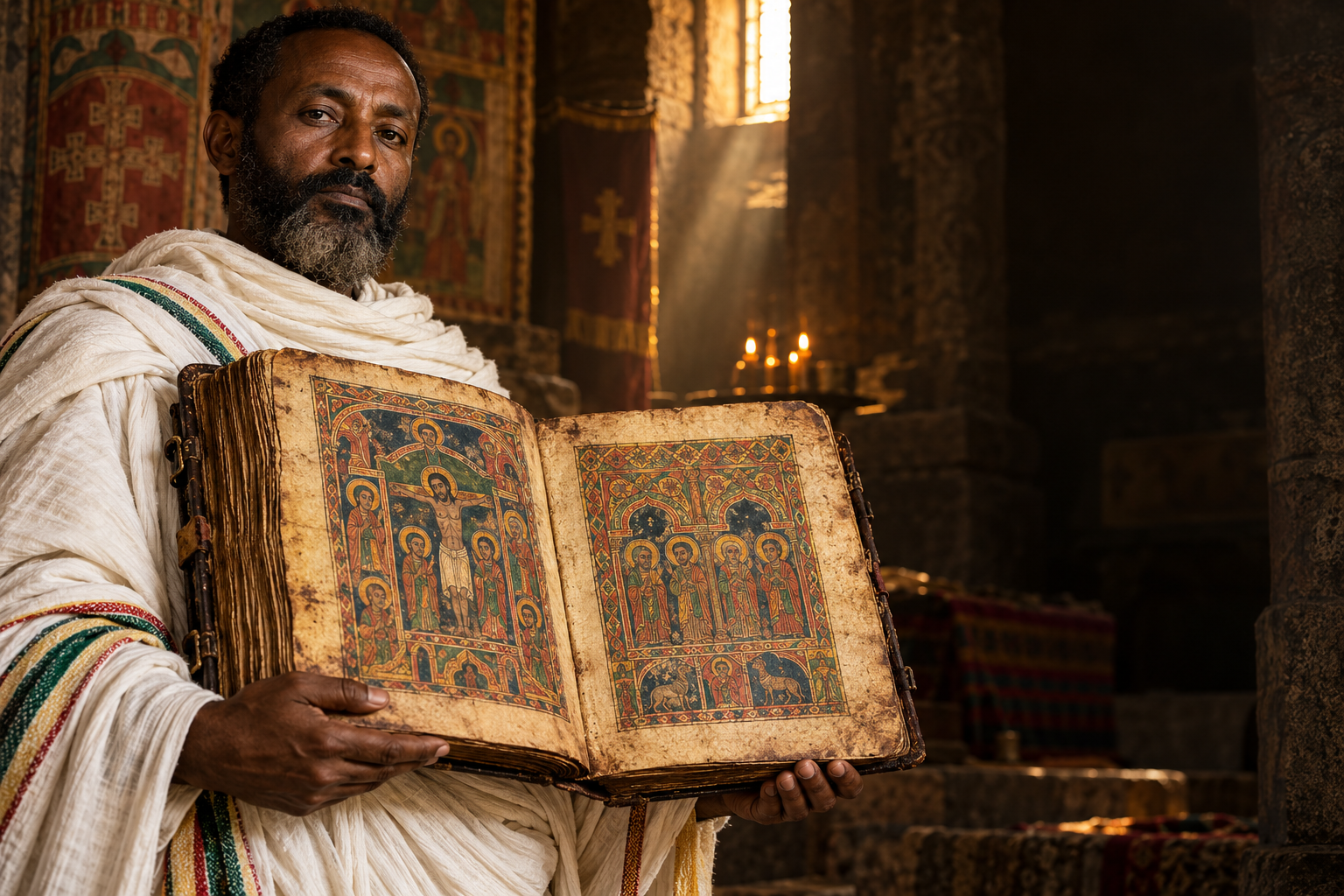
The Ethiopian Bible
The claim needs a careful definition
The claim sounds powerful: the Ethiopian Bible is the oldest and most complete Bible in the world, while Western churches removed books that challenged their version of Christianity. But several different questions have been collapsed into one. Is an ancient church tradition the same thing as an ancient physical manuscript? Does having more books make a canon older - or more authoritative?
Ethiopian Christianity is genuinely ancient. The kingdom of Aksum embraced Christianity in the fourth century, and the Ethiopian Orthodox Tewahedo Church preserves one of the world's oldest continuous Christian traditions. Its biblical heritage is not a modern internet invention and should never be dismissed as though Africa merely received the Bible from modern Europeans.
Ancient tradition, ancient texts, and the oldest surviving manuscript are three different claims.
The Ethiopian Bible
What do we mean by 'the Ethiopian Bible'?
The expression can refer to at least three things: the Ethiopian Christian tradition, particular Ge'ez manuscripts, or the collection of books recognised by the Ethiopian Orthodox Church. Those are related, but they are not identical. A tradition may be ancient even when a particular manuscript is later. A canon may contain ancient books without ever having existed as one ancient bound volume.
The Ethiopian Orthodox Church officially speaks of an 81-book canon - 46 Old Testament books and 35 New Testament books. This is wider than the 66-book Protestant canon. Yet '81 books' describes the church's canonical collection; it does not identify one surviving manuscript that is older than every other Bible.
A church can preserve an ancient canon without possessing one ancient volume containing the whole canon.
The Ethiopian Bible
What is the oldest surviving Bible?
The oldest surviving manuscripts of biblical books are not complete Bibles. The Dead Sea Scrolls preserve much earlier copies and fragments of Old Testament books, while early papyri preserve portions of the New Testament. When scholars speak about the earliest nearly complete Christian Bible, the discussion usually turns to Codex Sinaiticus and Codex Vaticanus, both from the fourth century.
Codex Sinaiticus contains the oldest complete copy of the New Testament together with much of the Greek Old Testament. The international Codex Sinaiticus Project dates it to the fourth century, probably the middle of that century. It was preserved for centuries at Saint Catherine's Monastery in the Sinai Peninsula.
Ethiopia also possesses extraordinary early Christian manuscripts. The celebrated Garima Gospels are among the earliest surviving illustrated gospel books. They testify to a remarkably old African manuscript culture, but they contain the Gospels, not an 81-book Bible. Their importance does not establish that a complete Ethiopian Bible is the oldest Bible in existence.
The Garima Gospels are treasures of African Christianity, but they are not a complete 81-book Bible.
The Ethiopian Bible
More books do not automatically mean an older Bible
A frequent argument runs like this: Protestants have 66 books, Roman Catholics have 73, and Ethiopian Orthodox Christians have 81; therefore the largest collection must be the fullest and least corrupted Bible. But quantity cannot settle canonicity. We must ask when a work was written, what claims it makes, how it relates to the prophetic and apostolic writings, and how it was received in Jewish and early Christian communities.
The Ethiopian Books of Meqabyan, for example, should not be confused with the familiar Greek books of Maccabees. They share a similar name but are substantially different works. A book may also be historically valuable without being Scripture. Christians routinely learn from Josephus, the church fathers, and later histories without placing them inside the biblical canon.
The number of books cannot, by itself, establish which books carry prophetic and apostolic authority.
The Ethiopian Bible
What about the Book of Enoch?
First Enoch is particularly important because the Ethiopian Orthodox tradition receives it as Scripture and because Jude 14-15 closely quotes 1 Enoch 1:9. That relationship must be acknowledged honestly. Saying that Jude uses Enoch does not, however, require the conclusion that every part of 1 Enoch is canonical.
The New Testament can cite a true statement from a work without thereby declaring the entire work inspired - just as Paul can quote Greek poets without placing their writings in Scripture. First Enoch is a collection of Jewish apocalyptic writings produced over time, centuries after the historical Enoch of Genesis 5. Its ancient origin and influence make it worth reading, but antiquity and influence are not the same as apostolic authority.
A biblical writer may quote a true statement without canonising every part of the source.
The Ethiopian Bible
Africa was not absent from the canon
Some popular presentations imply that Europeans created the 66-book Bible while Africa preserved the original version. History is not that simple. In AD 367, Athanasius of Alexandria listed the same 27 New Testament books recognised across Protestant, Catholic, and Orthodox churches today. His Thirty-Ninth Festal Letter did not invent those books; it witnessed to a collection already read across the churches.
North African church leaders and councils played important roles in recognising and discussing the canon. They did not make books inspired by voting for them. Rather, the church received writings it believed carried prophetic and apostolic authority. Nobody can responsibly tell this story as though Africa had no voice until Europe delivered a finished Bible.
One of the earliest surviving exact lists of the 27-book New Testament came from an African bishop.
The Ethiopian Bible
So, is it the oldest Bible?
No - not if the claim means that an 81-book Ethiopian manuscript is the oldest surviving Bible in the world. The Ethiopian Orthodox Church is ancient, its scriptural tradition is precious, and some Ethiopian manuscripts are exceptionally early. But the age of the church, the age of individual books, the size of its canon, and the date of a surviving manuscript are separate matters.
Christians should resist two opposite mistakes. We should not repeat romantic claims simply because they affirm African dignity. Nor should we respond by belittling Ethiopian Christianity or treating the Bible as a European possession. The better answer is historically careful and genuinely African.
Ethiopia preserves a profound Christian inheritance, while the evidence must still be described accurately.
The Ethiopian Bible
Receive the Word truthfully
The authority of Scripture finally rests neither on the colour of those who copied it nor on which continent can claim the oldest binding. The Bible bears a coherent witness to God's work in creation, fall, redemption, and restoration, reaching its centre in Jesus Christ.
African Christians do not need exaggerated history to honour Africa's real Christian past. We can celebrate Ethiopia's ancient faith, preserve its manuscript treasures, ask honest questions about the canon, and still test every claim with care. Our task is to receive God's Word truthfully - not to recruit it into another contest for cultural superiority.
The truth does not diminish Africa's Christian inheritance; it allows us to honour it without myth.
Sources and further reading
- Codex Sinaiticus Project, “Date”
- Ethiopian Orthodox Tewahedo Church, “Canonical Books”
- Athanasius, Thirty-Ninth Festal Letter (AD 367)
- R. W. Cowley, “The Biblical Canon of the Ethiopian Orthodox Church Today,” Ostkirchliche Studien 23 (1974).
- G. A. Mikre-Sellassie, “The Bible and Its Canon in the Ethiopian Orthodox Church,” The Bible Translator 44, no. 1 (1993): 111-123.