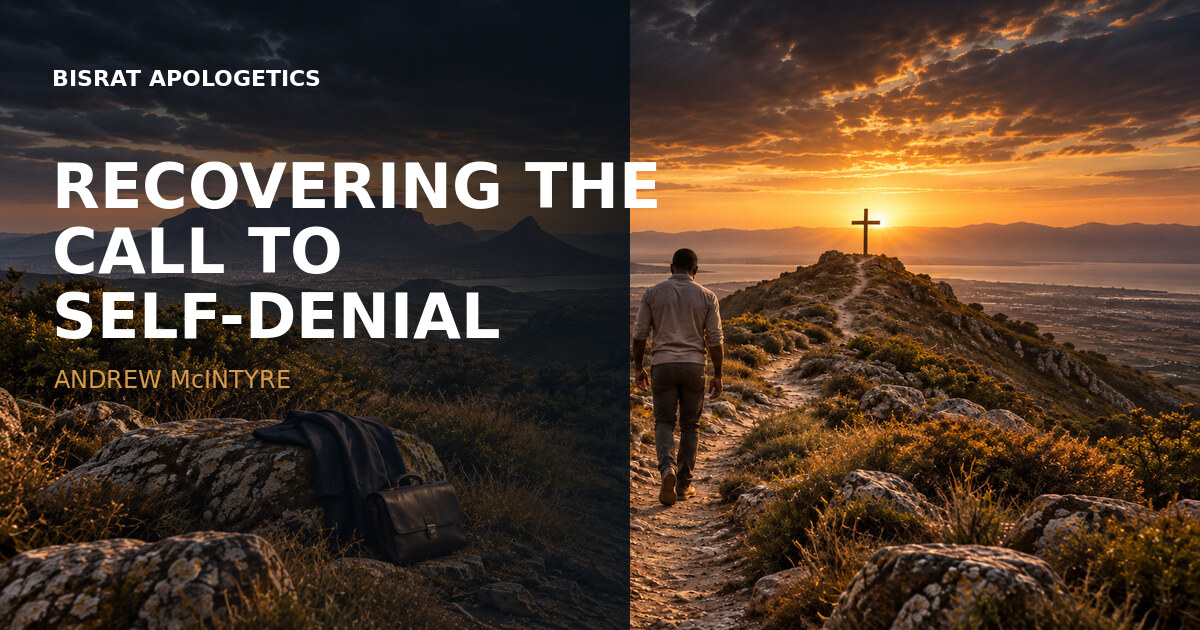
Cheap grace and the cost of discipleship
Contemporary Christianity, in many quarters, has become a system of religion that asks very little of us. We are promised much at cut prices, as if the gospel were for sale.
Dietrich Bonhoeffer wrote about this more than 75 years ago in his 1937 work, “The Cost of Discipleship.”
“Cheap grace means grace sold on the market like cheap jacks' wares. The sacraments, the forgiveness of sin, and the consolations of religion are thrown away at cut prices. Grace is represented as the Church's inexhaustible treasury, from which she showers blessings with generous hands, without asking questions or fixing limits. Grace without price; grace without cost!”
We are guilty of inviting people to add an unscriptural version of Jesus into their already comfortable, middle-class, first-world lives, rather than calling people to lay down their entire lives at the feet of Christ and to die to self. This has never been the gospel that Jesus preached.
Scripture never presents a Jesus, or a circumstance in the early church, where people were called merely to raise a hand or walk an aisle in order to make a decision. Christ called us to repent, believe, follow him, and take up our cross.
There is no guarantee that discipleship will preserve our comfort or protect our possessions. A life of discipleship never leaves our deepest loyalties untouched.
The Gospels are full of warnings about the cost of entering the kingdom of God. The gospel is wonderfully free, for salvation is entirely God’s gracious gift.
Yet nothing ever cheapens it. Grace costs us nothing to earn; however, Christian discipleship is a life in which everything we have and are is surrendered to Christ alone.
The Gospel confronts our self
The gospel of Mark (10:17) offers a clear account of this as it speaks of the rich young ruler. The man approached Jesus with an excellent question of eternal consequences: “‘Good Teacher, what must I do to inherit eternal life?”
This was an honest desire to learn of eternal life. The rich young ruler wished to enter the Kingdom of God.
He had lived a morally respectable life and had kept the commandments from his youth. Christ’s response exposed what was below the surface.
The man’s problem was not simply that he was rich and possessed much. The deeper problem was that his wealth possessed him.
“And Jesus, looking at him, loved him, and said to him, ‘You lack one thing: go, sell all that you have and give to the poor, and you will have treasure in heaven; and come, follow me.’” (Mark 10:21) The young man’s response was devastating in its simplicity: “Disheartened by the saying, he went away sorrowful, for he had great possessions.” (Mark 10:22) He came to Christ seeking eternal life, yet was unwilling to surrender to one thing that would compete with Jesus for the throne of his heart. Our possessions and attachments, like in this case, reveal who our true masters are.
This points to the uncomfortable reality of true discipleship. Jesus does not wish to add Christianity as a separate entity into our already packed existence.
He comes and demands total lordship over every aspect of our lives: our emotions, ambitions, relationships, possessions, reputations, careers and every plan you have ever made is to come under his authority.
The call to self-denial
Luke 9:23 clears up any misconceptions we have in this regard: “‘If anyone would come after me, let him deny himself and take up his cross daily and follow me.’” The language could not be clearer.
We are to deny ourselves. This does not leave room for denying ourselves in a few things that are particularly troublesome.
It is a call to total denial of self. Total depravity, one of the core elements of Reformed faith as exposited through Scripture, highlights clearly how fallen humanity wishes to be its own authority.
We see this when we demand to determine what we perceive as truth, in deciding what is right for ourselves, in the control of future events, in our relationships built on our own terms, in the use of money for our purposes, and in demanding that God bless our plans as we refuse to submit to his sovereignty. Christ’s call is radically at odds with this form of lifestyle.
His call remains one to surrender. And this is why the gospel is offensive to our reprobate human heart.
We never seek Christ as lord. We seek the benefits of Christianity without surrendering control.
We wish to achieve heaven with Christ’s holiness, forgiveness with no repentance, eternal life without dying to self, and Christ as Saviour but not as Lord. The gospel never makes such a separation.
The real cost of following Jesus
Luke 9 references many people who wished to follow Jesus. One response was “I will follow you wherever you go.”
Jesus responded clearly, with a warning that following him does not bring comfort or security: “And Jesus said to him, ‘Foxes have holes, and birds of the air have nests, but the Son of Man has nowhere to lay his head.’” (Luke 9:58) Another wished to follow Christ but return home first. Another wished to say goodbye to those at home.
Christ’s response to these statements sounds remarkably harsh to our contemporary ears. His response exposed how often we have divided loyalties.
Following Christ means that he becomes our supreme allegiance in life and death. This does not mean that we are to despise our families.
Elsewhere, Scripture commands us to honour parents, love our spouses, to care for children, and to serve our communities. Yet, nowhere are we taught that these relationships may take on or become more important than Christ.
Following Christ will create tension in relationships. We may have to refuse participation in dishonest business even when family members are involved.
Teenagers are called to refuse to follow friends into sinful behavior. Believers are called to sexual purity and biblical standards when society and many liberal churches tell them that biblical morality is outdated.
These are not peripheral decisions. They are part of Christ discipling us.
The gospel may cost us economically
Jesus confronts us regarding our thoughts about possessions. The Prosperity Gospel has caused great damage through its suggestions that following Jesus is primarily about earthly comfort.
This has created a form of Christianity that appears transactional in form. The ministers of the Prosperity Gospel call upon their followers to give to God via their ministries so that God will supply the giver with something greater in return.
Yet Jesus never made such claims. This is at odds with the reality that obedience to Christ will actually cost us materially.
The rich young ruler had to face the fact that following Christ would mean the loss of his possessions. This was also experienced by the early Christians who lost their property due to their faith (Heb 10:34).
The Apostle Paul experienced hunger, poverty, imprisonment, and persecution. Likewise, the apostles never preached a gospel that made a promise of financial advancement.
They preached Christ crucified and risen. This is particularly important for our South African church context.
South African Christians are experiencing genuine economic hardship. The challenges of unemployment, poverty, inequality, and corruption remain very real.
The church is called to care deeply about these realities as they demonstrate practical love towards those in need. True Biblical Christianity may never be allowed to turn into a promise of material prosperity.
Jesus is not the means to earthly wealth. He is to be our treasure.
We may lose our possessions and still possess Christ. Possessing Christ is infinitely greater than anything else this world can ever offer us.
Christ is the Narrow Gate
Jesus warned that the road to life is narrow. He describes two gates and two roads in Matthew 7:13-14.
The first is broad and leads to destruction. The second is narrow and leads to eternal life.
The Gospel call is clear that we are to “Strive to enter through the narrow door. For many, I tell you, will seek to enter and will not be able.” (Luke 13:24) These are words which should call us to action.
Salvation is never presented as something that we may casually add to our lives. Entering the Kingdom of God demands urgency.
Our Reformed faith explains why the road is narrow. The Westminster Confession of Faith (9:3) states that, “Man, by his fall into a state of sin, hath wholly lost all ability of will to any spiritual good accompanying salvation: so as a natural man, being altogether averse from that good, and dead in sin, is not able, by his own strength, to convert himself, or to prepare himself thereunto.”
Sinners do not want to surrender themselves to God. This is greater than mere ignorance.
We do not require greater or better information. We are sinners in need of new hearts.
We need divine grace. This is why salvation is impossible with man.
Our response to this statement agrees with the disciples: “Who then can be saved?” Christ answers us, “‘With man it is impossible, but not with God.
For all things are possible with God.’” (Mark 10:26-27) That is the hope of the gospel. The gospel reveals a demand that is impossible and then announces that God does what we cannot do.
The treasure worth everything
Christ offers us a right response to hearing the gospel in his two parables in Matthew 13. A man finds a treasure hidden in a field.
He goes to sell everything he has and buys the field. Another man finds a pearl of great value; he too sells everything he has to buy it.
The point is not that salvation may be purchased. It cannot.
Salvation is by grace alone, through faith alone, in Christ alone. The point is that Jesus shows us the value of what has been found.
When one sees the surpassing worth of Christ, everything else we have or desire becomes secondary. This does not mean that Christians ultimately have to give up all things and take on Christianity as a duty of misery.
Our response is rather that Christ is worth more than everything else we leave behind. This changes the way we understand self-denial.
Self-denial is not ultimately about losing. It is about gaining Christ.
In response to this, all our former achievements become loss because of the surpassing worth of knowing Christ Jesus as Lord.
The Gospel we must recover
One of the greatest needs within the contemporary church is the recovery of a biblical understanding of conversion. Christianity cannot be authentically presented as a way to achieve your best life now.
Christ transforms our lives by bringing an end to ourselves. The gospel is the announcement that sinners are reconciled to God through the death and resurrection of Jesus Christ.
We come to him empty-handed. We abandon any claims we have to self-righteousness.
We turn from our sins and place our trust in Christ alone. We submit to his lordship and follow him.
This does not mean that a Christian becomes perfect overnight. Rather, the Christian life is one of ongoing repentance and sanctification.
Our lives’ directions change. We no longer seek to live for ourselves.
Christ becomes our treasure, authority, hope, and life.
The grace behind the cost
Self-denial requires care. We must never permit this action to become a form of works-righteousness.
The gospel does not teach that self-denial merits salvation. Salvation is entirely by grace.
Likewise, we do not take up our cross so that we earn God’s love. We take up our cross as a response to God’s demonstration of love for us in Christ.
The order of these actions matters enormously. Christ gave himself for us.
Then he calls us to give ourselves to him. The Christian life is never an attempt to purchase god’s favour.
It is a grateful response of someone who has already encountered divine, undeserved mercy. The One who calls us to surrender is the One who surrendered all things for us.
He took up his cross and walked the road to Calvary on our behalf. He died so that we might live.
Christ is worth it
The gospel is costly because Christ is worthy. Following him may cost you friendships, opportunities, money, reputation, comfort, and even your freedom or life.
But Christ is worthy of all of these. He offers eternal life, forgiveness, and ultimately the Kingdom of God.
The church in South Africa does not need a Christianity that promises believers an easier life. We need to establish a gospel that calls sinners to repentance, points them to the cross, announces the resurrection, and summons them to follow Christ.
The church must proclaim a grace that saves. Jesus did not die to cause mankind to admire him.
He calls us to follow, and that invitation remains today. The question is not whether Christ will cost something.
The real question is whether we have come to see that Christ is worthy of all things.
Sources and key texts
- Dietrich Bonhoeffer, The Cost of Discipleship (first published in German in 1937).
- The Westminster Confession of Faith, chapter 9, section 3.
- Mark 10:17–27; Luke 9:23, 57–62; Luke 13:24; Matthew 7:13–14; Matthew 13:44–46; Hebrews 10:34.