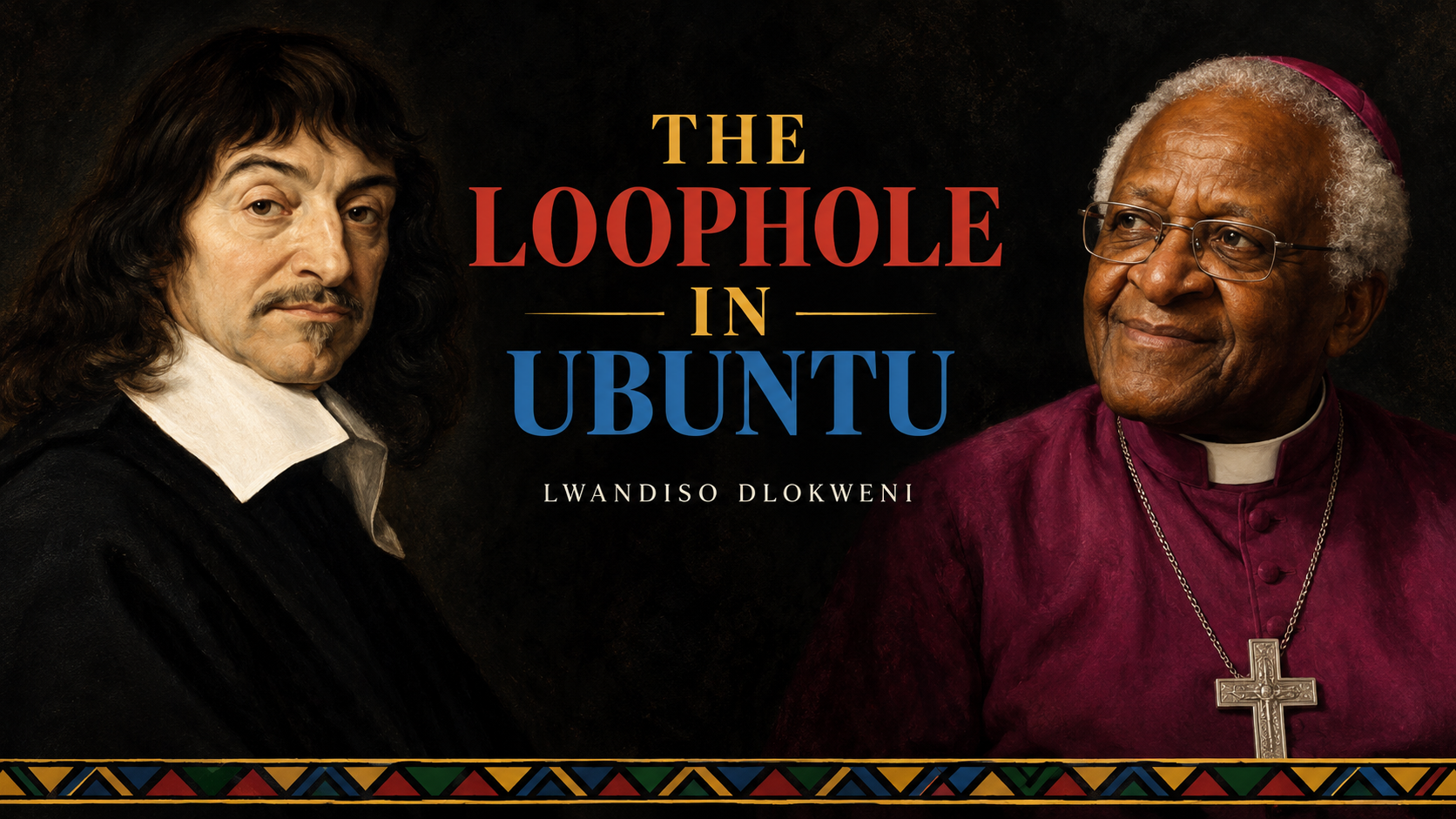
The Loophole in Ubuntu
Introduction
Few African ideas have travelled as successfully as Ubuntu. It has appeared in political speeches, corporate values, university programmes, reconciliation projects, and even the name of a computer operating system. Its familiar summary—“I am because we are,” or “a person is a person through other persons”—offers a powerful challenge to individualism.
Desmond Tutu described Ubuntu as the conviction that “I am human because I belong.” To possess Ubuntu is to recognise that our humanity is bound up with the humanity of others. We do not flourish in isolation. We need families, neighbours, churches, and communities. We receive language, memory, affection, correction, and identity through relationships.
This is one reason Ubuntu often appears more humane than the popular Western slogan associated with René Descartes: “I think, therefore I am.”
But is Ubuntu sufficient as a foundation for human identity and moral responsibility? Or does it point towards a deeper truth that it cannot establish by itself?
The Christian answer is not merely, “I think, therefore I am,” nor simply, “I am because you are.” It is:
We are because God is.
The Loophole in Ubuntu
“I Think, Therefore I Am”
René Descartes’s famous statement emerged from his attempt to find something that could not be doubted. He reasoned that even if he doubted everything else, he could not doubt that he was thinking. If he was thinking, then he must exist.
Descartes was addressing a question about knowledge and certainty. He was not attempting to provide a complete definition of human personhood, and it would be unfair to blame him for every form of Western individualism. Nevertheless, his slogan has come to represent a recognisably modern instinct: the independent thinking self becomes the starting point for understanding reality.
I begin with myself. I establish what I can know. My rational consciousness becomes the ground from which I interpret the world.
That approach recognises something important. Human beings are thinking and morally responsible individuals. Scripture never dissolves the individual into the group. Each person will give an account of himself or herself to God (Rom. 14:12). No family, tribe, nation, or church can believe on our behalf.
Yet the isolated self is too small a foundation for human identity. I did not create my mind, body, language, or world. I did not choose the family into which I was born. I did not give myself life. Before I could think, speak, or reason, I was already receiving from others.
Ubuntu rightly confronts this illusion of the self-created individual.
The Loophole in Ubuntu
“I Am Because We Are”
Ubuntu insists that human beings are relational creatures. As Tutu explained, Ubuntu means that our humanity is “caught up” in the humanity of others. A person with Ubuntu is generous, hospitable, compassionate, and conscious that diminishing another person also diminishes the community.
African philosophers have developed Ubuntu in different ways. Justice Yvonne Mokgoro, a former justice of South Africa’s Constitutional Court, described harmony as being achieved through ‘close and sympathetic social relations within the group.’ Archbishop Desmond Tutu, the Anglican church leader and Nobel Peace Prize laureate, emphasised generosity, hospitality, friendliness, care and compassion, insisting that ‘I am human because I belong.’ Professor Gessler Muxe Nkondo, a South African scholar and social-policy and heritage expert, spoke of commitment to the good of the community and of people experiencing their lives as bound up with their community. Thaddeus Metz (American-born, though based in Pretoria), for example, interprets Ubuntu as an ethic centred on identification with others and solidarity with them. He argues that Ubuntu can offer a meaningful account of human dignity and communal responsibility, while acknowledging common criticisms that the concept may be vague, insufficiently protective of individual freedom, or difficult to apply beyond traditional communities. Metz’s philosophical treatment demonstrates that Ubuntu is more than a sentimental slogan.
Ubuntu sees something that radical individualism misses: we become recognisably human within relationships.
God ordinarily mediates many of his gifts through other people. We receive care through parents, wisdom through elders, correction through friends, and spiritual encouragement through the church. Paul compares Christians to members of one body who need one another (1 Cor. 12:12–27). The eye cannot say to the hand, “I have no need of you.”
The Bible therefore has no sympathy for selfish autonomy. Cain’s question, “Am I my brother’s keeper?” is not a biblical ideal but an expression of rebellion (Gen. 4:9). Christians are commanded to bear one another’s burdens, honour one another, forgive one another, encourage one another, and love one another.
In this respect, “I am because we are” is better than an individualism that imagines, “I belong only to myself.”
Nevertheless, Ubuntu has a theological weakness when it is expected to function as a complete worldview.
The Loophole in Ubuntu
Ubuntu’s Theological Loophole
Abba Ayalew Amlak, associated with Abakhaliphi BokuKhanya, has used the language “I am because you are” while distancing this human interconnectedness from belief in what he dismisses as a “man in the sky.” Abakhaliphi BokuKhanya’s public teaching similarly presents Ubuntu as a truth grounded in the human relationship itself. Their online material explicitly uses the phrase “I Am Because You Are”.
This exposes the theological loophole in a secularised Ubuntu.
If I am because you are, why are either of us here? Why should your existence place a moral obligation upon me? Why must I love you when doing so threatens my interests? What gives every human being equal dignity when communities themselves disagree about who belongs?
A community can nurture, but it can also exclude. Tribes can protect their members while mistreating outsiders. Majorities can oppress minorities. Families can conceal abuse to preserve their reputation. Communities can identify some people as unwanted, impure, foreign, disabled, or dishonourable.
If the community creates my personhood, what happens when the community rejects me?
Ubuntu tells us that relationships matter. But, by itself, it cannot provide an unchanging authority by which every relationship and community must be judged. If people are the source of one another’s value, people may also decide whose value they will recognise.
This helps explain why forms of secular humanism readily embrace Ubuntu. It offers the moral attractiveness of love, solidarity, dignity, and compassion without requiring submission to God. We can affirm one another. We can save one another. We can build community together. We do not need God; humanity can complete the circle by itself.
But the circle is unable to support its own weight.
Human beings cannot be the ultimate source of human dignity because humanity is precisely what requires moral judgement. We are capable of extraordinary compassion, but also cruelty. We form communities, but we also corrupt them. We love, but our love is often partial, tribal, self-interested, and conditional.
Ubuntu describes the beauty of human interdependence. It does not adequately explain why human beings possess dignity in the first place, why love is morally binding, or why our communities must answer to a standard beyond themselves.
The Loophole in Ubuntu
“We Are Because God Is”
The Bible begins neither with the solitary thinker nor with the human community. It begins with God:
“In the beginning, God created the heavens and the earth” (Gen. 1:1).
Before there was an “I” or a “we,” God was. He does not receive his existence from another. He simply is. When Moses asks for his name, God answers, “I AM WHO I AM” (Ex. 3:14).
We exist because the self-existent God created us.
This means that human dignity is not bestowed by the individual or negotiated by the community. Every human being bears God’s image (Gen. 1:26–27). The unborn child, the disabled person, the foreigner, the poor, the elderly, and even the person rejected by society possess dignity because God made them—not because a community has decided to recognise them.
The biblical order is therefore:
God is. God creates. Therefore, we are.
The same order governs Christian morality. Before God gives Israel his commandments, he declares:
“I am the LORD your God, who brought you out of the land of Egypt, out of the house of slavery” (Ex. 20:2).
God does not begin with, “You must behave well so that I may become your God.” He begins with what he has done: “I am the LORD your God, who brought you out.”
Then comes the “therefore.”
Because God is their covenant Lord and Redeemer, Israel must worship him alone, honour his name, rest in his provision, honour parents, protect life, remain sexually faithful, respect property, speak truthfully, and resist covetousness.
Biblical ethics is a response to divine grace.
The New Testament follows the same pattern. “We love because he first loved us” (1 John 4:19). Our love does not begin within humanity and rise towards God. It begins in God and overflows towards others.
Christian love is not merely the recognition that I need you. It is the response of people who have first been loved by God in Christ.
Jesus does not say, “Love only those through whom your identity is formed.” He commands us to love our enemies and pray for those who persecute us (Matt. 5:44). That goes beyond ordinary communal solidarity. The enemy may contribute nothing to my wellbeing. He may reject my community and despise my identity. Yet I must love him because God loved his enemies and sent Christ to die for the ungodly (Rom. 5:6–10).
Ubuntu says, “My humanity is connected to yours.”
The gospel goes further: “Even when you treat me as an enemy, I must seek your good because God loved me when I was his enemy.”
The Loophole in Ubuntu
Community Is a Gift, Not a God
Christianity does not reject community. It gives community its proper foundation.
Our families, cultures, languages, and histories are genuine gifts of God. Through them, we learn who we are within the world. We must not despise the people through whom God has cared for us.
But these relationships cannot bear the weight of our ultimate identity.
Paul possessed an impressive communal and religious identity. He described himself as “circumcised on the eighth day,” belonging to “the people of Israel,” from “the tribe of Benjamin,” and “a Hebrew of Hebrews” (Phil. 3:5).
Paul did not pretend that these things were meaningless. They described his history, ancestry, education, and covenant privileges. Yet when compared with Christ, he counted them as loss:
“I count everything as loss because of the surpassing worth of knowing Christ Jesus my Lord” (Phil. 3:8).
Paul’s identity was no longer ultimately controlled by ethnicity, ancestry, education, or communal standing. His deepest identity was found in union with Christ.
This is where a Christian account of personhood surpasses both individualism and Ubuntu.
I am not merely a thinking individual. I belong to Christ.
I am not merely the product of my community. I have been created by God and redeemed by Christ.
I need other people, but other people are not my Creator.
My family may reject me. My culture may misunderstand me. My community may exclude me. Yet my personhood cannot be erased because my life is hidden with Christ in God (Col. 3:3).
At the same time, union with Christ never leaves me isolated. Christ joins me to his body, the church. Here I receive brothers, sisters, mothers, and fathers drawn from every nation and language. Christian community is not constructed around shared blood, tribe, or culture but around a shared Saviour.
The Loophole in Ubuntu
Ubuntu Fulfilled and Corrected
Christians need not reject everything associated with Ubuntu. Its emphasis on hospitality, generosity, solidarity, reconciliation, and mutual responsibility can expose the selfishness of modern individualism. It can remind African Christians of cultural resources that resonate with biblical commands concerning neighbour-love.
But Ubuntu must itself come under the authority of Scripture.
Where it recognises that human beings were made for relationship, Christianity can affirm it.
Where it turns community into the source of personhood, Christianity must correct it.
Where it encourages love only within a recognised group, Christ commands love that crosses ethnic, social, and even enemy boundaries.
Where secular Ubuntu believes humanity can achieve reconciliation without God, the gospel declares that true reconciliation begins with God reconciling sinners to himself through the cross (2 Cor. 5:18–21).
“I think, therefore I am” begins with the individual.
“I am because we are” begins with the community.
The Bible begins further back:
God is; therefore, we are.
And because this God created us, loved us, and redeemed us in Christ, we must love one another.
Our love is not humanity’s independent achievement. It is an answer to grace. It is not proof that we can live without God. It is evidence that God has acted first.
We are because God is.
We love because he first loved us.