Begin in Egypt. Follow the Nile, the ancient African churches and the Kingdom of Kongo—then journey into South Africa’s churches and the congregations next door.
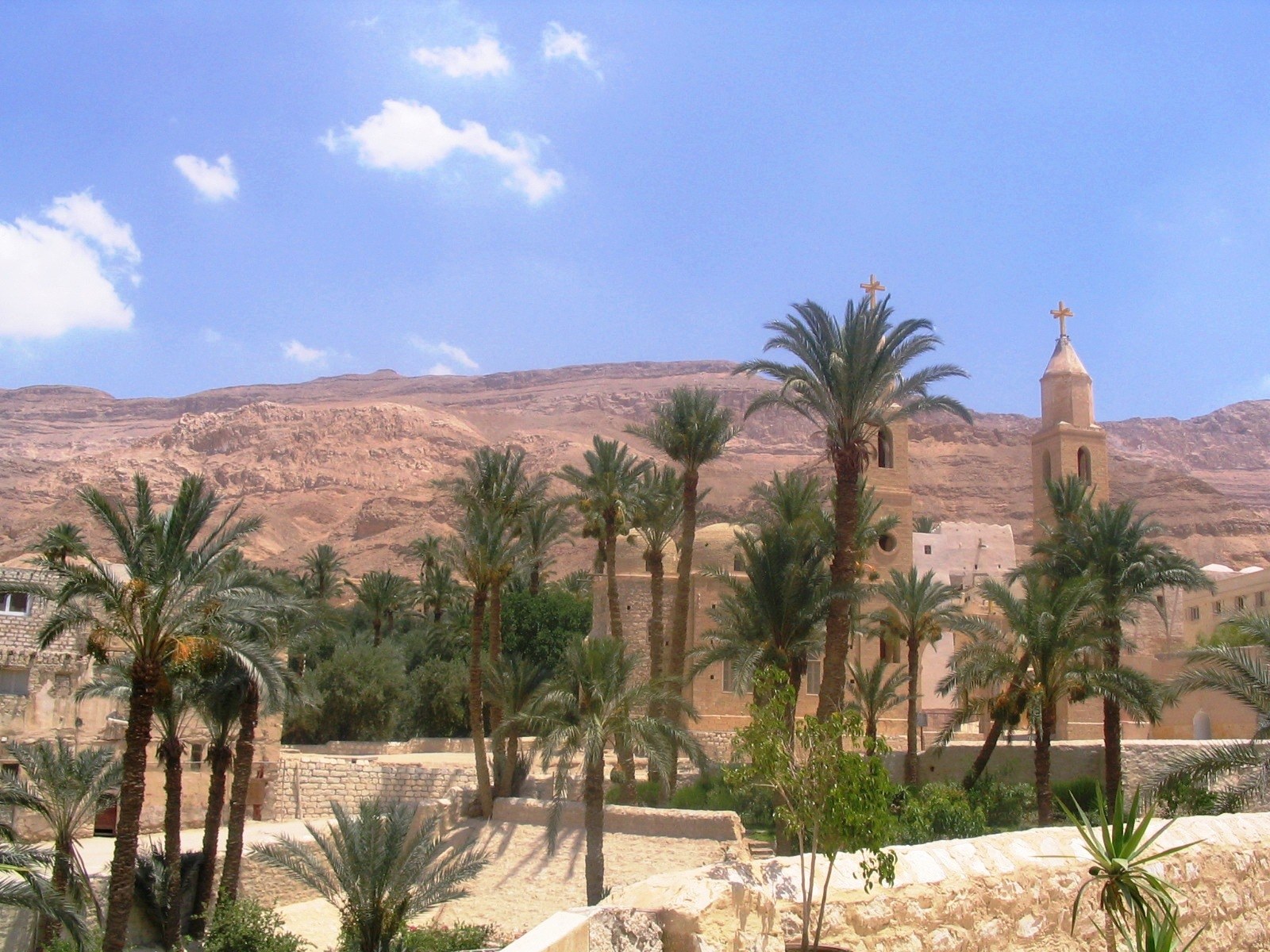
Saint Anthony’s Monastery, Egypt · Tentoila, 2006, public domain. An Egyptian Christian landscape rooted in the ancient desert tradition.
A story, then a field guide
Behind every name, a history
Why do so many different churches stand on the same street? Their names carry stories of missionary work, translation, African leadership, theological disagreement, revival, racial exclusion and renewal.
Follow those threads through time, then explore the church families they helped shape. Egypt, Ethiopia, Nubia and Central Africa are substantial chapters of the story, before the focus moves to South Africa. Eras overlap: older churches continue as new movements emerge.
The historical journey
From Egypt. Across Africa.
Begin with Egypt’s ancient churches, follow Africa’s Christian kingdoms and teachers, then explore South Africa. Choose a chapter below. Images move gently; captions identify surviving objects, later portraits and explanatory diagrams. Short quotations and chapter references lead into the historical books.
Chapter 011st–3rd centuriesAlexandria · Nile Valley
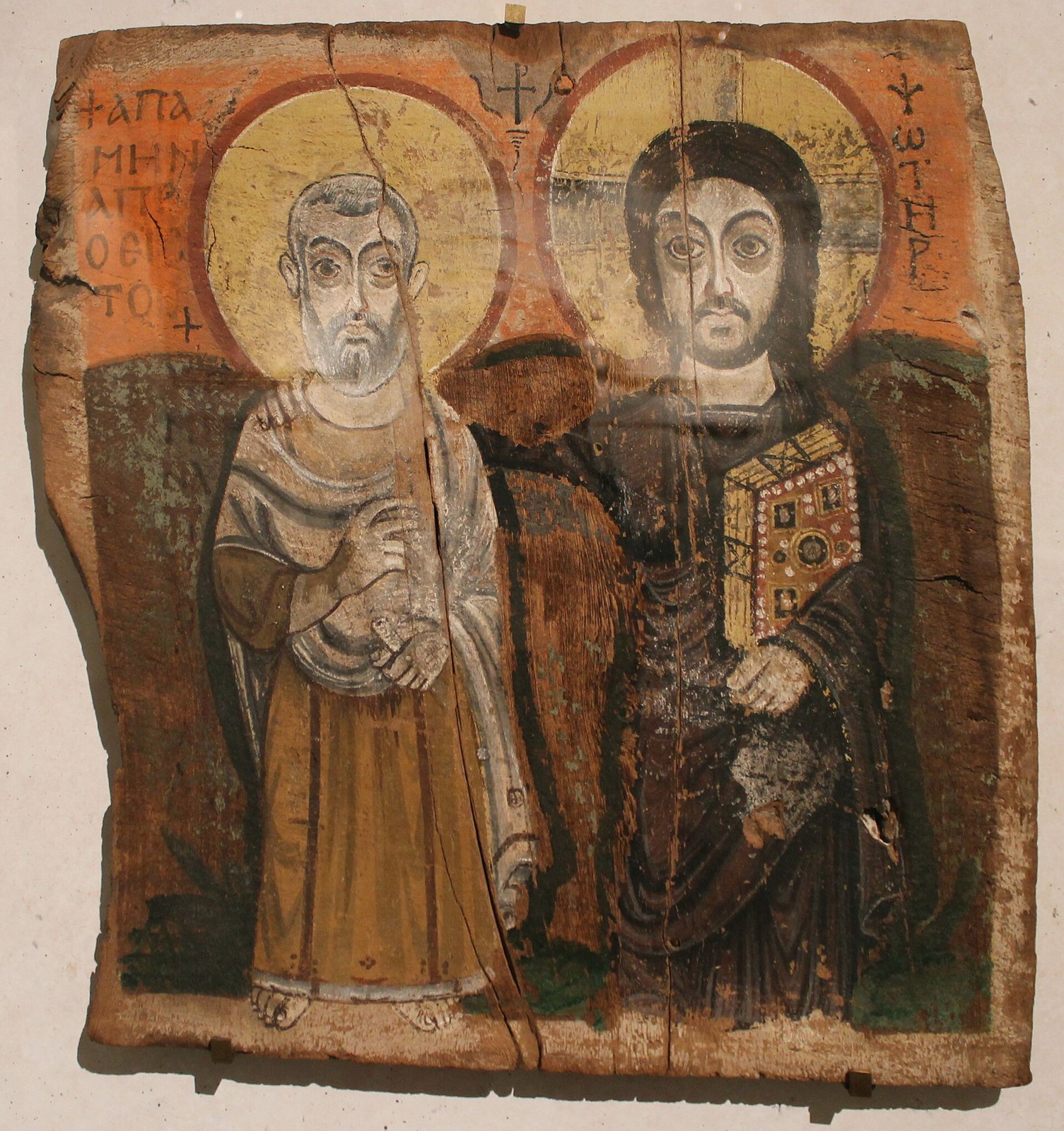
Christ and Abbot Mena, Egypt, sixth–seventh century · Musée du Louvre. A later surviving Egyptian Christian painting, not a portrait of the first converts.
01 / 24 · 1st–3rd centuries
Begin in Egypt: an African church takes root
Alexandria · Nile Valley
Christianity began with Jesus and the apostles in the eastern Mediterranean. Its African history begins here in Egypt, not with European settlement at the Cape. The New Testament already places Egyptians and people from Libya at Pentecost (Acts 2:10), and names Apollos as an Alexandrian who taught about Jesus (Acts 18:24–28). These passages show early African participation; they do not give us a complete founding chronology for Egypt’s churches.
Coptic tradition identifies Mark the Evangelist as the founder of the church in Alexandria in the first century. We should distinguish that received tradition from surviving physical evidence. Gospel papyri found in Egypt, generally dated to the second and third centuries, and the teaching of Clement and Origen show an established Christian presence by the late second and early third centuries.
Alexandria became a major centre of biblical interpretation and Christian learning. Greek and, increasingly, Coptic carried Christian teaching into Egyptian life. The Coptic church belongs to Egypt’s own continuing history: it is not the product of modern European missions.
Bantu recounts the Alexandrian foundation tradition in greater detail: Mark’s encounter with the cobbler Anianus, his instruction of converts and the appointment of a local bishop. But he identifies the Acts of Mark as a late-fourth-century narrative, and his notes point to Eusebius as an earlier literary witness. This distinction matters. A tradition can preserve a community’s memory without functioning as a contemporary diary of its founding.
We can also look beyond founding stories. Bantu describes early copies of Christian writings found in Egypt, including biblical fragments, Irenaeus and the Shepherd of Hermas. These manuscripts connect Egyptian readers with wider Christian networks. They are evidence of people reading, copying and circulating texts, rather than simply an assertion that an African church once existed.
Instruction developed in a city where Jewish, Egyptian and Greek intellectual traditions met. Pantaenus, Clement and Origen belong to this setting. Origen’s teaching moved between elementary formation and advanced biblical study, while disputes with Bishop Demetrius show that theological learning and church supervision were not always harmonious. Alexandria’s Christian history includes classrooms and contested authority as well as celebrated ideas.
“Alexandria and Egypt represent the gateway for Christianity on the continent of Africa.”
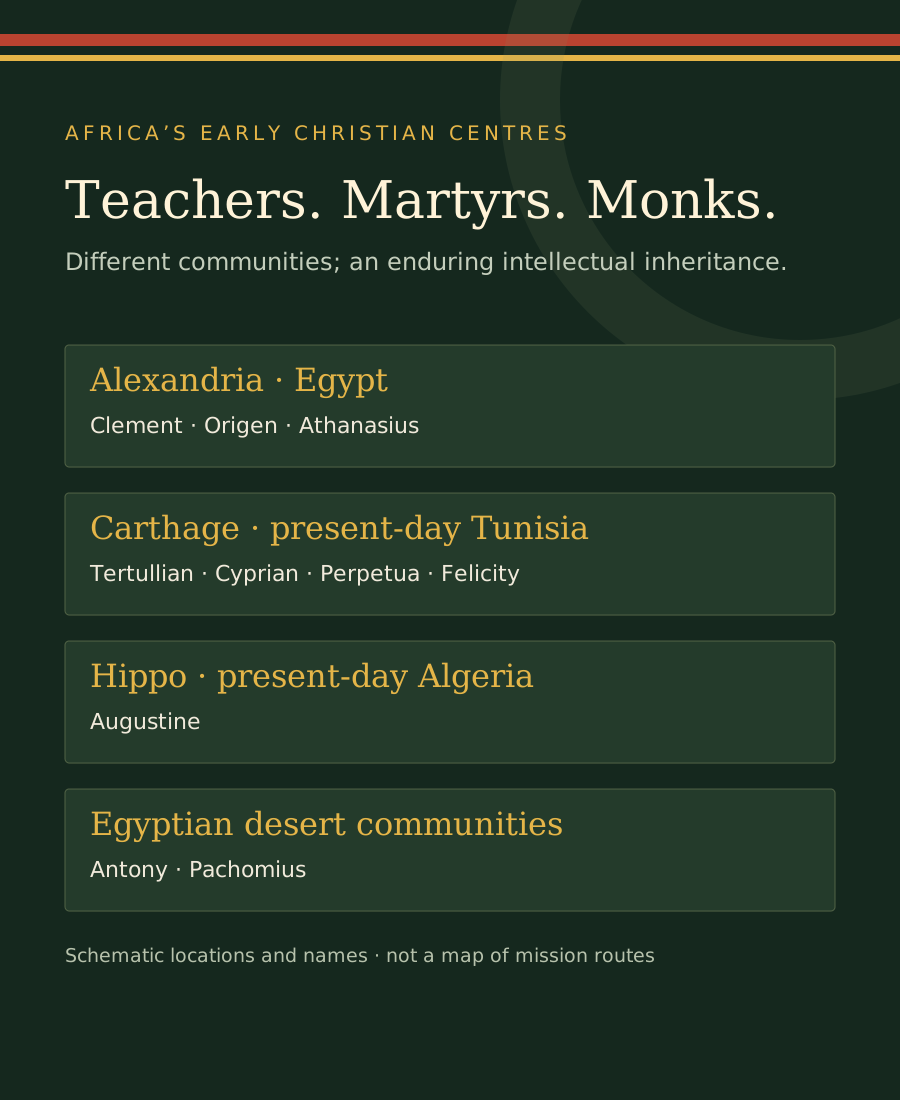
Bisrat location diagram: three centres of early Christian thought. Schematic, not a map of a single empire or mission route.
02 / 24 · 2nd–5th centuries
Africa helps shape the faith of the whole church
Alexandria · Carthage · Hippo
The early African church was not one ethnic group or one theological school. Egyptian and Roman North African Christians lived in multilingual societies. Clement and Origen worked in Alexandria; Tertullian and Cyprian wrote from Carthage; Augustine ministered at Hippo in what is now Algeria. Their African location is certain even where modern racial categories would be misleading.
African Christians contributed to biblical interpretation, Latin theological vocabulary, reflection on the Trinity, the church and salvation. Athanasius of Alexandria defended the full divinity of the Son in the fourth-century controversy over Arius. Perpetua and Felicity, martyred at Carthage in 203, remind us that this inheritance includes women, suffering and ordinary Christian witness as well as famous teachers.
In Egypt, Antony, Pachomius and other desert Christians shaped traditions of ascetic life and monastic community that influenced churches beyond Africa. Thomas C. Oden’s How Africa Shaped the Christian Mind invites readers to recover these contributions. That recovery should rest on texts and evidence, not on assigning every ancient achievement to Africa.
Consider the people behind the theological vocabulary. At Carthage, Perpetua and Felicity shared Christian confession across differences of social status: one was a young woman from a prominent family; the other was enslaved. Tertullian’s Latin writings, Cyprian’s pastoral response to persecution and the later Donatist controversy reveal a North African church wrestling with holiness, church unity, baptism and the treatment of believers who had denied their faith under pressure.
Augustine’s life moved between Thagaste, Carthage, Italy and Hippo. His travels do not make him less African, just as writing in Latin does not turn a North African Christian into a European. His debates over sin, grace and the church became part of an intellectual inheritance later read by Roman Catholics and Protestant reformers. Africa contributed substantially to that inheritance without being its sole source.
Egyptian monasticism also contained different forms. Antony’s withdrawal, Pachomius’s organised communal life and Shenoute’s leadership and extensive Coptic writing should not be collapsed into one generic “desert father.” Shenoute argued against the indigenous worship of his own society: early African Christians could affirm their language and people while confronting inherited religious practices.
Oden organises Africa’s intellectual influence around biblical interpretation, doctrine, councils, monastic life, educational institutions, philosophy and rhetoric. He traces how African scholarship and practices travelled through figures such as Basil and John Cassian. Some of his wider priority claims are proposals for further research. The defensible conclusion is substantial African participation, not that Africa invented every doctrine or that the rest of the early church was irrelevant.
“Africa had a major hand in crafting the basic Latin and Greek views of sin and grace”
Chapter 034th century onwardAksum · present-day Ethiopia and Eritrea
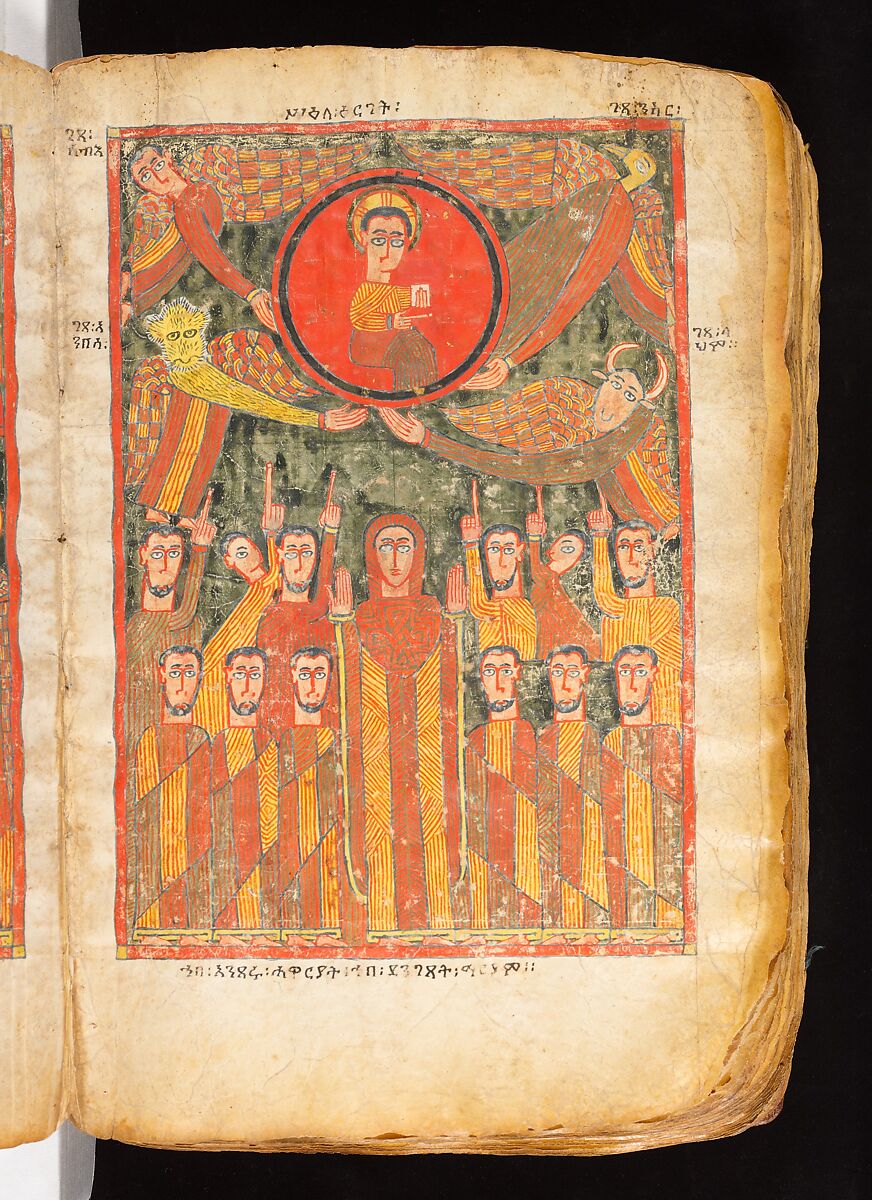
Ethiopian Book of the Gospels, late 14th–early 15th century · The Metropolitan Museum of Art. A surviving witness to an older Christian tradition.
03 / 24 · 4th century onward
An African kingdom embraces Christianity
Aksum · present-day Ethiopia and Eritrea
Aksum’s adoption of Christianity under King Ezana in the fourth century gives us another ancient African Christian centre. Crosses on royal coins and inscriptions provide material evidence. Frumentius became its bishop through the church of Alexandria; the connection with Egypt continued across many centuries.
The Ethiopian official baptised in Acts 8 came from the kingdom associated with the Kandake, in the region of ancient Kush south of Egypt. The ancient term “Ethiopian” must not simply be equated with the borders of modern Ethiopia. His conversion and Aksum’s later royal conversion are distinct events.
Geʿez Scripture, liturgy, manuscripts and monastic traditions became part of an enduring African Christian culture. The illustrated Gospel shown here is medieval: it witnesses to continuity, not to the appearance of a fourth-century manuscript. Ethiopia’s church existed long before Portuguese missionaries or the Protestant Reformation.
Bantu relates the account preserved by Rufinus of the brothers Aedesius and Frumentius arriving at the Aksumite court. Frumentius’s later connection with Athanasius links this story to Alexandria. The encounter belongs to a world of Red Sea movement, commerce and Afro-Asian relationships, rather than a modern European colonial mission.
Doctrine also mattered. Bantu discusses an attempt by Emperor Constantius II to bring Frumentius under an Arian-aligned church authority. Aksum’s alignment with Athanasius complicates the idea that an emperor simply imposed belief in Christ’s divinity on passive African subjects. African Christian leadership participated in the argument over who Christ is.
The story then moves beyond the court. Traditions associate the Nine Saints with monastic development and Geʿez Christian learning, and Yared with Ethiopian chant. The Garima Gospels witness to an early manuscript culture. Much later, the churches of Lalibela and theological writing in Geʿez show that Ethiopian Christianity continued to produce its own institutions and forms of expression.
Women also carried this continuity. Bantu discusses Walatta Petros’s defence of Ethiopian Orthodox Christianity during conflict over the imposition of Roman Catholicism under Susenyos. These later disputes were not the arrival of Christianity in an empty religious landscape; they took place within a church that already had many centuries of history. Exact deeds assigned to early saints belong partly to hagiographical tradition and should be distinguished from inscriptions and manuscripts.
“the earliest historically substantiated Christian period in Ethiopia was under the fourth-century king Ezana.”
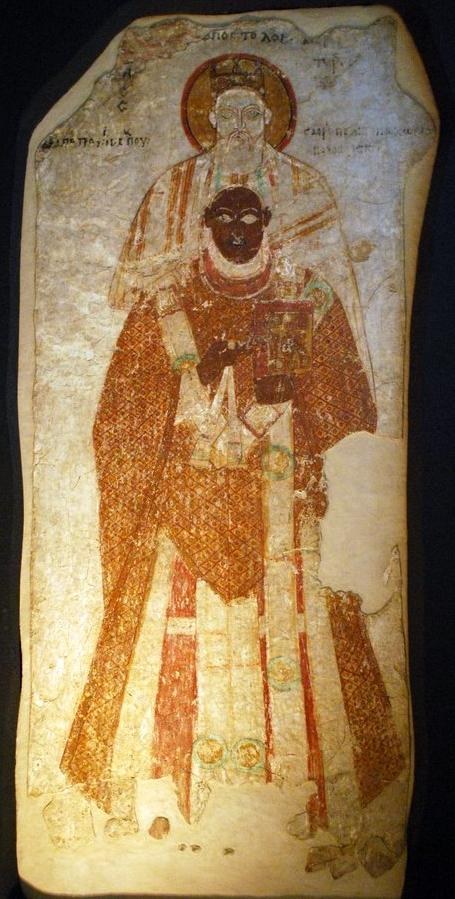
Bishop Petros with Saint Peter, Faras Cathedral, late tenth century · National Museum in Warsaw. Public-domain reproduction of a Nubian Christian painting.
04 / 24 · 6th–15th centuries
Christian kingdoms flourish along the Nile
Nobatia · Makuria · Alodia · present-day Sudan
South of Egypt, Christianity took root in the Nubian kingdoms of Nobatia, Makuria and Alodia. Sixth-century missions helped bring their royal courts into the Christian world, building on earlier contacts. Egyptian and Byzantine connections mattered, but Nubian Christians developed institutions and artistic traditions in their own settings.
Churches, inscriptions, wall paintings and texts in Old Nubian, Coptic and Greek make this history visible. Faras Cathedral’s portraits show named African bishops and rulers, not an imagined European substitute for them. The image of Bishop Petros is a surviving witness to that Christian society.
These kingdoms endured for centuries alongside Muslim Egypt. Their later changes were gradual and uneven, shaped by political conflict, migration and religious change. Christianity did not disappear everywhere in Africa when Islam spread: Egyptian and Ethiopian Christian communities continued, and Nubia followed its own long trajectory.
Bantu examines the accounts of sixth-century missionaries Julianus and Longinus, including the rivalry between missions associated with the emperor Justinian and the empress Theodora. John of Ephesus is an important witness, but also a partisan one. We should hear his account without treating it as a neutral transcript of every royal conversion.
The kingdoms’ political history is equally important. Nubian resistance to conquest and the subsequent baqt arrangement with Muslim Egypt demonstrate African Christian political independence. The arrangement involved goods and transfers of enslaved people as well as negotiations over coexistence. Christian history here includes diplomacy and morally troubling institutions, not only a romantic story of heroic resistance.
The paintings at Faras are especially valuable because they portray bishops, rulers, queen mothers and officials within the Christian symbolic world. They show the faces of the society whose church we are describing. Texts and inscriptions in Old Nubian, Coptic and Greek, including documents invoking Father, Son and Holy Spirit, also place Christian language within civic and everyday life.
Bantu discusses evidence that may point to wider African contacts, including a Dongola painting he interprets as possibly connected with peoples farther west. That interpretation is a hypothesis. It cannot carry the same weight as a named bishop’s inscription or a surviving cathedral. Keeping that distinction makes the argument for Africa’s Christian inheritance stronger, because the clearest evidence does not depend on its most speculative edges.
“Medieval Nubian culture was essentially Christian in nature.”
Chapter 0514th–15th centuriesMansa Musa · al-ʿUmari · Takrur
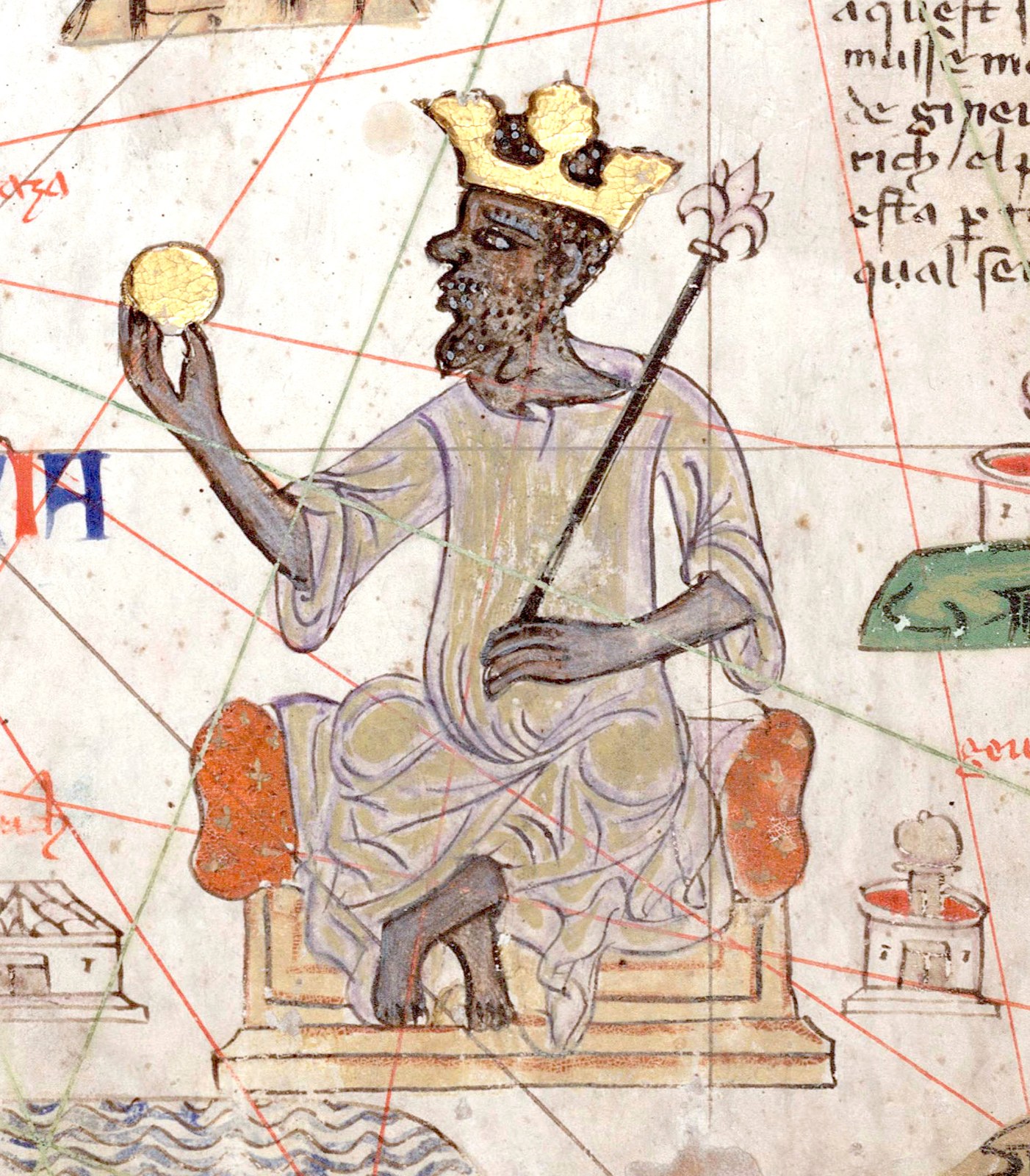
Mansa Musa in the Catalan Atlas, 1375 · Bibliothèque nationale de France. A European mapmaker’s depiction of Mali’s Muslim ruler, not a Christian king.
05 / 24 · 14th–15th centuries
West Africa: reports, encounters and evidence
Mansa Musa · al-ʿUmari · Takrur
The account recalled here is associated with the Egyptian writer al-ʿUmari and reports about Mansa Musa after his pilgrimage through Cairo in 1324. A passage describes gold-producing territory as belonging to the “Christians” of Takrur. It is a significant question for West African religious history, but it must be handled carefully.
The identification is disputed. Some readings understand the word as Christians; other historians or translators identify the people as non-Muslim adherents of local religions. Michael A. Gomez’s African Dominion discusses the passage, while Robyn d’Avignon’s A Ritual Geology presents the wording with a different gloss. The report alone cannot establish the size, location, institutions or continuity of a medieval West African church.
Mansa Musa was a Muslim ruler. He should not be made into a Christian witness merely because the report concerns his kingdom’s gold trade. Egypt, Aksum and Nubia already provide much firmer evidence against the claim that Christianity is inherently European; the West African question can remain open without weakening that case.
The historical books help us place the question without settling it artificially. Bantu considers a possible connection between Nubian Christian art and peoples farther west, but presents an interpretation rather than a demonstrated chain of church foundations. Neither that suggestion nor the Mali report should be used to announce a medieval Christian Malian empire.
Sundkler and Steed supply a later, distinct account from the Gambia. They recount Diogo Gomes’s report of a religious discussion in 1458 with the Mandingo chief Nomimansa and a Muslim cleric. The chief reportedly asked for Christian instruction and baptism, but Gomes lacked priestly authority and later sought the sending of a priest. This is evidence of a reported encounter; the passage does not establish that the proposed baptism occurred.
The historians also describe small Christian communities associated with Portuguese settlers and local families, served intermittently by clergy from Cape Verde and the coast. They subsequently experienced decline and movement elsewhere. These scattered contacts differ from the sustained nineteenth-century African-led churches considered later in the journey. West Africa deserves its own history rather than being made to fit either “no Christians until colonialism” or “a proven Christian empire before the Portuguese.”
Chapter 061491 onwardMbanza Kongo · Central Africa
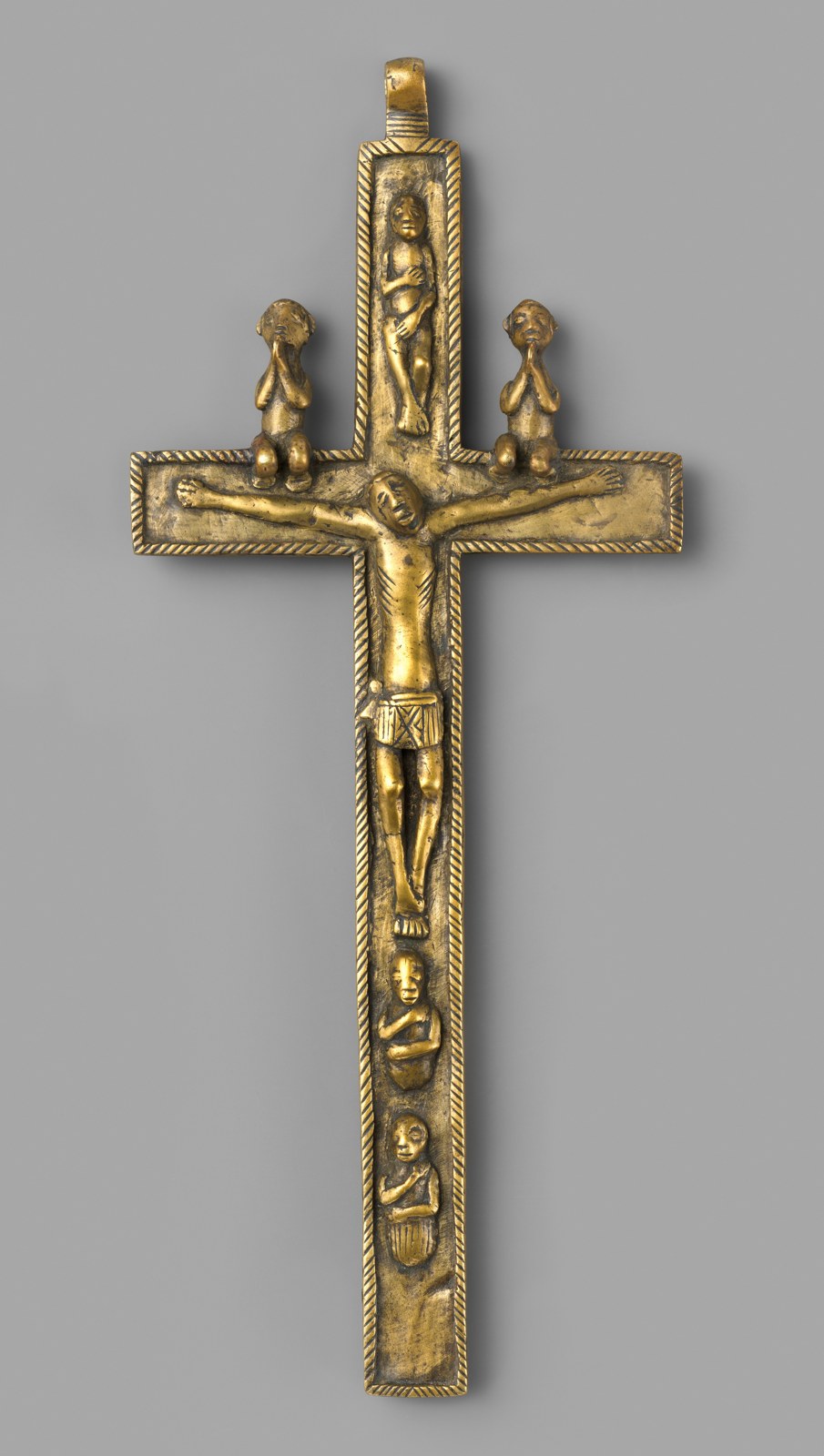
Crucifix by a Kongo artist, seventeenth–eighteenth century · The Metropolitan Museum of Art, 1999.295.5. Public domain; a later object showing Kongo Christian art.
06 / 24 · 1491 onward
Kongo’s rulers and people make Christianity their own
Mbanza Kongo · Central Africa
Portuguese contact opened a new chapter in Central African Christian history. In 1491, the ruler Nzinga a Nkuwu was baptised João I. Under his son Afonso I, Christian schooling, diplomacy and church life developed further. Kongo was an African kingdom, not simply a Portuguese colony, and its rulers actively shaped their relationship with European clergy.
Kongolese teachers, interpreters, nobles and artists helped sustain Christian life. Henrique, Afonso’s son, was consecrated a bishop in 1518. The surviving crucifix shown here combines Christian imagery with Kongo artistic choices: evidence of local work, rather than Africans merely receiving imported objects.
This encounter also became entangled with Atlantic slavery and Portuguese commercial ambitions. Afonso protested abuses in the slave trade. We must hold African initiative, genuine Christian institutions and exploitation together, rather than telling a story in which every missionary was identical or every conversion was either coerced or culturally uncomplicated.
Sundkler and Steed show that translation and African initiative were present from the beginning. Kongolese who had spent time in Portugal and learned Portuguese helped mediate the encounter. The ruler of Soyo was baptised before the royal baptism at Mbanza Kongo. Christian instruction therefore involved African participants and local political relationships, not simply a European priest addressing an undifferentiated population.
Afonso’s commitment developed during years in Sundi before he ruled the kingdom. The historians describe him explaining Christian teaching himself, promoting a school for boys and a school for girls led by his sister, and corresponding with overseas rulers. Education and royal preaching were instruments of an African-directed Christian project. Court conversion, however, did not mean that every subject shared the same understanding or conviction.
Henrique’s ecclesiastical career also needs precision. The Kongolese prince studied in Lisbon and became a bishop with a titular North African see. That makes him an important early-sixteenth-century African church leader; it does not make him Africa’s first bishop. Egypt, Nubia and Ethiopia had older episcopal histories. Portuguese patronage and overseas appointments also restricted how much authority a local church could exercise.
Afonso’s increasingly bitter protests against slave trading expose a contradiction within the relationship. People who spoke of Christian brotherhood could simultaneously participate in destructive commerce. The Portuguese royal patronage system, the padroado, tied church affairs to crown power; external ecclesiastical supervision did not simply disappear because an African king was Christian. Yet later visitors still found local catechists preparing communities for Christian instruction. The church’s persistence cannot be measured only by the presence or absence of Europeans.
“Mvemba Nzinga's realm was an independent African kingdom”
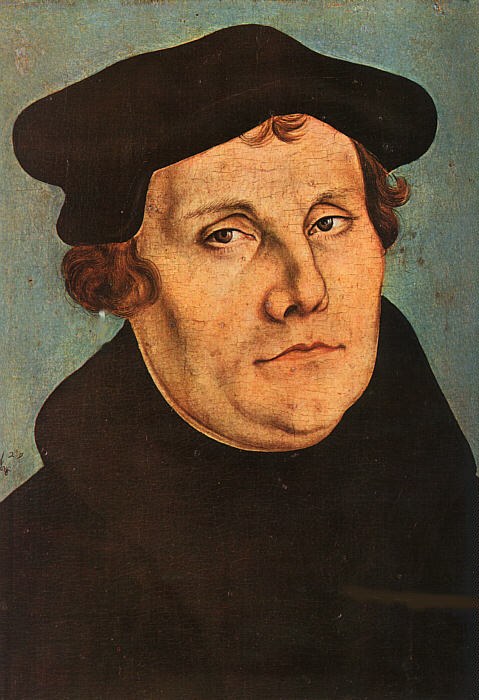
Martin Luther in a historical portrait by Lucas Cranach. No verified contemporary portrait of Abba Mikaʾel is used here.
07 / 24 · 1534
An Ethiopian deacon meets a German reformer
Abba Mikaʾel · Wittenberg
In 1534, the Ethiopian Orthodox deacon Abba Mikaʾel, also called Michael the Deacon, visited Wittenberg and discussed Christian faith and worship with Martin Luther. The Ethiopian visitor went to Luther; Luther did not travel to Ethiopia for this meeting.
Luther welcomed Mikaʾel and found important points of agreement with the Ethiopian church’s practice. His letter of 4 July 1534 commended the visitor to other Christians. David Daniels has drawn attention to this encounter as a neglected connection between African Christianity and the Reformation.
The meeting took place seventeen years after 1517. It does not establish that Mikaʾel caused the Reformation or that Ethiopian Orthodoxy became Lutheran. Its significance is that a European reformer recognised and conversed with a much older African Christian tradition. The other Reformation traditions brought to South Africa also carried their own histories of Scripture, justification, sacraments and church government.
The African background makes the Wittenberg encounter easier to understand. Mikaʾel did not arrive as the representative of a new European mission. He belonged to a church whose Scripture, bishops, worship and theological disputes had developed through centuries of relationships with Egypt and the Christian East. The German reformer was meeting a Christian tradition that was neither Roman Catholic in the Latin sense nor Protestant in the new European sense.
Bantu also discusses the Stephanites, an Ethiopian movement that resisted aspects of imperial religious policy before Luther’s era. His comparison with a Reformation is suggestive, but remains an analogy: resisting rulers or religious abuses does not establish agreement with all the later Protestant confessions. African Christian history had its own reforming arguments, not merely delayed copies of European events.
These historical works deepen that Ethiopian background but do not narrate the Mikaʾel–Luther meeting itself. The documented 1534 encounter therefore retains its separately identified historical source. That is a useful discipline throughout this guide: a respected book must support the particular claim for which it is cited. The Reformation’s later arrival in southern Africa introduced particular confessions and institutions into an African continent where Christianity already possessed older homes.
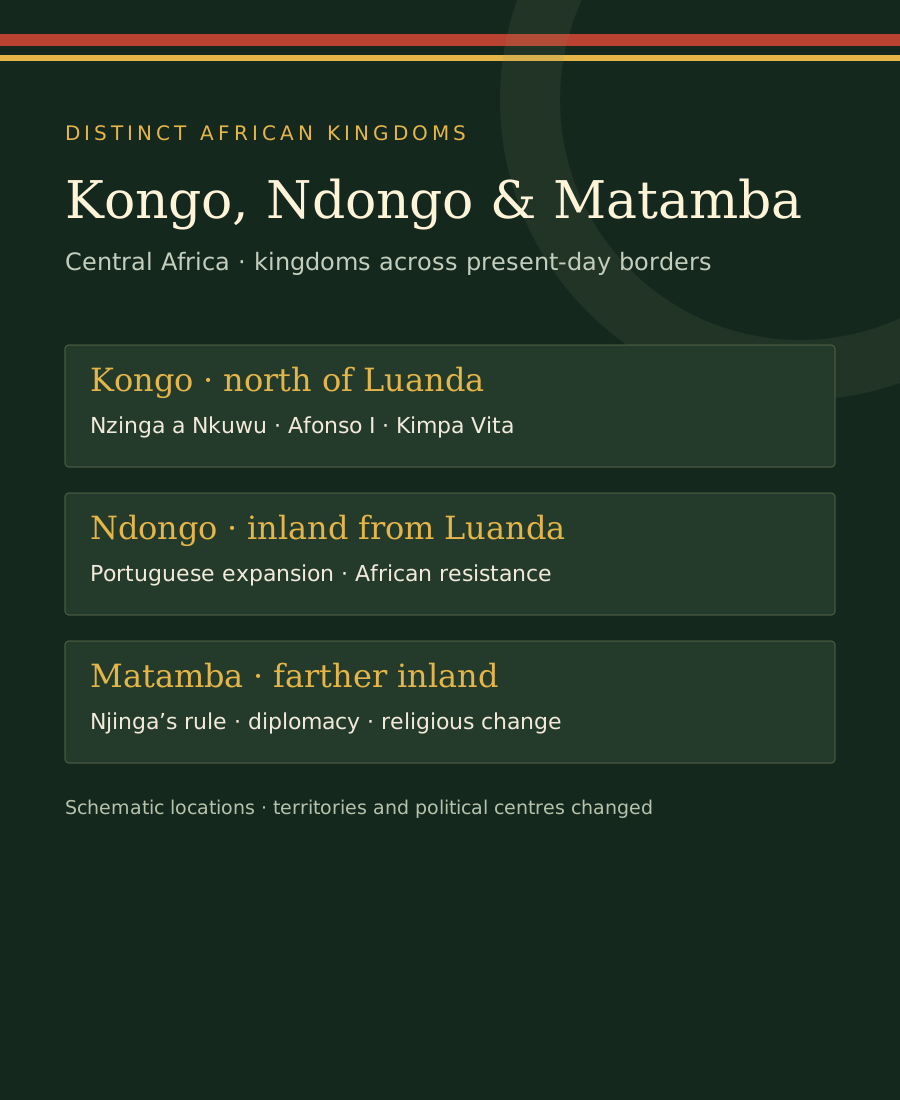
Bisrat historical location diagram. Kongo and Ndongo were distinct kingdoms; their territories changed over time. This is not a boundary map.
08 / 24 · 1575–1706
African power, Portuguese missions and contested faith
Ndongo · Matamba · Kongo
Kongo must be distinguished from Ndongo, farther south in the region of present-day Angola. Portuguese expansion from Luanda in 1575 joined missionary activity to military and slave-trading projects. Njinga, a ruler of Ndongo and Matamba, accepted baptism as Ana de Sousa in 1622, while negotiating with the Portuguese. Her later relationship with Catholic Christianity developed through conflict, diplomacy and a peace settlement in 1656.
Back in Kongo, Dona Beatriz Kimpa Vita emerged during civil war. In 1704 she led the Antonian movement, seeking restoration of the kingdom and rejecting missionary domination. She claimed to embody Saint Anthony and relocated the biblical story to Kongo, teaching that Jesus and other biblical figures were Kongolese. These claims departed from the historical and doctrinal account of Christianity.
Kimpa Vita was executed in 1706. Her story belongs in African church history as a contested reinterpretation of Christian symbols amid political crisis. Recording African agency does not require endorsing every teaching. Nor should her movement be confused with Kongo’s earlier royal conversion or treated as representative of all African Christianity.
Sundkler and Steed locate Njinga’s changing alliances within the pressures of war and enslavement. She negotiated with Portuguese authorities, moved her centre of power, aligned with the Dutch after their capture of Luanda in 1641, and later negotiated again following the Portuguese return. Baptism, political strategy and religious commitment intersected; the evidence should not be reduced either to pure private piety or to an assumption that every profession of faith was insincere.
Missions and colleges at Luanda were part of this colonial setting. The training of clergy and Christian instruction could exist beside military domination and slave trading. African resistance to Portuguese power does not automatically mean opposition to every form of enslavement, just as a missionary’s stated Christian purpose does not remove the political conditions in which the mission operated.
Kimpa Vita’s movement arose in a Kongo kingdom fractured by civil war and disputes over the old capital. Its call for restoration belonged to that local crisis. Sundkler and Steed describe her identifying herself with Saint Anthony, challenging royal and missionary decisions, and rejecting sacred objects, including crucifixes. Her programme cannot be understood simply as adding African decoration to an otherwise unchanged Catholic faith.
The historians also emphasise her sense of responsibility for a church she regarded as her own. That matters historically even where her claims depart from orthodox Christian teaching. Her execution followed condemnation by a royal council, with missionaries supporting it; it should not be described as an exclusively Portuguese state action. Her followers continued after her death. The episode reveals a struggle over who could interpret the faith and restore a Christian kingdom, rather than an uncomplicated story of missionaries on one side and non-Christian Africans on the other.
“She insisted that it was her Church, too, and that she had a responsibility for it.”
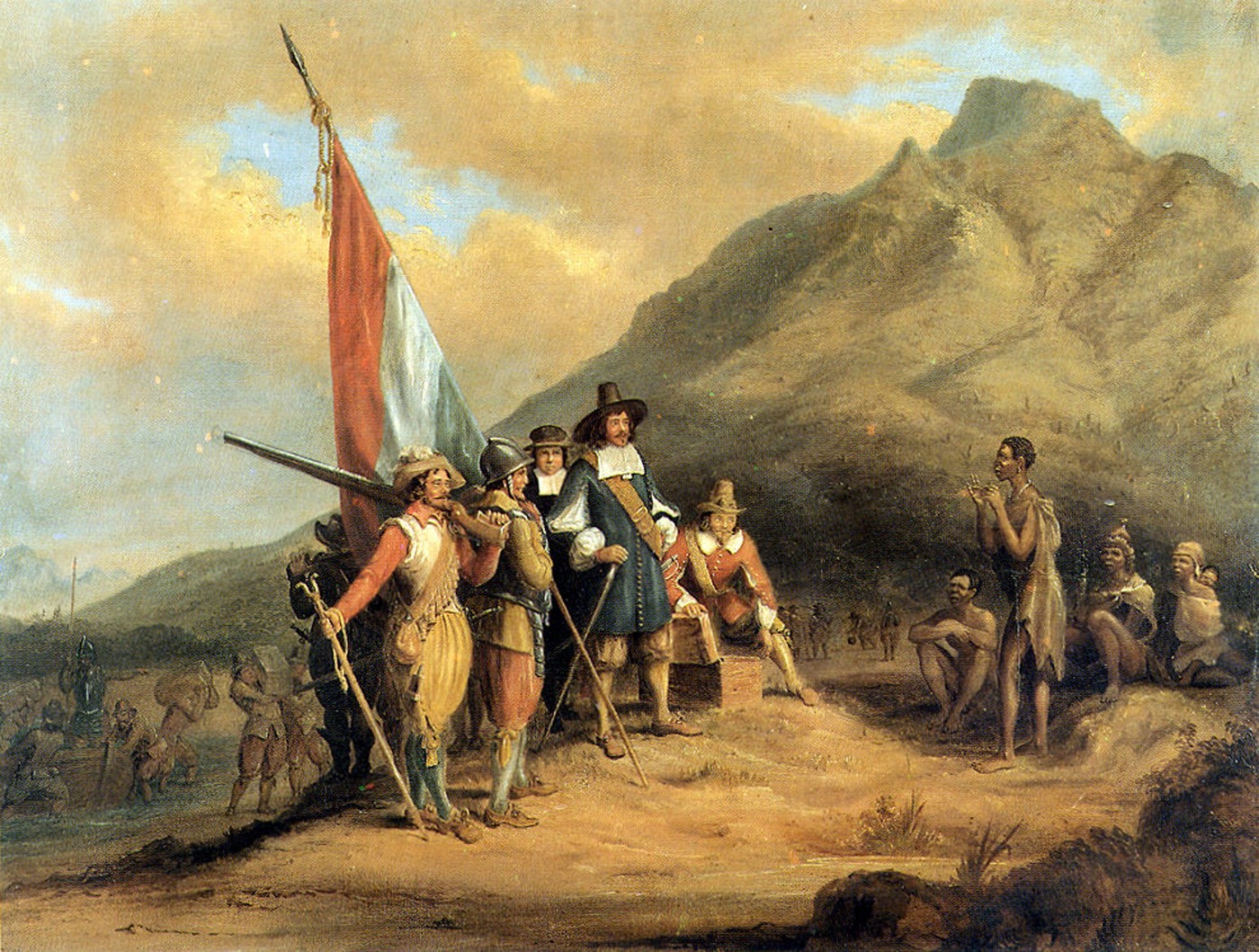
Charles Bell’s nineteenth-century painting of Van Riebeeck’s arrival in 1652. A retrospective colonial representation, not an eyewitness image.
09 / 24 · 1652
A colonial settlement brings a Reformed church
Cape of Good Hope
The Dutch East India Company’s settlement at the Cape in 1652 established a lasting European colonial presence, with Dutch Reformed worship becoming part of colonial life. The church’s institutions developed within a society structured by company power, slavery and unequal status.
This is an important beginning for South Africa’s institutional Reformed history, but not the beginning of Christianity on the African continent. Later Reformed churches would inherit both a rich confessional tradition and difficult questions about the relationship between church, state and racial power.
Early converts also belong in this story. Krotoa, a Khoikhoi interpreter in the settlement, was baptised as Eva in 1662. Her experience sits at the intersection of Christian baptism, colonial dependence and unequal power. A baptismal record cannot tell us everything about personal conviction, nor should the settlers’ arrival be mistaken for the whole story of indigenous Christian life.
Sundkler and Steed place the Cape’s later missions within the expansion of European settlement and the unequal distribution of power. The church’s position in a company colony differed from Christianity’s history in independent African kingdoms. That comparison prevents a single arrival story from swallowing the continent: the Cape is one regional encounter, not Africa’s first Christian chapter.
The relationship between worship and colonial institutions also matters. Membership, baptism, education and recognised marriage could have social consequences in a society that distinguished settlers, enslaved people and indigenous communities. Such conditions complicate any claim that every recorded baptism was freely chosen on equal terms, while also warning against assuming that no convert could hold a genuine Christian conviction.
Later Protestant missions would sometimes challenge colonial abuse and sometimes reproduce paternalism. Those tensions did not begin only with twentieth-century apartheid. Reading the Cape beside Genadendal allows us to distinguish the establishment of a settler church from the growth of indigenous communities that read Scripture, gathered for worship and preserved Christian life beyond the missionary’s immediate supervision.
Chapter 101737–1800sGenadendal · Eastern Cape · Southern Africa
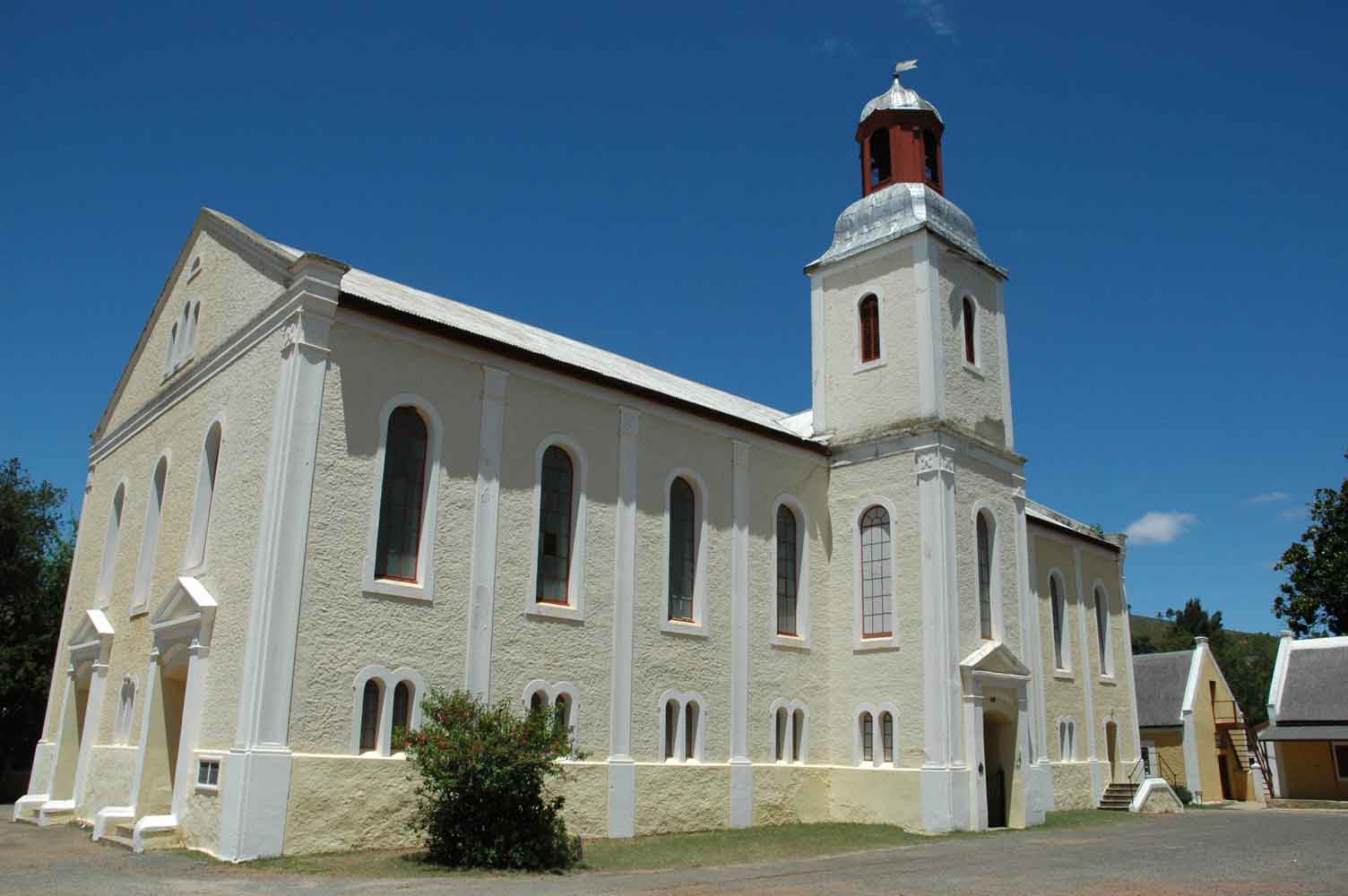
The Moravian church at Genadendal, photographed in 2005 · Jochenernst, CC BY-SA 3.0. The mission community began long before this building.
10 / 24 · 1737–1800s
The first converts become keepers of the faith
Genadendal · Eastern Cape · Southern Africa
Georg Schmidt arrived in 1737 and moved his mission to Baviaanskloof, now Genadendal, in 1738. Among his early converts baptised in 1742 were Africo (Christian), Wilhelm (Josua), Kyboddo (Jonas), Vehettge (Magdalena) and Christina. These names matter: the mission’s history belongs to the people who became Christians as well as to the missionary.
Vehettge, remembered as Mother Lena, learned to read and kept the New Testament Schmidt gave her. When Moravian missionaries returned in 1792, they encountered her and the Christian witness she had helped preserve. She was an active bearer of the faith, not merely a name on a missionary’s baptismal list.
Across the following century, missions established schools, printed books and translated Scripture. African teachers, interpreters and evangelists carried the message into local communities. Missionary paternalism and colonial entanglement also shaped the encounter. The history contains both service and unequal power; neither should erase African Christian agency.
The most important expansion is what happened while Schmidt was absent. Sundkler and Steed describe believers continuing to meet, reading the New Testament he had left and passing the faith to children. When the Moravian missionaries returned, Lena’s failing eyesight did not end that memory: a younger woman could read the treasured book. The community’s continuity depended on more than the return of European personnel.
This history changes the cast of the story. Converts were not merely the results of a missionary’s work; they became the people who sustained a congregation. Agricultural work, literacy, household teaching and collective prayer belonged to the same local life. The missionaries’ reports remain useful, but they must not eclipse the voices and responsibilities of those who stayed.
The later southern African mission network grew through teachers and catechists, travelling workers and local families. Sundkler and Steed challenge accounts that count Europeans as the evangelists while making African Christians disappear into statistics of “converts.” Their argument is not that foreign missionaries contributed nothing. It is that the spread of the faith cannot be explained adequately without the Africans who carried it to other Africans.
“The faith was transferred to the next generation”
Chapter 111787–1864 onwardSierra Leone · Yoruba towns · the Niger
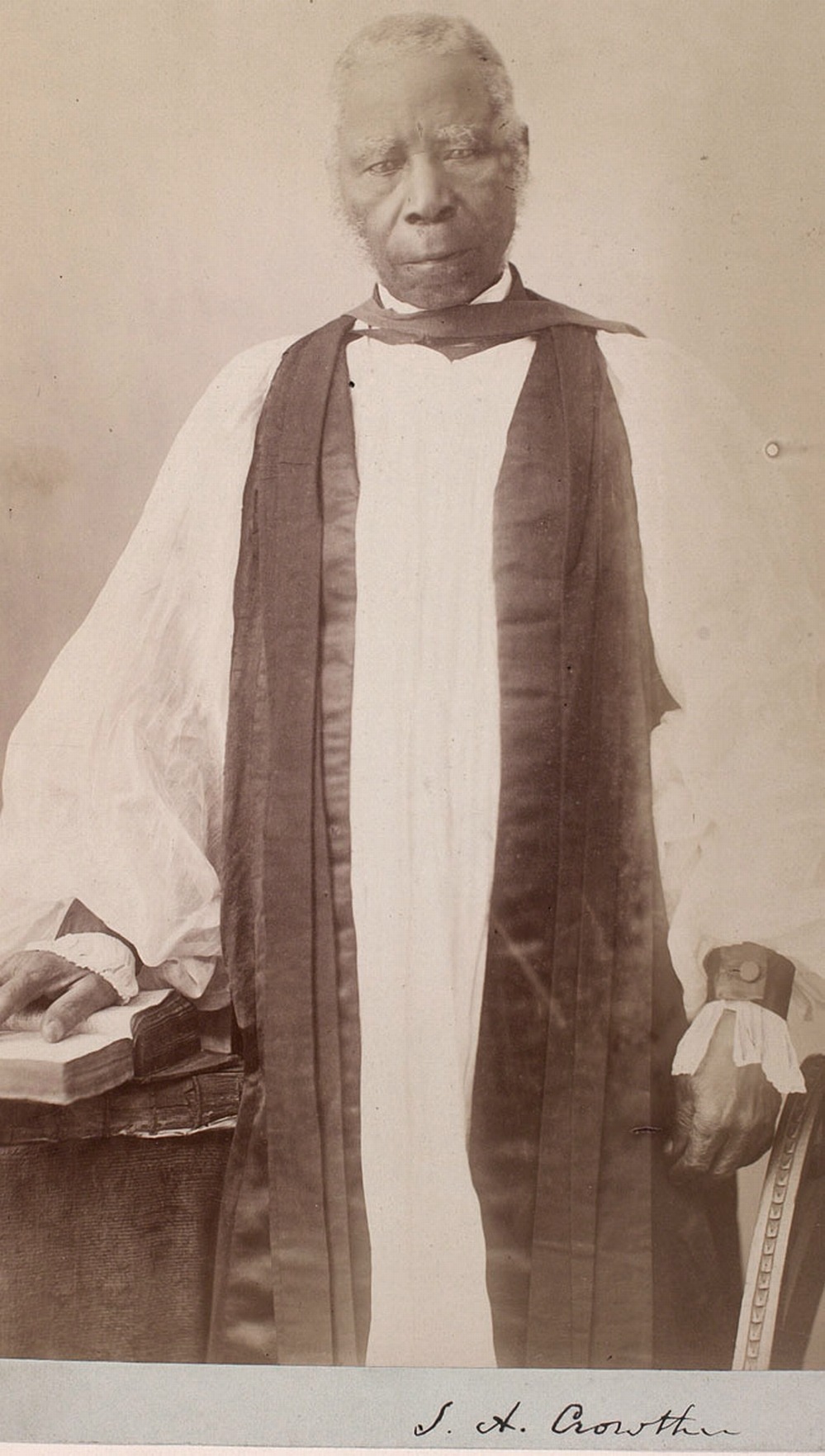
Samuel Ajayi Crowther, nineteenth-century Anglican bishop and translator · historical portrait, public-domain reproduction. His episcopal consecration took place in 1864.
11 / 24 · 1787–1864 onward
Traders, teachers and an African bishop carry the faith
Sierra Leone · Yoruba towns · the Niger
Sundkler and Steed’s West African account gives us a sustained history beyond the disputed medieval report. Sierra Leone became a meeting point for settlers, liberated Africans, churches, schooling and trade. These communities were not socially uniform: distinctions between settler groups and newly liberated Africans could appear even in church leadership and worship.
Returning Africans carried Christian teaching along the coast and into Yoruba towns. The historians describe trading networks and journeys through Badagry to Abeokuta, sometimes before an official mission was established. Thomas Birch Freeman and William De Graft are part of this African missionary story. Local rulers’ welcome could involve political hopes as well as religious interest; admission of a preacher did not automatically mean acceptance of everything he taught.
Women deserve a place in this account. Krio traders used commercial journeys and associations to spread Christian practice. The historians describe Mami Kakabra, known as Mami Pray, leading devotion among Freetown’s market women. Such activity sat outside the familiar hierarchy of paid catechists and ordained pastors. It shows faith travelling through everyday work and relationships, rather than only through formal mission programmes.
Samuel Ajayi Crowther had been captured and enslaved, then liberated and brought to Sierra Leone. His education, ordination and return to Yoruba ministry made language and local knowledge central to his work. He was consecrated an Anglican bishop in 1864. His career connects African Christian scholarship and translation with an African-led mission; it does not begin African episcopal history, which was already ancient elsewhere.
The later undermining of Crowther’s authority reveals the fragility of missionary promises about African self-government. Sundkler and Steed discuss racial attitudes, changing mission policy and disputes over staff and oversight. Their account contains competing explanations, but the African church’s dependence on overseas decisions is unmistakable. Recovering Crowther means remembering both his achievement and the struggle over whether African Christians would be trusted to govern their own institutions.
Chapter 12c. 1815–1821Tyhume · amaXhosa Christian communities
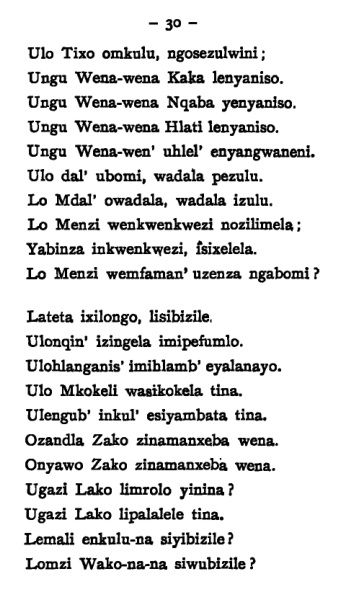
Ntsikana’s Great Hymn in John Knox Bokwe’s digitised booklet, p. 30 · University of Pretoria Library Services scan. Historical spelling retained; image cropped for legibility.
12 / 24 · c. 1815–1821
The faith is sung in isiXhosa
Tyhume · amaXhosa Christian communities
Before Tiyo Soga’s ordination, Ntsikana became an important early amaXhosa Christian teacher and hymn writer. His Christian witness developed around 1815, in a region where Johannes van der Kemp and Joseph Williams had also preached. Accounts of his conversion include remembered spiritual experiences; those accounts should be identified as traditions rather than treated as independently verified events.
Ntsikana gathered followers and expressed Christian worship in isiXhosa. His Great Hymn shows that African language and musical expression were already part of the reception of the faith. His followers helped carry Christian teaching beyond his lifetime after his death in 1821.
The story of Christian mission therefore includes African teachers and communities as well as European missionaries. Ntsikana’s legacy helps us understand the setting in which the Soga family and later isiXhosa Christian writers emerged.
John Knox Bokwe gives us an African Christian author’s account of Ntsikana, rather than only a later missionary summary. His booklet is retrospective community testimony, shaped by Christian devotion and the expectations of its readers. It should not be treated as a stenographic record of visions or deathbed speeches. Its value lies in preserving a remembered community, its teaching and its music.
Bokwe records Ntsikana urging his family to remain together through hardship and to continue in the Christian faith. His account describes Ntsikana’s own converts taking responsibility for his funeral. The emphasis moves from an isolated visionary to a community learning how to endure after its teacher’s death. Sundkler and Steed likewise underline Ntsikana’s initiative and creativity.
The hymn’s theology deserves attention alongside its African musical form. In Bokwe’s English translation, wounded hands and feet lead to the confession that Christ’s blood was shed for the singers. This is an isiXhosa Christian expression of creation, divine protection and redemption, not simply a generic celebration of ancestral spirituality. Its local form does not erase its specifically Christian content.
Bokwe explains that Ntsikana composed both words and music and that the song was transmitted before being written in musical notation. The image here now shows the isiXhosa hymn as printed in the digitised booklet. It is a historical witness to the hymn’s transmission, not a photograph of Ntsikana or an original manuscript written by his hand.
Chapter 131823–1841John Bennie · John Ross · Lovedale
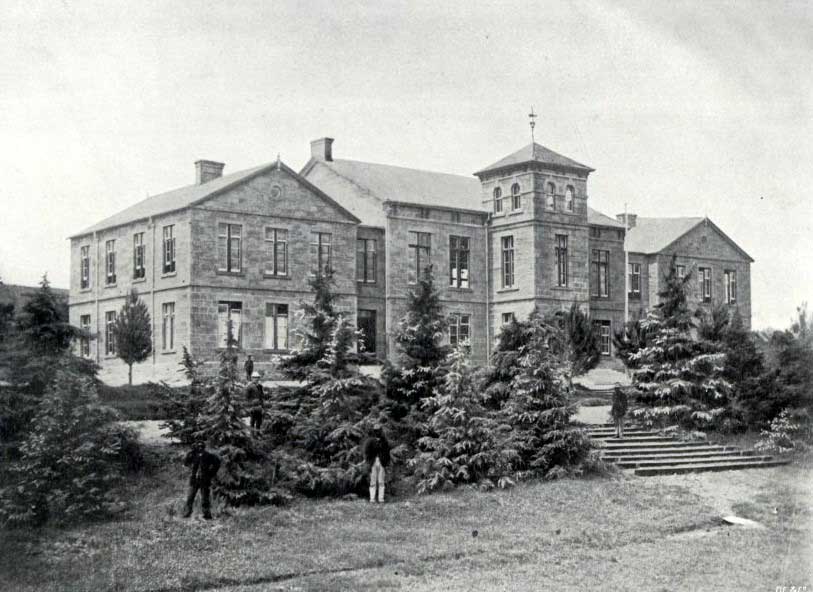
Lovedale Missionary Institution · photograph reproduced by South African History Online from The Southern Cross. The mission began in 1824; the institution opened in 1841.
13 / 24 · 1823–1841
Scripture, schools and an African reading public
John Bennie · John Ross · Lovedale
John Bennie and John Ross of the Glasgow Missionary Society were central to early isiXhosa printing and the establishment of Lovedale. Ross brought a printing press in 1823; the mission began in 1824, and Lovedale Missionary Institution opened in 1841. Distinguishing these dates avoids making the press, mission station and college appear to be the same founding event.
Translation depended on African speakers, interpreters, teachers and readers as well as European linguists. Printed Scripture, hymns and educational materials helped create an isiXhosa reading public. African writers subsequently used mission education and printing for their own religious, literary and public arguments.
Lovedale formed ministers, teachers and other leaders, while carrying the paternalism and cultural assumptions of its missionary setting. Tiyo Soga and later figures such as John Knox Bokwe belong in this larger story of African Christian authorship. The educational network also helped prepare the ground for Fort Hare.
Sundkler and Steed identify William Govan’s aspiration for shared education: African and European pupils should study together and dine in the same hall. They describe the first class in 1841 as eleven Africans and nine Europeans. This did not eliminate racial hierarchy, and later restrictions changed the arrangements, but it establishes that the institution’s history cannot be reduced to a school that always operated in exactly one way.
African communities also paid for educational institutions. The historians record Mfengu fundraising for Blythswood, which opened in 1877. Such contributions correct the image of education as only a gift from missionaries to passive recipients. Communities could identify what they wanted, organise resources and help shape the institutional future of their children.
The transcription of Isigidimi SamaXosa, dated 1 March 1888, provides another kind of witness. Page 22 carries a cattle-killing narrative attributed to “W. W. G.”; page 23 includes a dialogue about Christian and customary life. These texts show African-language print carrying recollection and argument, rather than Africans remaining silent while Europeans described them. The source edition is a transcription, not a newspaper facsimile, and the historical isiXhosa is not silently recast here as an unverified English translation.
“Blacks and Whites should meet in the same classes and dine in the same hall.”
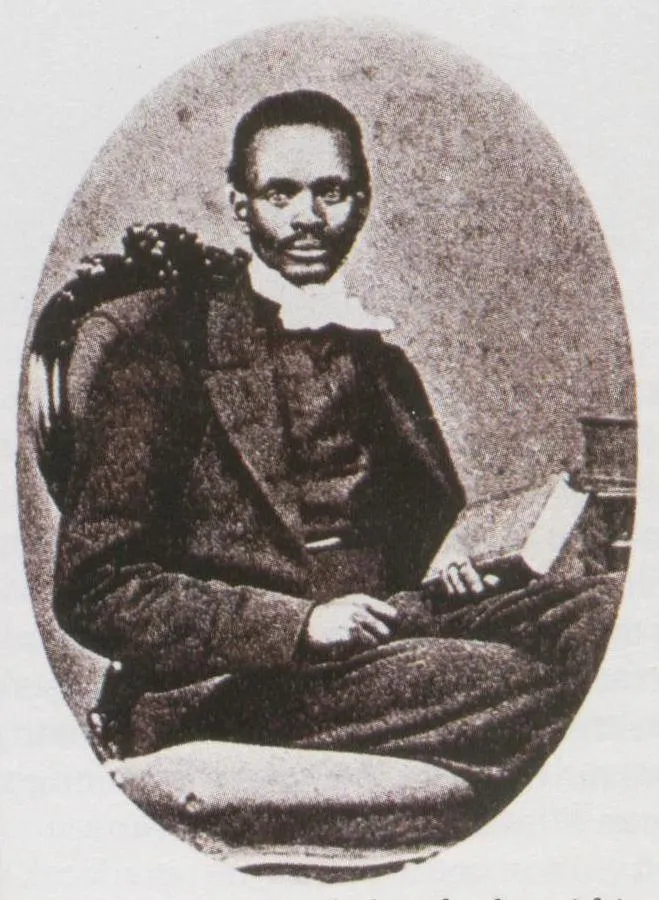
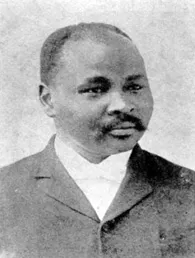
Tiyo Soga (1829–1871), minister, writer and translator · South African History Online.
14 / 24 · 1857
African Christians become authors of the story
Tiyo Soga · isiXhosa Christian life
Tiyo Soga was ordained in Scotland in 1857 and returned to minister among his own people. His contribution to isiXhosa translation and literature makes him a vital figure in the history of African Christian thought.
His life helps correct a misleading picture in which Africans merely received a finished European religion. African Christians preached, wrote, translated and reasoned about the faith in their own languages. Language was not simply a tool for importing ideas: it became a setting in which people understood Scripture and expressed Christian conviction.
Sundkler and Steed place Soga’s ministry amid frontier conflict, the cattle-killing catastrophe and the difficult rebuilding of local communities. He belongs in the story as a pastor addressing people’s spiritual and material distress, not only as a milestone in a list of firsts. His work on revising the isiXhosa New Testament connected theological training with the language in which congregations actually heard Scripture.
His journal, as quoted by the historians through an earlier biography, also records prayer and struggle over the work of preaching. The account allows us to see an African minister as a theological and devotional person, rather than merely a symbol in debates about race. It also exposes the assumptions of hearers who found it difficult to believe that an African could prepare and deliver an accomplished sermon.
The word “first” needs qualification. He is commonly identified as a pioneering ordained African Presbyterian minister in South Africa; he should not be described as the first African Christian minister or the first African church leader. Egypt, Ethiopia, Nubia and Kongo had their own much older clergy. Keeping those histories visible prevents a nineteenth-century South African achievement from becoming another accidental erasure of earlier African Christianity.
Translation, writing and pastoral ministry also required more than adopting a European accent or abandoning African identity. Soga’s work belongs to the development of African Christian authorship within a historic denomination. The same history later includes writers and musicians such as Bokwe, whose work preserved and extended an isiXhosa Christian intellectual and musical inheritance.
“O God, by Thy Spirit move me, and Thou shall have the entire glory.”
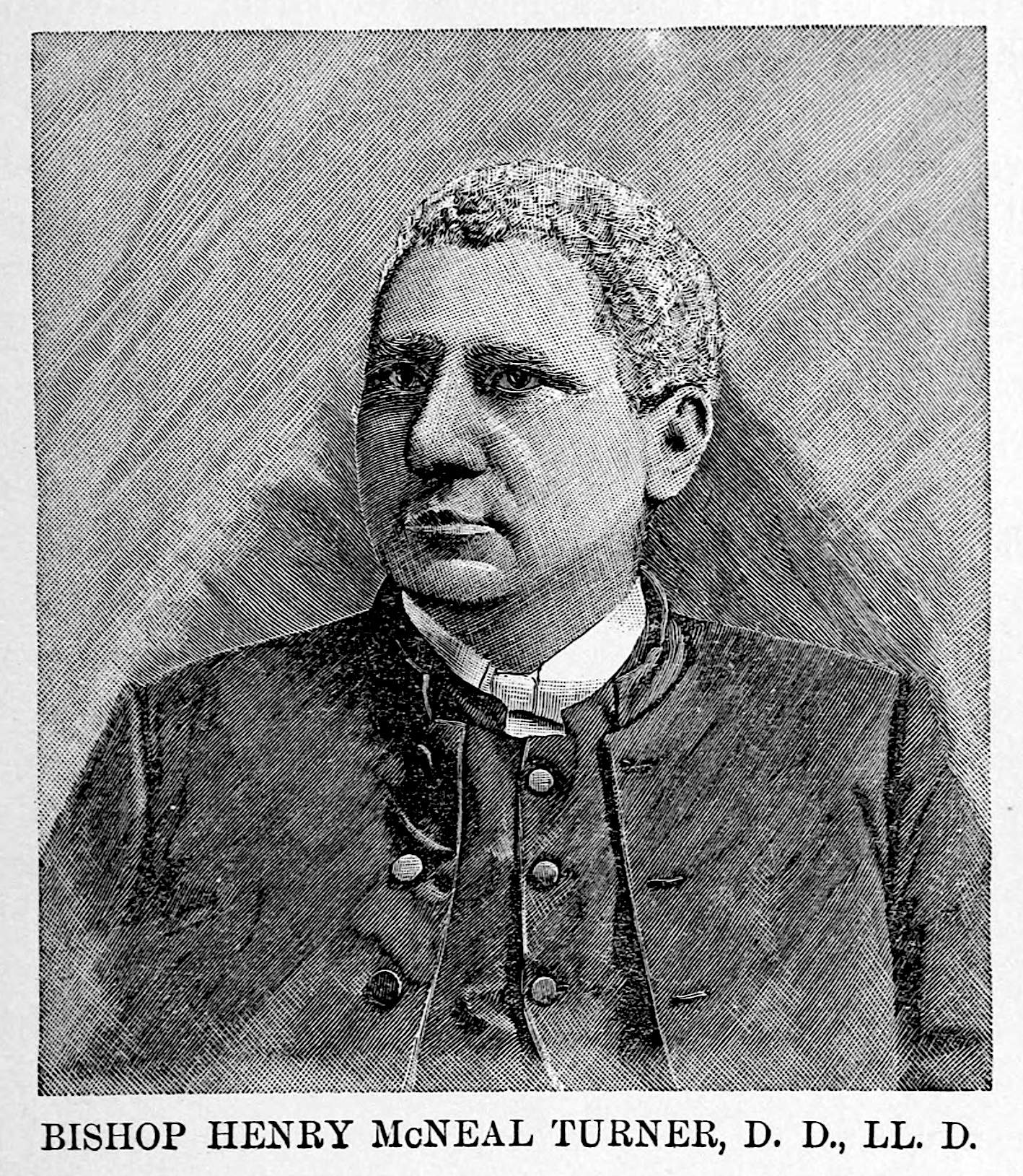
Bishop Henry McNeal Turner, in an 1891 published illustration. Mokone corresponded with Turner as the Ethiopian movement developed its African Methodist Episcopal connections.
15 / 24 · 1892
Whose church—and whose authority?
Mangena Mokone · Ethiopian movement
Mangena Mokone founded the Ethiopian Church in 1892. African religious self-government and resistance to racial discrimination helped drive the Ethiopian movement. Connections with the African Methodist Episcopal Church also linked South African Christians with black Christians abroad.
“Ethiopian” here names a southern African movement drawing on biblical African identity, not simply membership of Ethiopia’s ancient Orthodox Church. Nor does African independence automatically mean a departure from historic Christian doctrine. Some churches sought African leadership while retaining much of their inherited teaching and worship.
Sundkler and Steed describe concrete grievances behind the demand for self-government: unequal wages and housing, disrespect and a social distance between missionaries and their congregations. These conditions make the movement more intelligible than a vague statement that Africans wanted a different style of worship. Ecclesiastical authority and the everyday treatment of ministers were part of the dispute.
The roots and branches were varied. Nehemiah Tile’s Thembu Church preceded Mokone’s organisation. James Dwane later joined the Ethiopian movement, pursued African Methodist Episcopal connections and helped develop the Order of Ethiopia within an Anglican relationship. These changing affiliations show that independence, international black solidarity and participation in a historic denomination could intersect in more than one arrangement.
The movement drew on Psalm 68:31 and the biblical name Ethiopia. Its claim was African church leadership, not a demonstrated institutional succession from the bishops of Aksum. Likewise, opposition to racial domination did not automatically establish a single theological position. Some communities retained inherited Christian confessions and practices; others developed different claims about leadership, prophecy or sacred authority. History explains the grievance, while theological assessment still asks what each church taught.
“It meant the self-government of the African Church under African leaders.”
Chapter 161901–1912John Dube · Ohlange · African political organisation
John Langalibalele Dube, Congregational minister, educator and the first president of the South African Native National Congress · SA History Online.
16 / 24 · 1901–1912
The pulpit, the classroom and the political meeting
John Dube · Ohlange · African political organisation
John Dube brings the connections into focus. A Congregational minister and educator, he helped establish Ohlange and became the first president of the South African Native National Congress in 1912, the organisation later known as the ANC. His public leadership grew in a world of mission education, Christian communities, African initiative and resistance to racial exclusion.
Christian schooling and print helped develop literacy, public argument and networks of association. Ministers and mission-educated Africans used these tools to challenge restrictions on land, representation and opportunity. Some also criticised the paternalism of the missionaries who had educated them.
This is a history of Christians influencing politics, not a claim that the gospel is a political programme. Churches and believers could support, resist or negotiate political power. Their actions must be distinguished from the gospel they professed, and evaluated rather than automatically endorsed.
The family history behind Dube strengthens the point. Sundkler and Steed trace Christian continuity through Dalida Dube, her preacher son James and her grandson John. Public leadership emerged from communities and households as well as mission institutions. The political figure did not simply step into history disconnected from earlier African Christian life.
International participation nevertheless remained unequal. The historians describe Dube and Z. R. Mahabane among the small number of black participants at the 1926 Le Zoute missionary conference. African church leaders could speak internationally while still being underrepresented in meetings that discussed the future of Christianity in Africa. Education and travel opened doors without removing racial hierarchies.
Churches influenced public life through the people they taught, the associations they formed and the arguments their members made. Such influence is a historical fact about Christian actors. It does not mean that every political strategy followed from the gospel, that every minister held the same position, or that Christian salvation should be defined as participation in a national political programme.
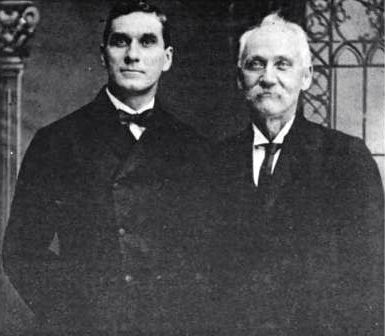
John G. Lake and Thomas Hezmalhalch, associated with the beginnings of the Apostolic Faith Mission, around 1908 · Wikimedia Commons.
17 / 24 · 1908 onward
First wave: classical Pentecostal churches
Johannesburg · KwaZulu-Natal · Limpopo
Healing, holiness and revival movements helped reshape the religious landscape. The Apostolic Faith Mission began in 1908. African Zionist churches developed through connections, adaptations and divisions in this wider world. Isaiah Shembe’s amaNazaretha and Engenas Lekganyane’s ZCC became influential African-initiated communities in the early twentieth century.
Shared language about the Spirit, healing or “Zion” does not mean identical beliefs. Classical Pentecostal denominations and African Zionist churches have historical points of contact but distinct developments. Likewise, “apostolic” can describe different claims about spiritual gifts, church origins or living apostles. Each church’s actual teaching needs to be heard.
In this guide’s four-part framework, classical Pentecostalism is the first wave: denominations such as the AFM, Assemblies of God and Full Gospel Church emphasised conversion, holiness, Spirit baptism and spiritual gifts. African evangelists and congregations helped spread the movement. The nearby Zionist and Apostolic developments have related but distinct histories; they should not all be relabelled classical Pentecostal.
The international setting includes the Azusa Street revival associated with the African American preacher William J. Seymour. The formal 1908 AFM origin is retained from its institutional history. Sundkler and Steed’s later narrative contains inconsistent AFM founding dates, so those dates are not copied simply because they appear in a respected history. African and African American participation must remain visible alongside Lake and Hezmalhalch.
Sundkler’s Bantu Prophets supplies a more detailed genealogy of an important Zionist stream. John Alexander Dowie’s movement emphasised healing and baptism by immersion before Pentecostal missionaries brought an additional emphasis on Spirit baptism. African leaders including Paulo Mabilitsa, Daniel Nkonyane and Elias Mahlangu helped form their own congregations and institutions. A foreign connection did not settle what the resulting African churches would become.
Shembe’s Baptist connections, hymn composition and disciplined Nazaretha worship belong to a particular development. Lekganyane’s ZCC developed its own pilgrimage centre and organisation. Calling both “African-initiated” provides a broad historical category, not proof that they shared identical doctrines. Sundkler’s mid-century observations also cannot be converted into current membership figures or verdicts on every present branch.
Nicholas Bhengu supplies another essential African Pentecostal story. Sundkler and Steed describe his Back to God Crusade, founded in 1950, its East London headquarters and wider regional work. They also describe J. F. Rowlands’s Bethesda ministry among Indian South Africans. These examples shift attention from white founders alone to African and Indian preachers, workers and congregations shaping the movement’s reach.
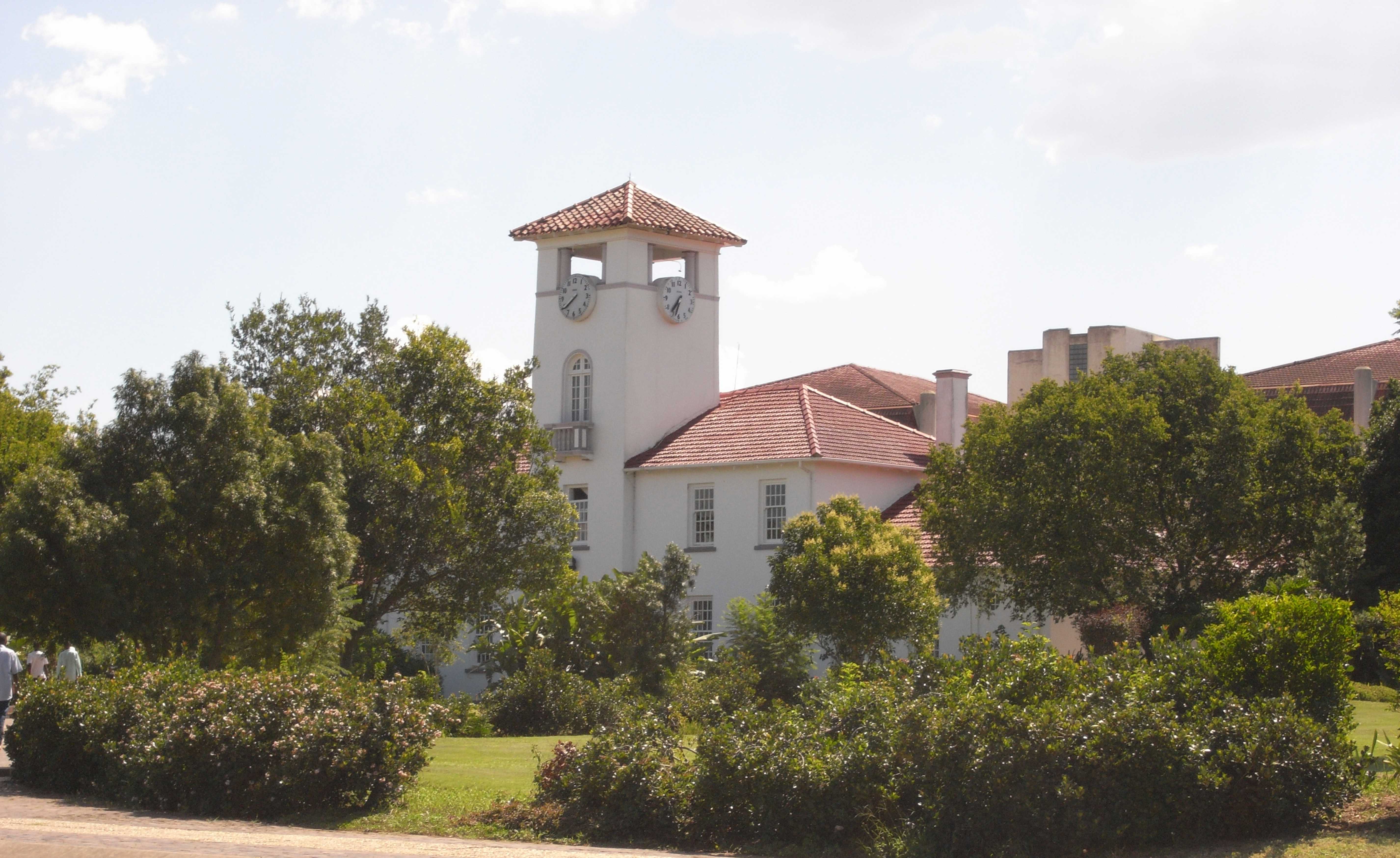
Historic building at Fort Hare, Alice, photographed in 2008 · Lysippos, CC BY-SA 3.0.
18 / 24 · 1916
Mission education helps shape a continent’s leaders
Lovedale · Alice · Fort Hare
Fort Hare opened in 1916 as the South African Native College. Its origins lay in cooperation between Protestant missionaries and African leaders, including John Tengo Jabavu, and in the educational work associated with nearby Lovedale. The United Free Church of Scotland contributed the site and support. Africans helped build this institution; it was not simply a gift handed down to passive recipients.
The college’s Christian institutional setting is visible in Anglican and Methodist hostels and in the Christian Union building donated by the YMCA. Education, religious life and the formation of an African intellectual community intersected on the campus.
Among those who studied at Fort Hare were Nelson Mandela, Oliver Tambo and Robert Sobukwe. Attendance did not mean they all held the same theology or politics. It does show how an institution with missionary roots helped create a setting in which future leaders could study, debate and organise. Colonial educational intentions did not control everything students would later do with their learning.
Sundkler and Steed connect the opening of Fort Hare to the longer ambition for higher education associated with James Stewart of Lovedale. The setting was a network of mission schools, trained teachers, Christian institutions and African aspirations. The university did not arrive from nowhere in 1916, nor did its later political significance belong entirely to its founders’ intentions.
The same historians later place Fort Hare alongside Lovedale, Ohlange, Adams and Healdtown when discussing apartheid’s takeover of mission education. The educational history therefore includes both the building of opportunity and the contest over who would control it. Institutions that had helped form African intellectual life could become targets of policies limiting that life.
Readers should distinguish institutional background from individual belief. Mission education gave students skills, friendships and access to wider debates, but it did not make every student a Christian or produce one uniform politics. African graduates could use their education to challenge both state injustice and missionary paternalism. Their subsequent initiative is part of the history, not merely an unintended footnote to a European educational project.
Allan Boesak, a Reformed minister associated with resistance to apartheid.
19 / 24 · 1948–1994
The church confronts its own divisions
Apartheid South Africa
Apartheid exposed profound divisions within Christian institutions. Some churches and theologians defended racial separation; others resisted it. Black congregations also lived with unequal resources and restrictions on leadership. A shared denominational label did not mean a shared response to injustice.
The South African Council of Churches, established in 1968, became an important voice of opposition. Within the Reformed family, the Belhar Confession, adopted in 1986, addressed unity, reconciliation and justice. These developments help explain why present church names can carry memories of exclusion, protest and attempts at reunion.
The political influence of churches was therefore contradictory. Religious arguments and institutions could reinforce racial rule, while other ministers, congregations and ecumenical networks challenged it. Resistance involved preaching and protest, support for threatened communities, and arguments about justice and human dignity. A historical account must examine both complicity and resistance without treating every Christian response as the gospel itself.
Sundkler and Steed describe apartheid’s attack on mission education and the pressures placed on churches that challenged racial policy. At the Cottesloe consultation in 1960, delegates rejected racial exclusion from the church, after which political pressure was brought against participating Dutch Reformed leaders. Institutional statements did not necessarily produce immediate agreement in every congregation.
Albert Luthuli, speaking from within an African Christian life, objected to a paternalist Christianity that behaved as if white people had invented the faith. His criticism belongs beside the ancient history at the beginning of this guide. Christianity’s African inheritance could be obscured not only by secular caricatures but also by the behaviour of professedly Christian institutions.
The authors’ later account follows the conflicts of the 1980s, church involvement in opposition, attempts at reconciliation and the Rustenburg consultation. Some Christians avoided political engagement; others defended the state or joined resistance. Recording these positions does not endorse them all. The question of a church’s faithful public conduct must be evaluated rather than settled by its denominational label.
The theological distinction remains important for this guide: the gospel announces what God has done in Christ for sinners; public responsibility concerns what Christians and their institutions ought to do. History can examine how the latter was obeyed, neglected or distorted without making a political platform the content of Christian salvation.
“White paternalist Christianity — as though the whites had invented the Christian faith — estranges my people from Christ”
Chapter 201960s–1980sCities · townships · national networks
Ray McCauley, pictured later in life, from Rhema Bible Church’s official history collection. The church began in 1979.
20 / 24 · 1960s–1980s
Second wave: renewal within established churches
Cities · townships · national networks
From the 1960s, charismatic renewal brought renewed emphasis on spiritual gifts, healing and participatory worship into established Protestant and Catholic settings. South African developments occurred within this wider international movement. Some believers remained in their historic denominations; others moved into new fellowships.
This second wave is distinguished by renewal inside existing churches, rather than only the founding of Pentecostal denominations. David du Plessis, a South African Pentecostal leader, became known for conversations across denominational boundaries. Practices and teaching varied, and renewal did not produce one unified church.
By the late 1970s and afterward, independent charismatic ministries increasingly overlapped with this renewal. Rhema, founded in 1979, is one local landmark. Its place at the intersection of renewal, independent church growth and Word of Faith teaching shows why the dates of the waves overlap.
The historical works are particularly helpful in showing that “renewal” did not arrive in an African setting without earlier movements of prayer, healing and Christian community. Bhengu’s evangelism, African Zionist congregations and the wider Pentecostal world were already part of the landscape. Mainline charismatic renewal formed another strand in that history; it did not replace everything that preceded it.
Sundkler and Steed emphasise healing as a fundamental feature of many charismatic communities. Historically, this helps explain the appeal of churches that prayed with people confronting illness and insecurity. It does not by itself establish the truth of every healing claim or show that all Christian teaching about suffering was the same.
The second-wave label remains an explanatory framework for renewal inside established churches. The authors’ own description of three earlier international revival streams refers to a different period and classification. It would be misleading to cite that description as if it proved the four-wave outline used here. Historical books and later scholarship are brought into conversation while their distinct scopes remain visible.
“The healing aspect of the charismatic community is fundamental to the whole movement.”
Chapter 211970s–1990s onwardUrban South Africa · transnational connections
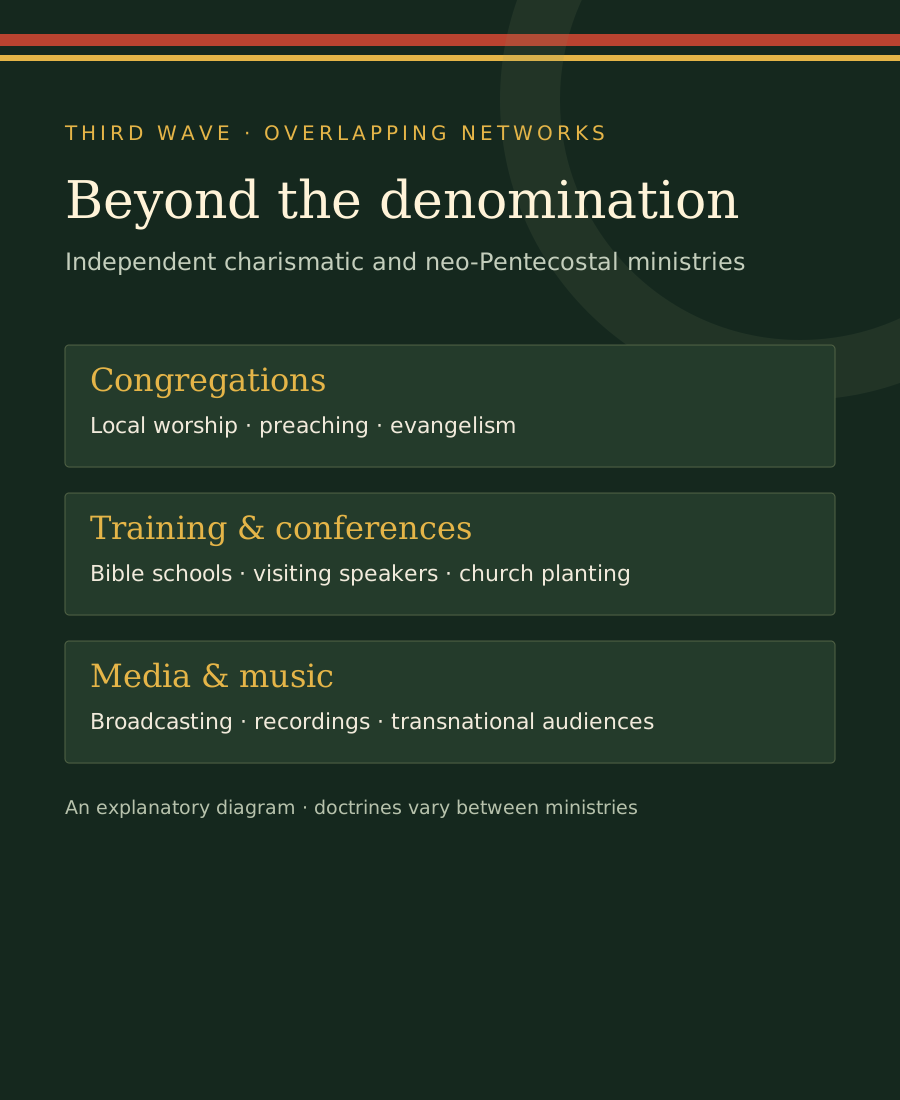
Bisrat explanatory diagram of church networks, not a historical photograph or a claim that all networks share one theology.
21 / 24 · 1970s–1990s onward
Third wave: independent charismatic networks
Urban South Africa · transnational connections
Independent charismatic and neo-Pentecostal congregations expanded through Bible schools, conferences, music, broadcasting and personal ministry networks. Some scholarship places this wave mainly from the 1990s; South African precursors, including Rhema in 1979, make a rigid starting date misleading.
Word of Faith and prosperity teaching influenced some ministries. Others emphasised church planting, worship or local evangelism without adopting every prosperity claim. A large building, contemporary music or a prominent founder does not by itself determine a congregation’s doctrine.
This wave altered how churches organised authority and reached people: networks could cross denominational and national boundaries. Its historical influence should be distinguished from the theological evaluation of particular claims about faith, wealth, healing and suffering.
Sundkler and Steed’s account of South Africa’s later churches helps locate Rhema and other charismatic developments amid broader social change. These congregations were emerging while historic denominations debated apartheid, political responsibility and church unity. Different churches could occupy the same national moment while addressing it in markedly different ways.
Networks also changed the relation between congregation and institution. A believer could attend a local church, receive teaching through broadcasts, take part in a conference and identify with a transnational ministry. The boundaries of influence no longer corresponded neatly to the boundaries of a diocese, mission station or traditional denomination.
The early historical books cannot establish the present policies of every network. Their value is in explaining the conditions and earlier patterns from which later ministries developed. The continuing theological questions concern what is actually taught: whether Scripture judges the leader’s claims, whether the gospel is confused with material success, and how congregations understand faithful suffering. Those are questions for evidence about each ministry, not conclusions drawn only from its size or music.
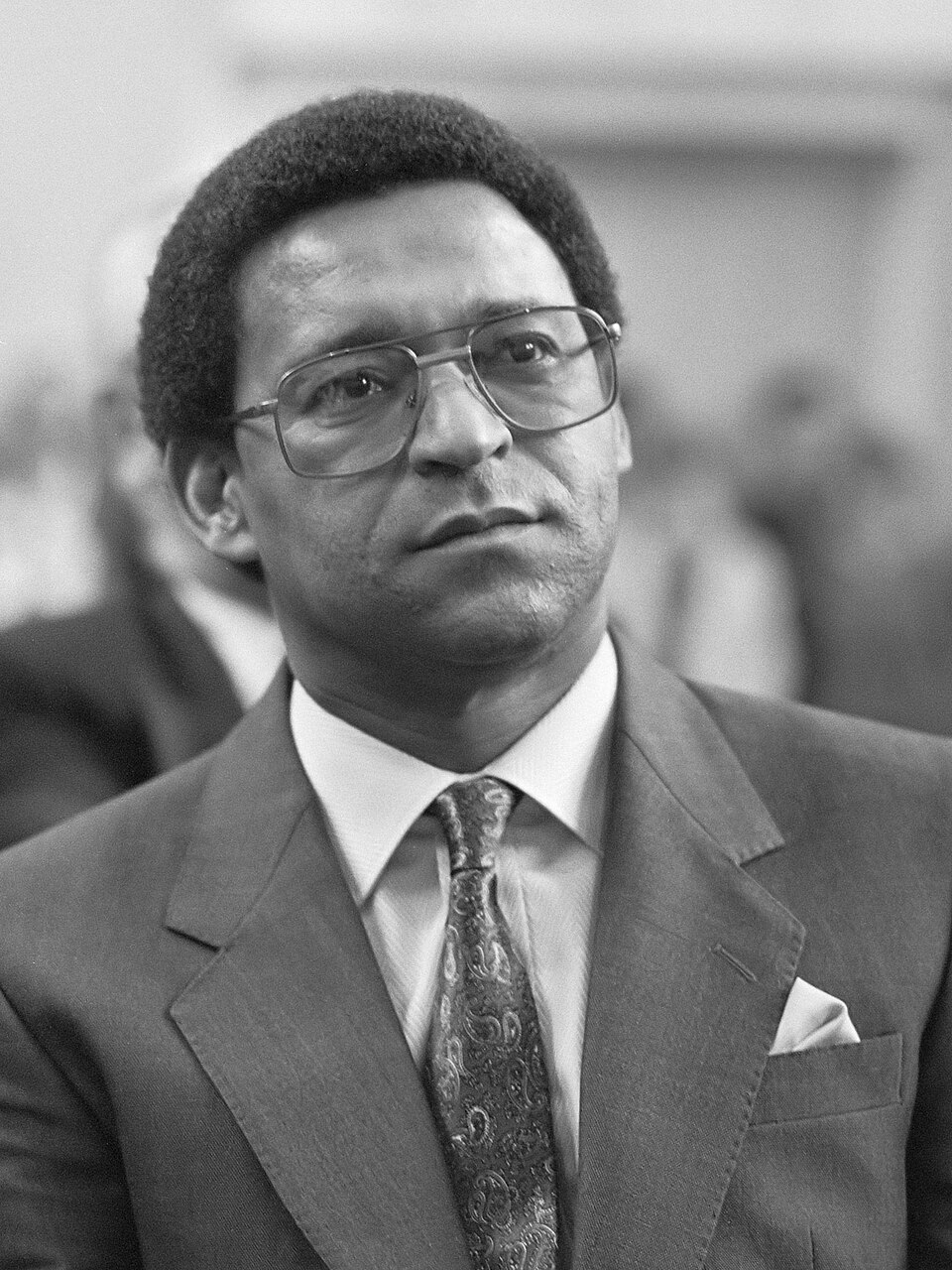
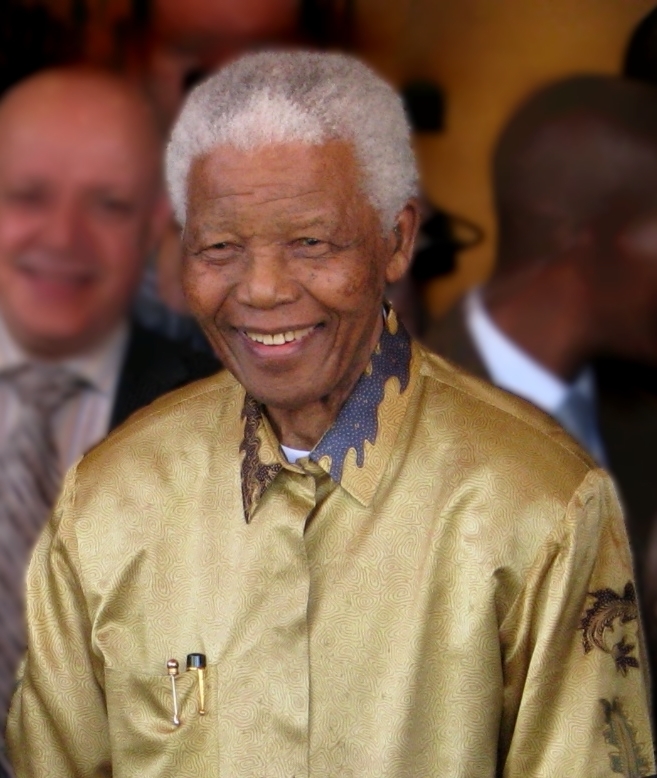
Nelson Mandela in 2008 · South Africa The Good News, CC BY 2.0. Mandela attended Fort Hare; this later portrait illustrates the democratic era.
22 / 24 · 1994 onward
A new country, unfinished church histories
Democratic South Africa
Democracy changed the public setting of church life, but did not automatically heal ecclesiastical divisions. In 1994, the Dutch Reformed Mission Church and the Dutch Reformed Church in Africa united to form the Uniting Reformed Church in Southern Africa. Wider questions of unity in the Reformed family remained.
Historic churches, African-initiated communities, Pentecostal denominations and evangelical networks continued alongside one another. Their stories involve both change and continuity. A new name or merger can signal institutional reconciliation; it does not erase the histories that shaped the people in the pews.
The endpoint of Sundkler and Steed’s history, published in 2000, is useful here. It looks back across African church growth and changing relations with state power, while still standing close to the end of apartheid. That makes it a source for the earlier transition, not a witness to everything that happened in the following decades.
Reconciliation had to address more than constitutional change. Congregations inherited property arrangements, resources, leadership patterns, languages and memories formed under segregation. A merger could alter an institutional name while leaving substantial work to be done in relationships and practice. Historical continuity explains why “after 1994” is not a clean beginning for every church.
African Christians also participated in wider continental and international relationships. Earlier stories of African-led schools, mission and church government continued to matter. The new political setting opened possibilities, but it did not resolve every doctrinal disagreement or supply a single model of Christian public responsibility. The historical question remains how particular communities navigated those continuities and changes.
Chapter 232000s onwardSouth Africa · wider African networks
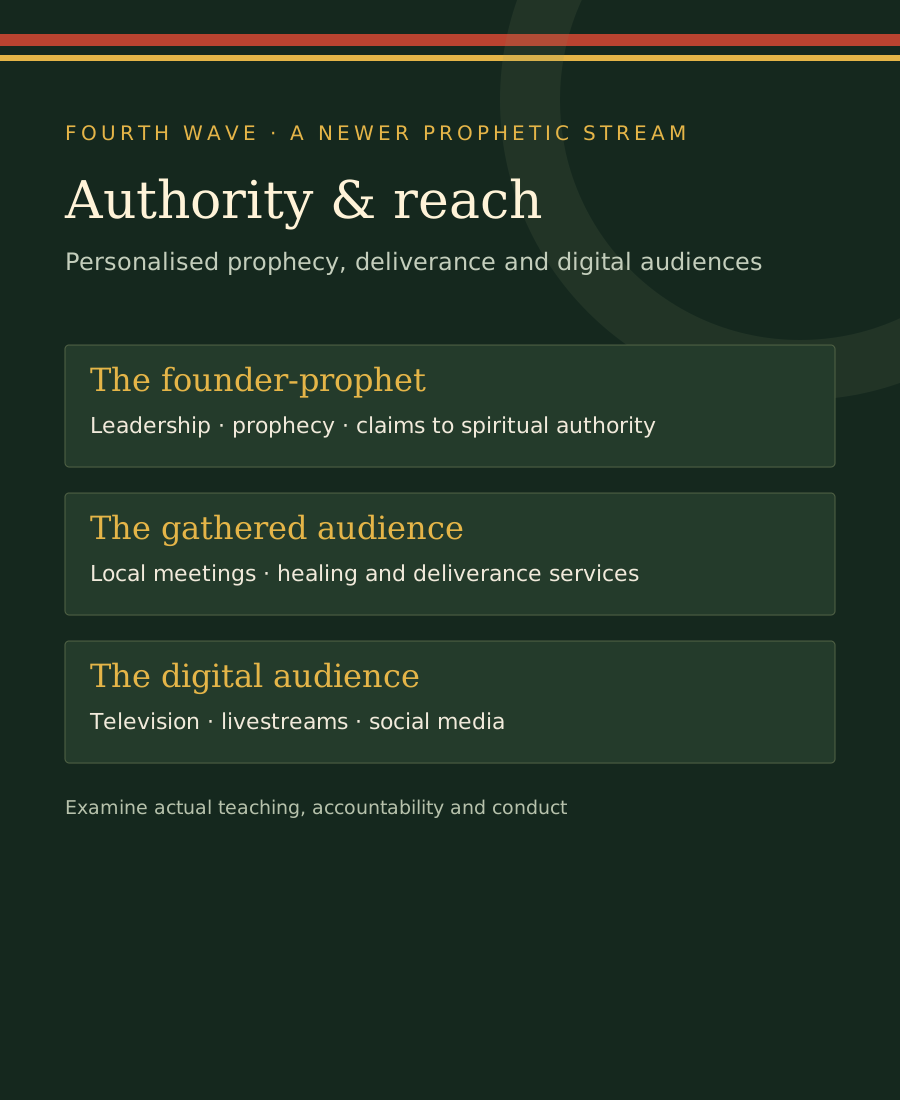
Bisrat explanatory diagram. It represents communication and leadership patterns, not the appearance or beliefs of every ministry.
23 / 24 · 2000s onward
Fourth wave: personalised prophecy and digital reach
South Africa · wider African networks
A newer prophetic stream places a strong emphasis on the founder-prophet, personalised prophecy, deliverance and miracles. Television, livestreams and social media can draw followers from far beyond the local congregation. Researchers also call these new prophetic or prophetic Pentecostal churches.
This four-part account follows a framework that distinguishes classical Pentecostalism, charismatic renewal, independent neo-Pentecostal networks and newer prophetic ministries. Other scholars use three waves or define a fourth around network churches instead. These are interpretive categories with overlapping dates, not four official denominations or four stages that every church passes through.
Some documented ministries raise serious questions about accountability, the sale of spiritual services, prophetic objects and claims that the leader mediates divine favour. Those questions must be examined through a ministry’s actual teaching and conduct. The newer prophetic stream should not be equated with every Pentecostal church, or confused with the older African Zionist and Apostolic traditions.
Sundkler’s mid-century study gives useful historical comparisons: healing, founding leaders, pilgrimage, distinctive worship and the organisation of followers were already significant in earlier African-initiated churches. But a comparison is not a direct line of descent. It would be wrong to use his observations of a 1930s or 1950s congregation as evidence of a contemporary pastor’s teaching.
The newer prophetic ministries operate with communications and economic opportunities the early studies did not describe. An online audience can support a ministry financially, follow personalised claims and participate in services across borders. Later scholarship, identified below, is therefore needed for the contemporary chapter. The historical books ground the background rather than pretending to cover developments beyond their period.
The four waves are a reader’s map of overlapping streams. They do not imply that the fourth is the highest stage of the church or that newer automatically means more faithful. Nor does a historical connection with healing give every movement the same Christology. A ministry’s claims about its founder, mediation, prophecy and salvation still need to be heard and assessed in their own terms.
A Reformed church in Reddersburg: historic denominations remain part of today’s landscape alongside newer movements.
24 / 24 · 2000s–today
Many histories now meet in one neighbourhood
South Africa · today
A South African neighbourhood may now contain a Methodist circuit, a Catholic parish, a Baptist congregation, a Zionist community, an independent prophetic ministry and a church plant. Migration, local languages and online ministry add further layers to the landscape.
The seven families below are a map for understanding these overlapping histories. They are not a ladder from old to new, and not a verdict on every congregation. History explains how a community arrived here. Discernment asks what it believes today: who Christ is, what the gospel is, what authority governs the church and how leaders care for their people.
The books together give us a different way of seeing that neighbourhood. Its churches stand within histories of Egyptian learning, Nubian kingdoms, Ethiopian continuity, Kongolese catechists, West African traders, isiXhosa song, mission schools and African-led evangelism. These are not all branches of one modern European institution. They are different encounters with a faith whose earliest geography was already wider than Europe.
Sundkler and Steed explicitly challenge accounts that obscure African evangelists. Bokwe preserves an African Christian hymn and its remembered community; Bantu follows ancient African and Asian churches; Oden asks how African thought shaped Christianity beyond the continent. Their arguments are not identical, but together they help recover people and institutions hidden by a missionary-only narrative.
This inheritance also needs honest discernment. African authorship is historically important, but neither African origin nor European origin makes a teaching true. An ancient pedigree does not remove the need to hear what a congregation confesses today. The strongest answer to the “white man’s religion” claim is therefore a truthful history of African Christian participation, joined to the Christian claim that Christ’s gospel is for people of every nation.
“it was largely Africans who evangelized other Africans.”
The chapters draw directly on these historical works and African-language sources. Open a chapter’s references to find the relevant pages. Short quotations are distinguished from the narrative; quotations mediated through a historian name both the speaker and the historian.
01
Vince L. Bantu
A Multitude of All Peoples: Engaging Ancient Christianity’s Global Identity
2020 · digital edition
Egypt, Nubia, Ethiopia and the Maghreb within the wider ancient Christian world. References name the chapter or section and the digital PDF page; they are not presented as print pagination.
02
Thomas C. Oden
How Africa Shaped the Christian Mind: Rediscovering the African Seedbed of Western Christianity
InterVarsity Press, 2007
Africa’s contribution to biblical study, doctrine, councils and Christian intellectual life. References follow the printed pagination. Broad historical proposals are distinguished from established particular evidence.
03
Bengt Sundkler and Christopher Steed
A History of the Church in Africa
Cambridge University Press, 2000
A continent-wide history: early churches, Kongo, West African mission, southern African communities and the twentieth century. References follow the printed pagination; the account is read critically where dates or generalisations require qualification.
04
Bengt G. M. Sundkler
Bantu Prophets in South Africa
Second edition, 1961 · Routledge digital reissue, 2018
A historical study of African-initiated churches, leadership, worship and healing. The original title is retained bibliographically; its period terminology and judgements are not adopted as present descriptions of every church. References identify sections and digital PDF pages.
05
John Knox Bokwe
Ntsikana: The Story of an African Hymn
Undated booklet · digitised by University of Pretoria Library Services
An African Christian author’s retrospective account and the hymn in isiXhosa with his English translation. References follow printed booklet pages. Community testimony is distinguished from an eyewitness record of every narrated event.
06
W. W. G. / attributed to W. W. Gqoba
Isigidimi SamaXosa, 1 March 1888, pp. 22–23
Historical isiXhosa texts · transcription
A cattle-killing account and a separate dialogue about Christian and customary life. The source used here is a typeset transcription, not an original newspaper facsimile. No unverified English translation is supplied.
Historical scope & image credits
This is a selective African church history that narrows into South Africa. It is not a single line of descent: chapters overlap, traditions continue and kingdoms’ territories change. The first-century Mark narrative is identified as Coptic tradition; manuscripts and archaeology provide distinct evidence. The medieval Mali report remains disputed. Recording a movement does not endorse every doctrine it teaches.
New historical images: Egyptian monastery, Tentoila, 2006, public domain; Christ and Abbot Mena, public-domain artwork reproduction; Faras Bishop Petros, public-domain artwork reproduction; Mansa Musa, Catalan Atlas, public domain; Kongo crucifix, The Met, public domain; Luther, Cranach workshop, public domain; Lovedale, SA History Online / The Southern Cross. Diagrams are labelled Bisrat explanatory designs, not archival evidence. The Ntsikana hymn is now a cropped scan of p. 30 of Bokwe’s digitised booklet, credited to University of Pretoria Library Services. Crowther’s portrait is an archival public-domain reproduction, 1867.
Retained images: Charles Bell’s Dutch landing painting and Henry McNeal Turner’s 1891 illustration are public-domain historical works. Genadendal: Jochenernst; Fort Hare: Lysippos; both CC BY-SA 3.0. Mandela: South Africa The Good News, CC BY 2.0. Lake and Hezmalhalch: archival photograph, circa 1908. Soga and Dube: SA History Online collections. Rhema: official history collection. Ethiopian Gospel: The Met. Boesak and Reddersburg are retained from the existing collection. Images may be cropped by the display’s gentle pan and zoom; each appears once in this guide.
HistoricCatholic, Anglican, Methodist, Lutheran, Presbyterian and CongregationalAfrican-initiatedZionist, Apostolic, Ethiopian and prophetic churches founded by AfricansPentecostalClassical denominations, charismatic networks and independent ministriesEvangelicalBaptist, Reformed, Anglican and independent Bible-centred networks
A field directory
Seven families you are likely to encounter
These categories overlap. They are starting points for listening, not boxes to force onto every congregation.
01
Historic and mainline churches
Churches with long institutional histories, formal ministerial training and recognisable denominational structures. ‘Mainline’ describes history and organisation; it does not guarantee that every congregation holds identical theology.
Examples
Roman Catholic Church
Anglican Church of Southern Africa
Methodist Church of Southern Africa
Evangelical Lutheran churches
Uniting Presbyterian Church in Southern Africa
United Congregational Church of Southern Africa
What you may notice
Parishes, dioceses or circuits; set liturgies or hymnals are common; clergy usually serve within regional oversight.
Questions worth asking
How much authority belongs to Scripture, historic tradition and denominational decisions? Local congregations within the same denomination can differ considerably.
02
Reformed and Dutch Reformed families
Churches shaped by the Reformation and Reformed confessions. South African Reformed history also carries the wounds of racial separation and apartheid, so names that sound similar may represent distinct histories and communities.
Examples
Dutch Reformed Church (NG Kerk)
Uniting Reformed Church in Southern Africa
Reformed Churches in South Africa (GKSA)
Reformed Church in Africa
Presbyterian and Congregational Reformed traditions
What you may notice
Strong emphasis on preaching, covenant, catechesis, confessions and ordered church government, though worship style now varies widely.
Questions worth asking
Which confession is actually used? How does the congregation understand the gospel, race, culture, baptism and church discipline?
03
African-initiated and independent churches
Churches founded and led by Africans, often in response to missionary control, racial exclusion and pastoral questions that Western churches did not address well. This is a vast family, not one denomination or theology.
Examples
Zion Christian Church (ZCC)
Nazareth Baptist Church / amaNazaretha (Shembe)
St John’s Apostolic Faith Mission
African Zionist and Apostolic churches
Ethiopian-type African churches
What you may notice
Uniforms, healing prayer, prophecy, pilgrimage, sacred water, dance, drums and strong founding leaders may appear—but none of these features alone tells you what a church believes.
Questions worth asking
Who is Jesus? What saves and protects a person? Can prophecy be corrected by Scripture? Do ancestors, sacred objects or a leader function as additional mediators?
04
Classical Pentecostal churches
Movements rooted in the early twentieth-century Pentecostal revival, emphasising conversion, the Holy Spirit, spiritual gifts, healing and evangelism. Many now have substantial institutions and formal theological training.
Examples
Apostolic Faith Mission of South Africa (AFM)
Assemblies of God
Full Gospel Church of God
Pentecostal Holiness traditions
Independent Pentecostal denominations
What you may notice
Lively congregational singing, testimony, prayer for healing, altar calls and expectation of the Spirit’s present work.
Questions worth asking
How are prophecy and tongues governed? Is the gospel central, or has spiritual power become a product? What accountability exists for pastors?
05
Charismatic and neo-Pentecostal churches
A broad and rapidly changing world of churches influenced by Pentecostal spirituality but often organised around a local congregation, network, media ministry or prominent founder rather than an older denomination.
Examples
Rhema and Word-of-Faith influenced churches
CRC and similar multi-site churches
Independent charismatic megachurches
Prophetic and deliverance ministries
Township and city-based church networks
What you may notice
Contemporary music, large events, strong branding, healing or deliverance ministry, leadership conferences and extensive online media.
Questions worth asking
Do not assume every charismatic church teaches prosperity theology. Examine its doctrine of Christ, money, suffering, prophecy, pastoral authority and financial accountability.
06
Evangelical, Baptist and independent churches
Congregations centred on conversion, biblical preaching, evangelism and local church life. Some belong to denominations or national networks; others are independent. Worship may range from formal to contemporary.
Examples
Baptist Union of Southern Africa
Baptist Convention of South Africa
REACH South Africa
Independent Bible churches
Evangelical church-planting networks
What you may notice
Expository preaching, Bible study, evangelism, congregational participation and statements of faith are common, but governance and sacramental practice differ.
Questions worth asking
What does ‘evangelical’ mean here in practice? Ask about baptism, church government, confessional accountability, spiritual gifts and partnership with other churches.
07
Other influential church traditions
South Africa also contains large churches that do not fit neatly within the categories above, as well as Orthodox, restorationist and international traditions.
Examples
Seventh-day Adventist Church
New Apostolic Church
Coptic and Eastern Orthodox churches
African Methodist Episcopal Church
International migrant congregations
What you may notice
Each has its own history, vocabulary and authority structure. Familiar Christian words may carry meanings different from those used in Protestant or Catholic settings.
Questions worth asking
Learn the church’s own authoritative texts and leadership structure. Ask what it teaches about Christ, salvation, Scripture, sacraments and continuing apostles or prophets.
A vital caution
Do not identify theology by clothing alone
Robes, collars, head coverings, badges and church uniforms communicate belonging and history. They can help a newcomer recognise a community, but they do not reveal everything that community teaches.
A white robe does not automatically mean syncretism. A suit does not automatically mean orthodoxy. Begin with the church’s account of God, Christ, Scripture, salvation, spiritual authority and protection.
Before joining or partnering
Ten questions for understanding a church
Who is Jesus Christ?
What is the gospel?
What must a person do to be saved?
What is the church’s final authority?
How are pastors, bishops, prophets or apostles held accountable?
How are money and offerings handled?
What place is given to ancestors, dreams and revelation?
What does the church teach about healing and suffering?
Can members question leaders or leave freely?
Does the church belong to a wider body with a public confession?