Article · African Religion
Did Africans Know God Before the Missionaries? John Mbiti and the African Knowledge of God.
John Mbiti demonstrated that Africans knew of a supreme Creator long before missionaries arrived. But does recognising that God exists mean truly knowing who he is? This article appreciates Mbiti’s correction of colonial caricatures while arguing that God is fully and savingly revealed only through Jesus Christ.
By Lwandiso Dlokweni
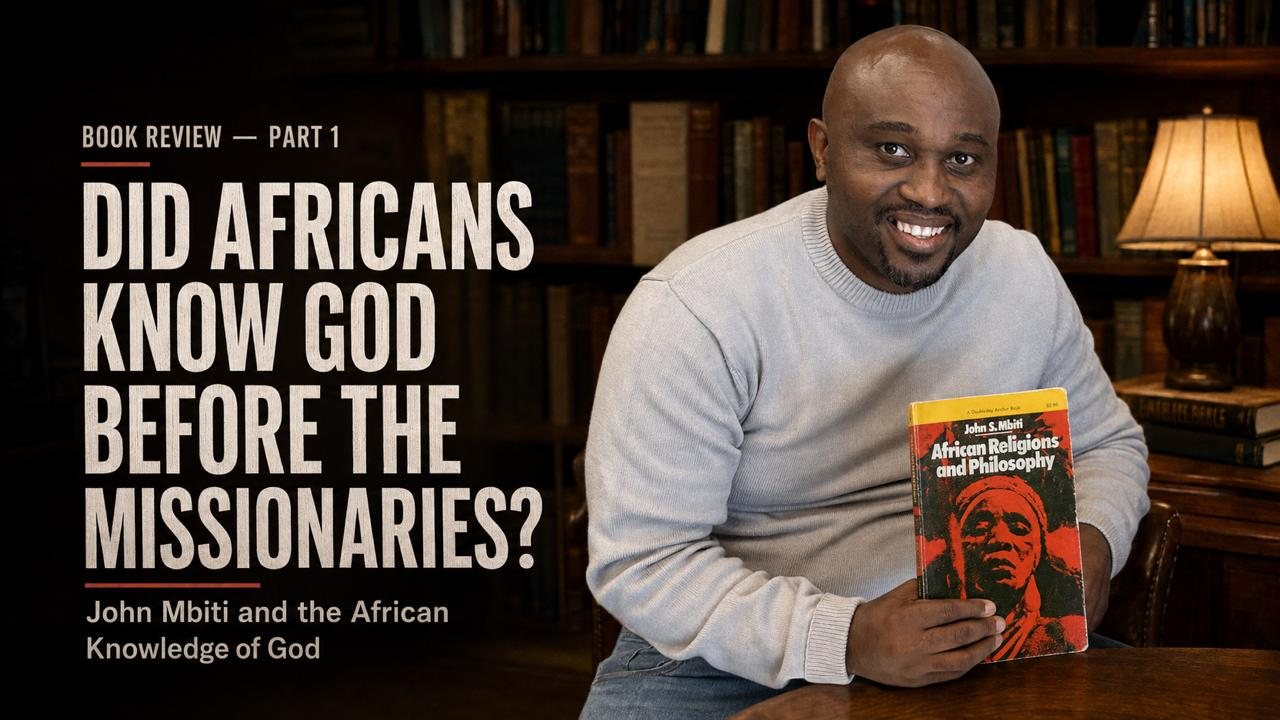
Did Africans know God before the Missionaries?
For generations, Africans were described as people without God. Christianity, it was assumed, brought belief in God to a continent previously occupied by superstition, magic, spirits and ancestors. Traditional Africans were labelled “pagans” or “unbelievers,” while adherents of religions such as Islam were more readily recognised as believers because they possessed scriptures and an organised doctrine of God.
John Mbiti decisively challenged that colonial caricature. In African Religions and Philosophy, he argued that African peoples did not need Europeans to introduce them to the idea of God. Examining nearly three hundred African peoples, Mbiti found “without a single exception” some notion of God as the Supreme Being (p. 37).
“God is no stranger to African peoples,” he concluded, “and in traditional life there are no atheists” (p. 38).
Mbiti was right to recover this African knowledge of God. Nevertheless, a further theological question remains: If an African people believes in a supreme Creator, does that mean that the God they worship is the God revealed in the Bible?
No One Shows a Child God.
Mbiti explains that African knowledge of God is preserved not in written creeds but in “proverbs, short statements, songs, prayers, names, myths, stories and religious ceremonies” (p. 38). Theology is carried in the living language of the community.
He illustrates this with a striking Ashanti proverb:
“No one shows a child the Supreme Being” (p. 38).
The point is that God’s existence is regarded as self-evident. A child does not need to be taken outside and shown that there is a God in the same way that someone might point out a distant mountain. God is already known through creation, conscience and communal life.
Across Africa, Mbiti discovers remarkably elevated descriptions of God. The Yoruba say, “Only God is wise,” and call him “the Discerner of hearts.” The Akan speak of the One who knows and sees everything. The Barundi call him “the Watcher of everything,” while the Ila express his perfect knowledge by saying that his “ears are long” (pp. 39–40).
The Banyarwanda say, “The plant protected by God is never hurt by the wind,” and that “God has very long arms.” The Ngombe praise him as “the One Who clears the forest,” while the Kiga call him “the One Who makes the sun set” (pp. 40–41). Each people uses the world it knows to confess that God possesses power beyond human ability.
God is also described as eternal and self-existent. A Bacongo saying declares, “He is made by no other; no one beyond Him is” (p. 42). The Gikuyu say that God has neither father nor mother and does not grow young or old. The Yoruba call him the “Mighty, Immovable Rock that never dies,” while a Tonga saying declares, “Heaven never dies, only men do!” (pp. 43–46).
Creation is, according to Mbiti, the most widely acknowledged work of God across Africa. The Akan title Borebore describes God as Excavator, Carver, Creator, Originator and Architect. Two Akamba names for God identify him as Maker and Cleaver—the One who not only creates but gives each creature its particular shape. The Tiv imagine him as the Carpenter who carved the world, while the Lunda call him the Father Creator (pp. 50–51).
These are not the beliefs of a people who had never conceived of God.
What Mbiti Corrected.
Mbiti’s work helps us correct a serious distortion of African history. The missionary did not bring God to Africa. God was already present, sustaining his creation and making himself known through the things he had made.
This should not surprise Christians. Scripture teaches that “the heavens declare the glory of God” (Ps. 19:1). God has not left himself without a witness, for he gives rain, fruitful seasons, food and gladness (Acts 14:17). Paul says that what can be known about God is evident because his eternal power and divine nature have been perceived in creation (Rom. 1:19–20).
The African proverbs collected by Mbiti provide powerful testimony to this general revelation. The Akan saw an ordered creation and confessed an Architect. The Ngombe saw a forest no human being could master and spoke of the One who clears the forest. The Banyarwanda observed human frailty and declared that God’s arms are long. The Tonga watched generations die while heaven remained and confessed that God does not die.
In Reformed theology, this is sometimes called the sensus divinitatis: humanity possesses an inescapable awareness of God. Sin can suppress, distort and redirect this knowledge, but it cannot erase it completely.
Mbiti was therefore right to reject the idea that Africans were uniquely godless. But we must be careful not to replace the colonial error with an opposite error.
Knowing That God Is—and Knowing Who God Is
Mbiti recognises that African concepts of God are shaped by the “historical, geographical, social and cultural background” of each people (p. 38). This produces both similarities and differences.
That admission matters. Mbiti speaks of African religions in the plural because each people has its own inherited system of beliefs and practices. There is no single, universally held African creed. We should therefore be cautious about speaking of “the African God” as though hundreds of communities possessed one internally coherent theology.
Even the same title can carry different meanings within different cosmologies. Words such as Creator, Provider, Father, Almighty and Supreme Being establish points of contact, but shared religious vocabulary does not automatically establish an identical theological referent.
Muslims also confess one Creator. They speak of God as eternal, merciful, almighty and sovereign. Nevertheless, Islam’s doctrine of God is not the Christian doctrine of God. Islam denies the Trinity, rejects the incarnation and refuses to confess Jesus as the eternal Son through whom the Father is fully revealed.
The same consistency must be applied to traditional African religion. Belief in one supreme Creator is significant, but it does not by itself answer the decisive questions:
Has this God spoken?
How is he related to his creation?
How may sinful people approach him?
Is he Father, Son and Holy Spirit?
What has he done in history?
Who is Jesus Christ?
Christianity does not identify God merely as the highest spiritual being. He is YHWH, the God of Abraham, Isaac and Jacob. He is the God who rescued Israel from Egypt, spoke through the prophets, judged idolatry and made himself decisively known in Jesus Christ.
As Hebrews begins, “Long ago, at many times and in many ways, God spoke to our fathers by the prophets, but in these last days he has spoken to us by his Son” (Heb. 1:1–2).
We must therefore distinguish true awareness of God from true worship of God, and general revelation from saving revelation.
Does Every Road Lead to the Supreme Being?
At points, Mbiti seems to move too quickly from recognising God-consciousness to validating African approaches to God.
In his discussion of sacrifice, he acknowledges that offerings may be directed to God, spirits or the living-dead. But he then argues that spirits and the living-dead function as intermediaries, so that God remains “the ultimate Recipient whether or not the worshippers are aware of that” (p. 76).
That conclusion goes beyond the evidence. The fact that God occupies the highest position in a religious system does not mean that every sacrifice offered to a lesser spiritual being is ultimately accepted by him.
The Bible takes the object and means of worship seriously. Israel could not justify sacrifices to other powers by claiming that the sacrifices eventually reached YHWH. Moses says that Israel “sacrificed to demons that were no gods” (Deut. 32:17). Paul similarly warns Christians that pagan sacrifices are offered to demons and not to God (1 Cor. 10:20).
Religious sincerity does not transform an unauthorised mediator into a legitimate bridge to God.
Mbiti is right that many Africans possessed a genuine awareness of God. But Romans 1 holds two truths together: humanity knows God through creation, and humanity suppresses that knowledge by exchanging God’s glory for created things. General revelation produces real knowledge, but sinners do not preserve that knowledge in an undistorted form.
Traditional African religion is not unique in this. Every human culture receives God’s revelation while bending it away from him. The ancient Greeks did it. The Romans did it. Europeans do it. Africans do it. Idolatry is not an African problem; it is a human problem.
Proclaiming the God Who Is Already There.
Paul’s preaching in Athens provides a helpful model. Paul did not treat the Athenians’ religious consciousness as meaningless. He acknowledged their awareness of the divine and even quoted their poets. Yet he did not conclude that their altars already constituted faithful worship of the biblical God.
Instead, he proclaimed the God whom they worshipped without adequately knowing (Acts 17:22–31). He affirmed the question while correcting the answer. He moved from their awareness of deity to the Creator, Lord, Judge and risen Christ.
Christian witness in Africa should do the same.
We can begin with the proverbs, names and prayers that testify to an enduring awareness of God. We can say with the Akan that no one needs to show a child the Supreme Being. We can agree with the Yoruba that only God is wise, and with the Bacongo that no one stands beyond him.
But we must continue beyond those affirmations. The gospel does not merely confirm that a Supreme Being exists. It announces that this God has a name, has acted in history, has spoken in Scripture and has revealed himself supremely through his Son.
Mbiti gave African Christians an important correction: the missionary did not bring God to Africa. God was already here, giving rain, sustaining life, governing nations and leaving himself a witness among our peoples.
Yet Christianity brings more than the confirmation of an existing intuition. It brings the good news that the Creator has come near in Jesus Christ. The God who could be glimpsed through creation has made himself known at the cross and empty tomb.
The gospel does not introduce Africa to the possibility of God. It reveals the character and saving work of the God whom Africa could never entirely forget.
Download printable PDF ↓